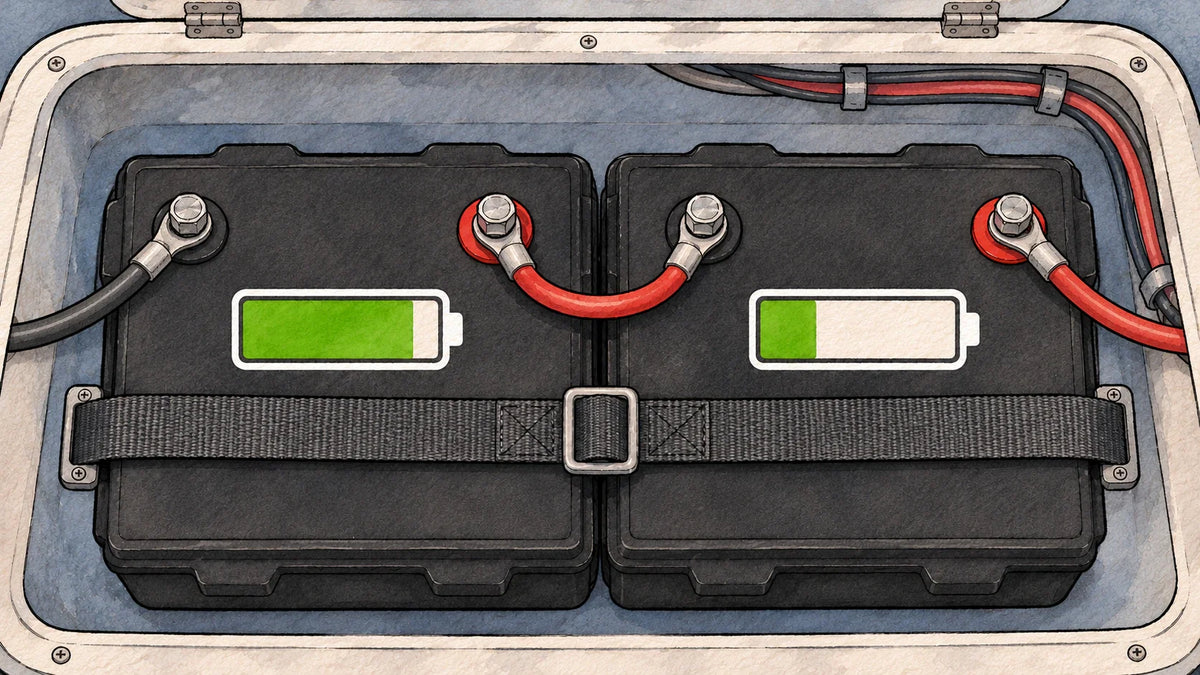

Two 12V LiFePO4 batteries can become unbalanced in a 24V trolling-motor bank when they start at different states of charge or differ in age, batch, use, or charging history. In series, the less-charged battery may hit its discharge limit first, while the fuller battery may reach its charge limit first; either can cause the bank to deliver less usable energy or shut off early.
Why the batteries diverge
Series connection adds the batteries’ voltage, but it does not make their individual charge levels equal. Different storage conditions, use, age, or charging history can leave one battery with less charge than the other before the bank is used. Charging and discharging the pair together can then expose the mismatch: one battery reaches its limit before the other.
Cell balancing inside a battery is different from balance between two complete batteries. A battery’s BMS may manage its internal cells, but that does not by itself equalize the state of charge of a separate battery in the series pair.
How to diagnose a mismatch

- Check the symptom. Unexpectedly low energy from the bank or an early charge or discharge cutoff can point to a mismatch. It does not identify the cause on its own.
- Separate a display difference from a confirmed mismatch. Bluetooth state-of-charge readings are estimates. A reading difference alone does not prove that the batteries are physically out of balance; compare other available indications and the behavior of the bank.
- Compare at a comparable state. Use the battery maker’s instructions to compare the batteries when both are fully charged or both fully discharged. A voltage difference can be a useful indicator, but there is no universal voltage threshold here that proves imbalance or battery health.
- Check the equipment’s indications. Review available BMS, charger, load, and temperature indications, then use the instructions for the actual battery and charger to distinguish possible causes. Do not assume a single early cutoff establishes which component is responsible.
How to prevent imbalance
Use batteries that match in model, voltage, and capacity, and preferably in age and use history. Before connecting a 24V series bank, confirm that the specific battery models permit series operation. Start with the pair at similar states of charge, and follow the battery and charger manufacturers’ charging and balancing instructions. Those instructions govern any corrective steps; a universal charging setting or reconnection procedure cannot be inferred for every battery.
FAQs
Can a difference in Bluetooth state-of-charge readings confirm that two 12V batteries are unbalanced?
No. Bluetooth state-of-charge readings are estimates, so a difference alone does not confirm a physical mismatch between the batteries.
What can cause one battery in a 24V series bank to reach its limit first?
The batteries may start at different states of charge or differ in storage conditions, age, use, or charging history. The less-charged battery may reach its discharge limit first, while the fuller battery may reach its charge limit first.
How should I compare two 12V batteries when diagnosing a possible mismatch?
Compare them at a comparable fully charged or fully discharged state, following the battery maker’s instructions. A voltage difference can be an indicator, but there is no universal threshold that proves imbalance or battery health.