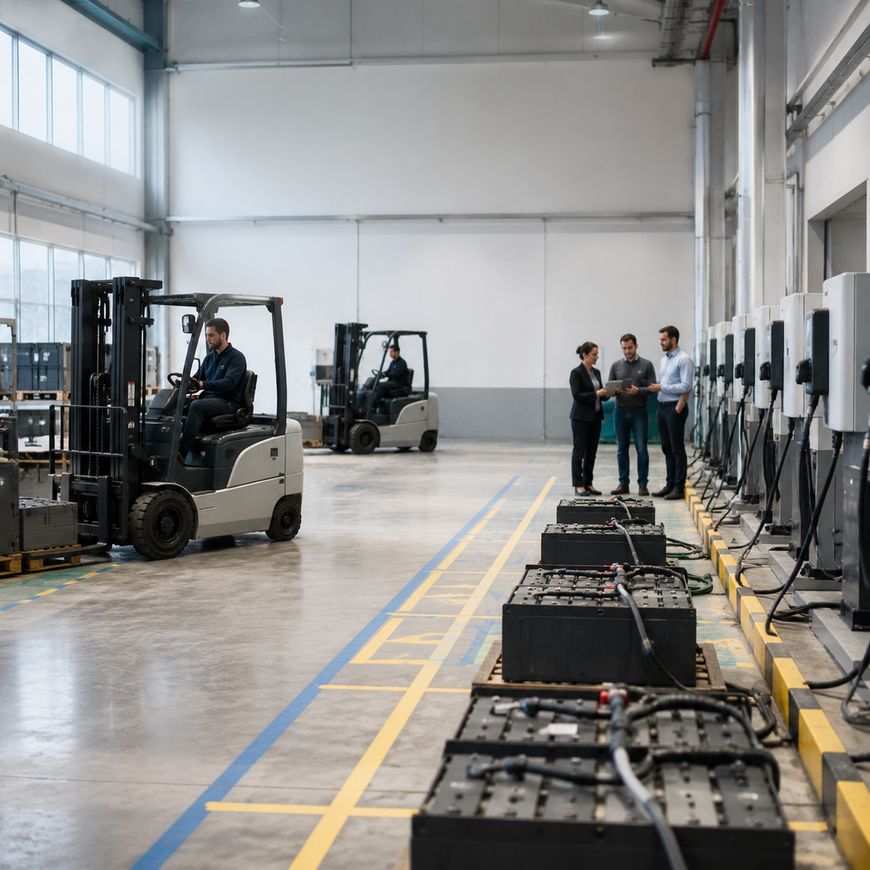

A commercial battery return is incremental, time-bound value created against the current battery program—not a feature, a purchase-price difference, or a headline savings percentage. For a warehouse fleet or multi-site migration, the strongest return lines are verified reductions in electricity, maintenance activity, battery-change labor, and future replacement purchases. Recovered operating time can count too, but only once and only through a documented site mechanism.
The governing question is simple: What expense falls, what capacity is released, or what future purchase is avoided because the proposed battery program replaces the current one?
Start with a Baseline-to-Proposed-State Comparison

Compare both battery programs over the same workload, equipment population, operating period, and planning horizon. A benefit belongs in the model only when the team can show the current baseline, the proposed operating state, the mechanism creating the difference, and when the value occurs.
Use a return register for every proposed benefit:
| Return Line | What to Document | How to Classify It |
|---|---|---|
| Electricity | Metered charging energy, tariff, charger use, duty cycle | Direct operating saving |
| Watering and routine maintenance | Work orders, labor records, contractor invoices | Direct saving if expense falls |
| Battery changes | Swap frequency, duration, labor assignment, equipment queues | Saving or capacity value |
| Replacement purchases | Battery age, failure history, replacement schedule, quoted costs | Avoided future cost |
| Recovered uptime | Constraint on output, labor utilization, throughput records | Conditional capacity value |
| End-of-horizon value | Credible remaining-use or disposal assumption | Terminal value, if supported |
Watering can be a measurable labor input in a lead-acid fleet. Likewise, battery swaps should be measured separately rather than assumed to be included in charging time. In one cited comparison, swaps were described as taking 15–20 minutes, but site results depend on shift pattern, fleet size, battery inventory, layout, and handling practices.
The important classification is whether recovered time creates a real cash-flow change. If fewer watering hours reduce overtime, contractor spend, or another actual expense, they may be a hard saving. If the same staff remain on payroll and use the time elsewhere, the benefit is operating capacity—not cash savings. It can still matter, but it should be valued once, not counted again as labor savings and productivity gain.
Put Auditable Savings in the Base Case
The base case should contain benefits that can be tied to bills, invoices, work records, or a scheduled future purchase.
Electricity Savings
Electricity savings should reflect meter-side energy input, not nominal battery capacity. A fair comparison starts with comparable useful energy demand, then examines the energy required to deliver that demand under each charging system.
Round-trip efficiency matters because it affects how much grid energy is needed for the same work. A cited comparison gives ranges of 70–80% for lead-acid and 95–98% for lithium-ion, but those figures are planning inputs rather than site proof. Charger performance, duty cycle, operating temperature, charging behavior, and tariff timing can materially change actual cost.
Use site meter data where available. Then apply the applicable tariff to the measured or modeled input-energy difference. For a closer review of the inputs behind this line item, see this guide to lithium and lead-acid efficiency and charging costs.
Maintenance and Replacement Avoidance
Maintenance activity can count when the proposed program removes recurring work that the current program requires. The same applies to avoided replacement purchases—but only at the time the baseline battery would otherwise have been replaced.
Lifecycle comparisons can help frame the schedule. One cited forklift comparison states lithium-ion ranges of 3,000–5,000 cycles and 7–10 years, compared with 1,200–1,500 cycles and 3–5 years for lead-acid. Those are not guaranteed results. Application, charging practices, and operating conditions determine actual life.
The appropriate model treatment is therefore not “longer life equals immediate annual savings.” Instead:
- Record each current battery’s age, utilization, maintenance history, and expected replacement timing.
- Identify which future purchases the proposed program could avoid or defer.
- Place each avoided purchase in the year it would otherwise occur.
- Validate proposed service-life and warranty assumptions against the supplier’s documentation for the specific equipment and duty cycle.
Treat Opportunity Charging as an Operational-Fit Case

Runtime and opportunity charging are not automatic financial returns. They become returns only when the site has a verified workflow constraint that the new operating pattern removes.
Opportunity charging is most relevant when operators have natural charging windows and chargers are placed where they will actually be used. Multi-shift, high-throughput operations can have very different battery demands from lighter single-shift operations, so a result from one facility should not be transferred automatically to another.
Map the operation by shift:
- Actual break and idle windows
- Charger location, access, and availability
- Equipment queues and battery-change activity
- Current throughput constraint
- Whether recovered time can produce more output or avoid a cost
Automated guided vehicles and autonomous forklifts may have short docking windows of 5–10 minutes between tasks. That pattern can justify a workflow assessment, but it does not establish charging performance, runtime, or financial value for a particular battery, charger, vehicle, and fleet configuration. Battery-management-system communication with chargers and vehicles may support charging-window management, yet integration must be confirmed for the actual system.
Use one double-counting rule: if fewer swaps, less downtime, and more productive hours all describe the same recovered operator time, include only one return line.
Keep Costs, Financing, and Returns Separate
Charger upgrades, electrical work, commissioning, training, facility changes, compatibility work, and migration disruption are project costs or implementation effects. Do not net them informally against a benefit line; place them in the investment and timing side of the business case.
Keep the operating-project view separate from financing decisions as well. Loan proceeds are not returns, and principal payments should not be mixed into an unlevered operating comparison. Depreciation is not an operating cash saving by itself; any tax-related cash-flow treatment should be modeled separately with qualified local tax and accounting advice.
This separation makes supplier comparisons clearer. A Vipboss quote, specification sheet, compatibility confirmation, warranty document, and implementation scope can be evaluated in the same return register used for any supplier proposal.
Use Sensitivities Before Seeking Approval

A decision-ready ROI model should show a base case and credible downside and upside cases. The most useful sensitivities are the assumptions that can change both the amount and timing of returns:
| Assumption | What Can Change |
|---|---|
| Equipment utilization and shift pattern | Swap activity, charging windows, replacement timing |
| Electricity tariff and charging schedule | Meter-side energy cost |
| Labor realization | Whether recovered time becomes cash savings or capacity |
| Battery life and replacement timing | Avoided-purchase value |
| Charger access and workflow fit | Opportunity-charging value |
| Implementation timing | When benefits begin |
| End-of-horizon value | Terminal-value assumption |
| Discount rate | Present value of future benefits |
For each line, assign an owner and evidence source: utility data for energy, work records for maintenance and swaps, fleet utilization data for operational capacity, and supplier documentation for compatibility, warranty, and scope.
If the team cannot identify the baseline, owner, evidence source, timing, and double-counting check for each proposed return, it is an assumption—not a bankable ROI benefit. Bring that completed input set to Vipboss for a site-specific, evidence-reviewed battery migration or replacement discussion.