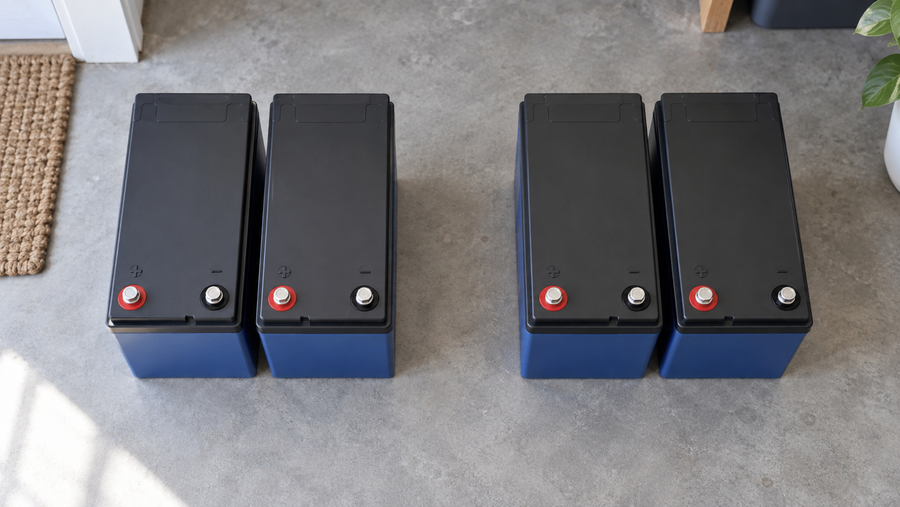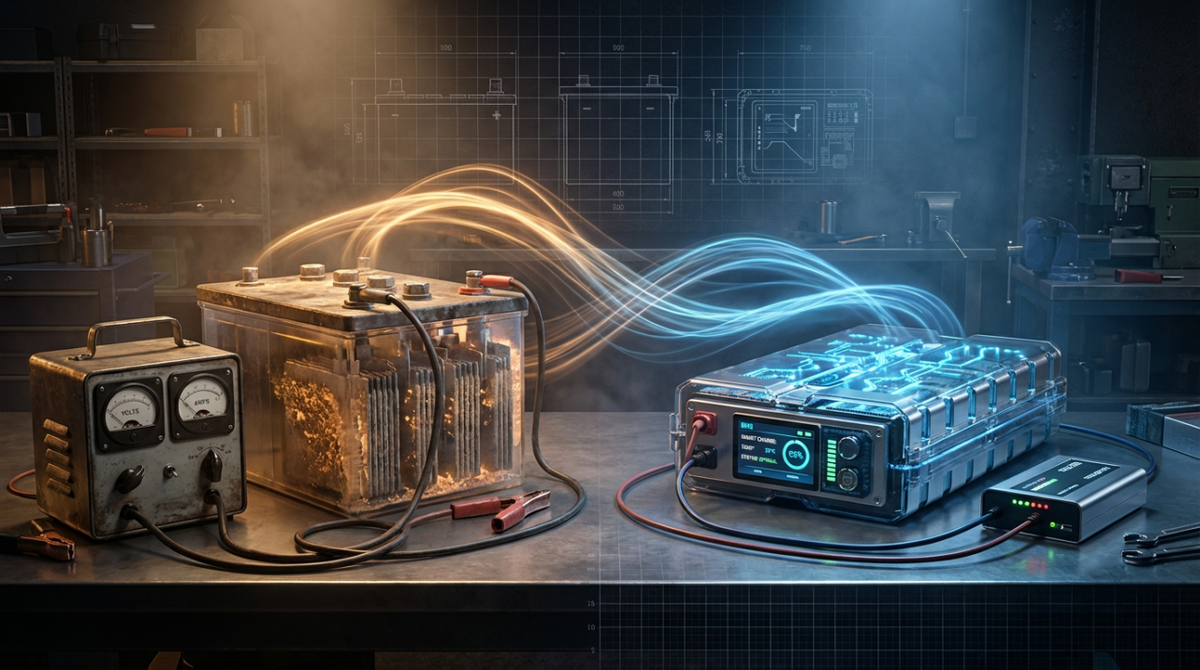

This guide explains what trickle charging is, why lead-acid and lithium batteries need different charging strategies, and how to configure real-world systems for long battery life.
Trickle charging is a very slow maintenance charge meant to offset a battery’s self-discharge. While that matches how lead-acid behaves, most lithium banks should not be kept on a classic always-on trickle; they should rely on smart, on-demand charging instead.
You park the RV for the winter, plug in the little “tender” that always kept your old starter battery alive, and months later your new lithium bank is throwing fault codes or has clearly lost punch. Mismatched charging like this can slice lithium battery life dramatically, sometimes by as much as half, simply by holding it full and stressed instead of letting it rest at a gentler state of charge. This article walks through what trickle charging really is, why lead-acid needs that spoon-feeding, why lithium does not, and how to set up off-grid and retrofit systems so your upgraded bank delivers long, reliable service instead of expensive surprises.
Trickle Charge, In Plain English
Trickle charging means feeding a battery a very small, steady current that roughly matches how fast it self-discharges, so the battery stays near full without being pushed hard in either direction—a maintenance mode rather than a fast refill definition of trickle charging. Instead of the 10–50 amp surge you might use to bring a dead battery back in a few hours, a trickle charger often dribbles 1–3 amps for days or weeks so a stored battery does not slowly run down and sulfate or freeze.
All batteries self-discharge, but the rate varies by chemistry: typical lead-acid batteries can lose around 10–15% of their charge per month in storage, while many lithium batteries only drop about 2–3% in the same time. The whole point of a trickle charger is to match that natural loss so the battery never falls into damaging deep discharge during long idle periods, especially in cold weather or when small standby loads stay connected importance of trickle chargers for stored equipment.
Modern gear blurs terms like “trickle charger,” “float charger,” and “battery maintainer.” A traditional trickle charger outputs a fixed low current all the time, while smarter maintainers and standby chargers monitor voltage, top the battery up when it dips, then back off or shut down entirely until needed again. For lead-acid backup banks, this kind of intelligent low-level support is exactly what you want; for lithium, it is only safe if the charger and profile are explicitly designed for that chemistry, and trickle charging is applied with safeguards.
Why Lead-Acid Needs To Be “Spoon-Fed”
Lead-acid batteries are like houseplants: leave them dry too long and they do not bounce back. As a lead-acid battery sits, sulfate crystals form and harden on the plates, especially if the battery spends time partially discharged, and this sulfation slowly chokes off capacity and cranking power trickle chargers help prevent sulfation. A low, steady maintenance charge keeps the voltage up so those crystals have less chance to form, which is why stored cars, boats, and RVs can wake up reliably after months if a quality maintainer stayed connected. Trickle chargers are especially valuable for seasonal vehicles.
Because lead-acid self-discharges so much faster than lithium, the math alone justifies that spoon-feeding. A typical starter battery that loses 10–15% per month can be halfway empty after a winter of sitting, while a lithium pack might still be comfortably charged. Studies on storage batteries and automotive use show that a properly sized maintainer can extend lead-acid life significantly, in some cases on the order of a 50% improvement in service life by avoiding repeated deep discharges and sulfation during idle periods trickle charging can extend service life.
The catch is that primitive trickle chargers are blunt instruments. A basic manual unit will push low current regardless of the battery’s state, which can overcharge a small or aging battery, boil off electrolyte, and cook plates if it is left on for weeks. Smart maintainers with voltage sensing, automatic shutoff, and temperature monitoring are far better suited to long-term lead-acid care, and they are now standard equipment for stored vehicles, marine house banks, and backup systems.

Why Lithium Does Not Want Traditional Trickle Charging
Lithium-ion and LiFePO₄ batteries play by different rules. Their chemistry is more sensitive to overcharge and does not tolerate continuous trickle in the way lead-acid does; keeping a lithium cell at full voltage with even a small excess current can trigger undesirable reactions and plating of metallic lithium on the anode lithium-ion cells cannot tolerate overcharge or continuous trickle. Those deposits and associated electrolyte damage can grow into dendrites that pierce separators, setting the stage for internal short circuits and, under abusive conditions, high-pressure venting or thermal runaway prolonged trickle charging can cause plating and dendrite growth.
Because of this, lithium chargers are designed to stop charging once the battery is full, not keep dribbling current forever. Standard practice is a constant-current phase up to around 80–90% charge, followed by a constant-voltage phase where current tapers to nearly zero and the charger cuts off when the battery is full. Guidance from lithium experts is clear that charging hardware for these chemistries does not require saturation charging, equalization, or continuous trickle; instead, intermittent, well-controlled charging works best and is actually simpler than legacy lead systems.
LiFePO₄, the go-to lithium chemistry for off-grid banks and house systems, amplifies this story. It has lower self-discharge, handles partial state of charge well, and does not need to be kept at 100% to live a long life. Manufacturers explicitly recommend disconnecting chargers once a LiFePO₄ pack finishes its charge cycle and warn against leaving it on unnecessary trickle or float modes that were designed for lead-acid.
In fact, applying an old-school float or trickle profile can actively confuse the pack’s internal Battery Management System (BMS). Lithium house batteries generally do not need maintenance charging, and ongoing lead-acid style float or trickle can trigger BMS faults or shorten life even if the bank appears to “work” at first. Other field guides to lithium charging go further and list continuous trickle on unsuitable gear among the “don’ts” because it keeps packs at high voltage, generates heat, and accelerates aging rather than preventing it.
Storage behavior seals the argument. Best practice for lithium is to park packs around 40–60% state of charge in a cool place, then top up every few months if needed, rather than holding them at 100% for weeks. Multiple references on LiFePO₄ and general lithium care agree that long stays at full charge, especially at elevated temperatures, are stressful and that about half charge is the sweet spot for long calendar life.

How Lithium Should Really Be Charged In Off-Grid And Retrofit Systems
Charging lithium properly in a power system is less about babying it with trickle and more about hitting the right targets, then getting out of the way. A healthy lithium charge cycle uses a bulk stage where the charger delivers constant current until the bank reaches its target voltage, then a finishing stage where voltage is held constant and current tapers off before charge is terminated. For many 12 V LiFePO₄ banks this means bringing the pack up to roughly 14.2–14.6 V, letting current fall toward zero, and either stopping entirely or dropping to a very mild top-up in the 13.4–13.6 V range instead of sitting at an aggressive float.
The charger itself matters just as much as the profile. Using a non-lithium charger often means your pack only reaches 80–90% full, wasting capacity and gradually skewing fuel-gauge readings; worse, an old automotive maintainer may hammer away in a float mode the BMS was never meant to see. Dedicated lithium chargers, MPPT solar regulators, and DC‑DC units with lithium profiles control voltage tightly, stop when the bank is full, and protect both cells and alternators from abuse.
Behind the scenes, the BMS is your insurance policy. A smart BMS monitors cell voltages, temperature, and state of charge, blocks charging below freezing or in very hot conditions, and shuts the pack down cleanly if limits are exceeded. Many drop-in LiFePO₄ batteries add Bluetooth monitoring so you can see what the BMS sees and confirm that charging stops when the pack is full rather than bleeding in unnecessary current.
Usage patterns are just as important as the hardware. Instead of running lithium banks to empty and slamming them back to 100%, you get far longer life by cycling between moderate limits—for example, recharging when you hit roughly 20–30% remaining and accepting that you do not need to reach a perfect 100% every time. Multiple lithium care guides recommend favoring partial charges, keeping packs between roughly 20–80% for everyday use, and reserving full charges for when you truly need maximum runtime.
Temperature is another non-negotiable. Charging lithium below freezing risks permanent damage, and repeatedly charging at very high temperatures dramatically shortens life, so reputable manufacturers call out a safe charge window of about 32–113°F and recommend charging in well-ventilated, moderate environments. Industrial suppliers go even further, encouraging users to avoid both extremes, integrate heaters where necessary, and keep storage packs cool and partially charged rather than full and hot.
So where does “maintenance charging” fit for lithium? In critical standby systems, some chargers operate in a reduced-stress voltage window, topping packs up only when open-circuit voltage falls slightly and otherwise letting them rest, rather than holding them hard at maximum voltage. Other “trickle” modes in lithium-compatible chargers are really just low-duty-cycle top-ups that briefly wake, check voltage, then switch off again—a world apart from the old idea of permanent low current flowing day and night.
At A Glance: Lead-Acid Versus Lithium And Trickle Charging
Aspect |
Lead-acid (flooded/AGM) |
Lithium (Li-ion / LiFePO₄) |
Typical self-discharge per month |
About 10–15% |
Around 2–3% |
Why use trickle |
Maintains charge, prevents sulfation, keeps starters ready in storage |
Mostly unnecessary; low self-discharge and no sulfation issues, so LiFePO₄ does not need to be kept at 100% |
Best maintenance method |
Smart maintainer or float with temperature and voltage control |
Lithium-specific charger that stops at full, with occasional low-voltage top-ups if truly needed |
Main risk if misused |
Overcharge, boiling, water loss, and plate damage |
Plating, dendrite growth, and thermal runaway if held at high voltage with continuous current |
Real-World Retrofit Scenarios
Seasonal RV Or Boat With A Lithium House Bank
Imagine a fifth-wheel that spends most of the winter in storage with shore power available. The optimal setup is a lithium-capable inverter-charger or shore charger set to a proper LiFePO₄ profile that charges the house bank to its full voltage, lets current drop, and then either shuts off or holds a mild, low-voltage maintenance level instead of a classic high float. Once the bank is topped up, you can even disconnect the charger and leave the pack sitting close to half full if the rig is parked in a safe, cool place, coming back every couple of months to verify state of charge and reconnect briefly if needed.
If the vehicle has a lead-acid starter battery plus a lithium house bank, treat them differently. A smart maintainer or automotive float charger still makes sense on the starter battery because it is vulnerable to sulfation and high self-discharge. The lithium house bank should instead see a lithium-specific charger or DC‑DC unit from the alternator that protects both the pack and charging system, rather than tying it directly into an alternator or trickle profile designed for lead-acid.
Off-Grid Cabin Or Van Solar Bank
Now consider a small cabin with a 12 V or 24 V LiFePO₄ bank and roof-mounted solar. Here the “maintainer” is usually an MPPT solar controller programmed for lithium that runs the pack through bulk and absorption stages during the day and then simply stops when the bank is full, resuming the next morning as panels wake up. There is no need for a separate trickle charger on the lithium bank, because the controller already offsets self-discharge and load automatically when the sun is out.
In practice, the best way to keep that cabin bank healthy is to size the array and charger properly, avoid running the pack to empty, and let it spend a lot of its life in the middle of its charge range, in the same 32–113°F temperature window recommended for safe charging. When the cabin will sit unused for months, bringing the bank to around half charge and shutting down nonessential loads is usually better than holding it full on a constant maintainer.
FAQ
Can you leave a lithium bank plugged into shore power all winter?
You can, but only if the charger has a genuine lithium profile that stops at full or uses a low-stress maintenance window instead of a high-voltage float. Lithium charging references stress that lithium-ion should not be kept at full voltage with continuous trickle current because that accelerates aging and, in extreme cases, can cause plating and other damage. Many lithium suppliers prefer that seasonal users store packs near 40–60% state of charge and either disconnect the charger or use a smart system that wakes only to top off small drops.
Is there any situation where trickle charging lithium is acceptable?
There is a narrow niche where lithium-compatible “trickle” or maintainer modes make sense, such as standby UPS or remote backup banks, but these are not traditional continuous low-current feeds. Instead, a smart charger or BMS-controlled system feeds only enough current to offset self-discharge, often in short pulses, and shuts off whenever the pack is at a safe voltage. The key is that both the charger and the pack must explicitly support lithium maintenance modes; using a generic lead-acid trickle charger on a lithium bank is specifically called out as a mistake to avoid.
What if you mix lead-acid starter batteries with a lithium house bank?
That is common in boats and RVs and a good place to separate maintenance strategies. The lead-acid starter battery benefits from a smart maintainer that keeps it topped up and ready without overcharging. The lithium house bank should see lithium-appropriate charging from a dedicated charger or DC‑DC unit rather than sharing the same float and trickle profile, especially because incompatible charging can both undercharge lithium and confuse its BMS.
A practical way to think about it is this: lead-acid likes being spoon-fed a slow, steady diet to stay healthy, while lithium prefers solid meals followed by rest. Build your retrofit or off-grid system so each chemistry gets the charging it was designed for, and your batteries will reward you with years of reliable power instead of expensive, premature failures.