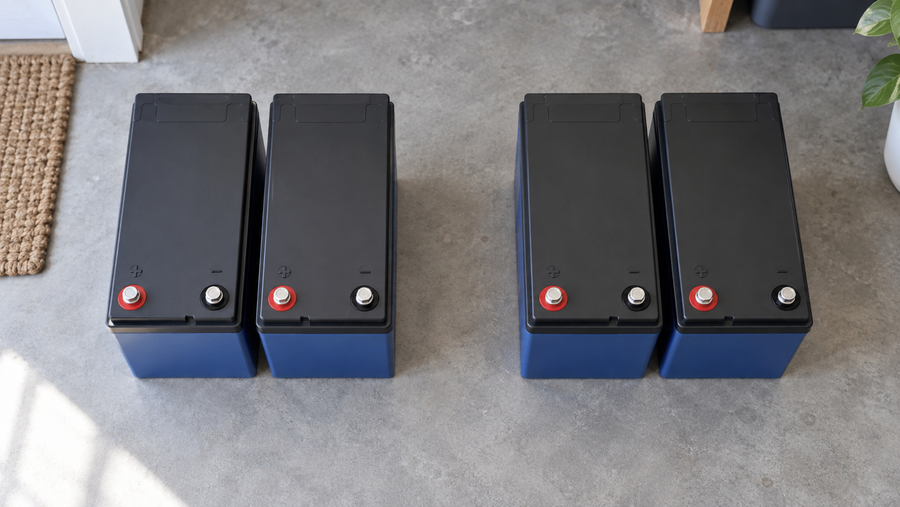

Switching your RV to lithium is usually worth considering if you spend nights without hookups, need more usable power, or want to reduce battery weight and maintenance. First, review your actual off-grid loads and charging equipment; if you mostly stay plugged in and your current battery meets your needs, the upgrade may not justify its added cost and system checks.
Lithium makes the biggest difference when you camp without hookups
Lithium is most useful when battery power affects how you camp. It can make sense when you regularly run lights, fans, a water pump, electronics, or an inverter away from shore power and want more usable energy in the same general footprint.
It is less compelling for an RV that spends nearly every trip connected to shore power. In that situation, the main benefit may be convenience or reduced maintenance rather than a meaningful change in your camping experience. If your existing battery starts the equipment you use, holds enough charge between trips, and does not create a weight or maintenance problem, keeping it can be the sensible choice.
Your answer changes again if you run high-demand appliances from an inverter. A battery can have enough stored energy for lights and small electronics but still be unable to supply the current required by a microwave, air conditioner, induction cooktop, or other large load. Check the battery, inverter, cables, fuses, and charging equipment as one system rather than judging the upgrade by amp-hours alone.
Check the RV system before treating lithium as a drop-in swap

A lithium battery does not automatically make every existing RV component compatible. Before buying, identify these parts of the system:
- The converter or converter-charger
- The solar charge controller, if installed
- Any inverter or inverter-charger
- Alternator charging equipment
- Battery cables, fuses, disconnects, and terminals
- The battery compartment's dimensions and mounting conditions
Read the manufacturer manuals for the actual converter or converter-charger, solar charge controller, inverter or inverter-charger, alternator charging equipment, battery cables, fuses, disconnects, and terminals. Confirm that each component is suitable for the target battery, and verify that the battery compartment fits the installation conditions.
A lithium-ready label on the RV is a useful starting clue, not a complete compatibility check. Read the manuals for the actual components. If you cannot confirm the charging profile, wiring, or protection requirements, have a qualified RV electrical professional review the system before installation.
For a concrete 12V option, the Vipboss 12V 105Ah Bluetooth LiFePO4 battery stores 1,344Wh, uses a Group 31-size enclosure, includes Bluetooth monitoring, and has a built-in 100A BMS. It may fit a moderate 12V house-battery setup only when its capacity, output requirements, dimensions, charging requirements, and temperature limits match the RV. Charging stops below 32°F (0°C) and resumes at 41°F (5°C), so confirm that behavior against the temperatures where you will charge it. These details do not establish compatibility with every inverter, system voltage, starting application, or installation.
Compare the upgrade with the way you actually camp

Use the branch that matches your trips rather than a generic battery-size recommendation.
Mostly plugged in: If shore power supplies nearly all your electrical use, lithium may be unnecessary unless you specifically value lower weight, reduced maintenance, or better battery performance during short unplugged periods. The upgrade becomes harder to justify when the current system already meets those needs.
Occasional overnight or weekend boondocking: Lithium may be worthwhile if your current battery runs low before the next reliable recharge. List the loads you will use, estimate their watt-hours, and compare that demand with the usable energy of the proposed battery. Include inverter losses and leave room for uncertain runtimes.
Frequent boondocking or solar use: Lithium is more likely to earn its place when you cycle the battery often and depend on stored energy between charging opportunities. Confirm that the solar controller, converter, and any alternator charging equipment can use the battery's required settings. More battery capacity does not solve a charging system that cannot replenish the energy you use.
Cold-weather camping: Confirm the battery's charging behavior at the temperatures where you camp. Some batteries stop charging below a specified temperature, while others require a separate heating or temperature-management approach. A protection feature can prevent charging in the cold, but it does not create usable charging time; plan where and when the battery will be recharged.
Use energy, not the battery label, to judge capacity
Amp-hours alone do not tell you whether the upgrade will meet your needs. For each device, estimate:
watt-hours = watts × hours of use
Add the loads that will run between charging opportunities. Then compare the total with the battery's usable energy, not just its advertised capacity. For an illustrative example, a 60-watt load used for four hours consumes 240 watt-hours. That is only one load; a refrigerator, furnace fan, inverter standby draw, lights, and water pump would add to it.
Your calculation is a planning estimate, not a runtime guarantee. Actual results change with temperature, battery settings, inverter losses, appliance cycling, and the amount of energy your charging sources replace. If the decision is close, measure your real loads during a typical trip instead of relying on a chart.
For the next sizing step, use this guide to estimate how many amp-hours your RV needs.