
Start by listing what you will run, how many watts each item uses, and how long you will use it each day. Add those watt-hours, multiply by the number of days you need to operate without recharging, then divide by your battery voltage and usable-capacity percentage. The result is your required amp-hour capacity. If you only need lights, a water pump, and small electronics overnight, the total may be modest; an inverter, electric heating, or other high-demand appliance can change the answer quickly.
Use your daily power instead of a battery-size guess

Amp-hours describe battery capacity at a particular voltage. Your RV’s actual demand is easier to estimate in watt-hours because appliances are commonly labeled in watts.
For each device, use:
watt-hours = watts x hours used
Add the result for every device that will run from the battery. Include the refrigerator controls, furnace blower, water pump, lights, fans, electronics, inverter losses, and any other load that will operate while you are off-grid. Do not count appliances powered by shore power unless you also expect to run them through an inverter from the battery.
For example, an illustrative overnight load might look like this:
| Load | Power | Use | Daily energy |
|---|---|---|---|
| LED lights | 20 W | 4 hours | 80 Wh |
| Water pump | 60 W | 0.5 hour | 30 Wh |
| Furnace blower | 36 W | 4 hours | 144 Wh |
| Phones and small electronics | 30 W | 3 hours | 90 Wh |
| Inverter and other small losses | 50 W | 4 hours | 200 Wh |
| Total | 544 Wh |
The 544 Wh total is an illustrative calculation, not a prediction of every RV’s usage. Replace each estimate with the wattage and runtime you expect in your own RV.
Convert watt-hours into amp hours
For a nominal 12-volt battery bank, use:
required amp hours = daily watt-hours x off-grid days / (battery voltage x usable-capacity fraction)
The usable-capacity fraction accounts for the portion of the battery you can use for your battery type and operating plan. Use the battery manufacturer’s guidance for that value. Do not assume that every battery can safely deliver all of its nameplate capacity.
Using the illustrative 544 Wh overnight load for two nights and a 12-volt bank with an 80% usable-capacity assumption:
544 Wh x 2 / (12 V x 0.80) = 113 Ah
That result points to a battery bank of about 113 Ah before allowing for uncertainty. A practical choice would be the next capacity above the calculated result, provided the battery bank fits the RV, supports the required current, and can be charged by the existing system.
The same load for one night would require about 57 Ah under the same assumptions. Three nights would require about 170 Ah. The number changes because the camping duration changes, not because the RV has a different label.
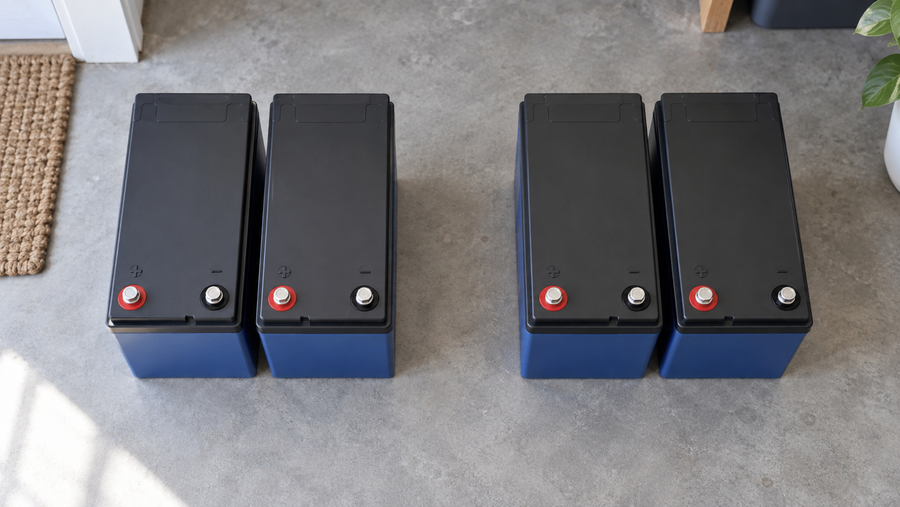
A 12V 105Ah battery is a useful reference point for a modest 12-volt RV load. The Vipboss 12V 105Ah Bluetooth LiFePO4 battery has 105 Ah and 1,344 Wh of stored energy, so it is in the range of the illustrative two-night calculation above. Its suitability still depends on your actual loads, required output, battery-compartment fit, charging equipment, and the limits in its documentation. One battery should not be treated as a guarantee of two nights for every RV.
For a lead-acid bank, use the usable-capacity guidance for the specific battery rather than treating the full nameplate rating as available. For lithium batteries, use the guidance for the specific model instead of transferring a lead-acid assumption to it. Chemistry changes the usable portion, charging behavior, weight, and system requirements.
Recalculate for the way you actually camp
Your required capacity changes when the load, time, or recharge opportunity changes. Use the branch that matches your trip rather than relying on a generic RV battery-size chart.
If you camp for one night and use only lights, a pump, and device charging, start with your measured or estimated daily watt-hours and multiply by one day. A smaller bank may meet the calculated demand, but leave room for cold weather, inaccurate appliance labels, and battery aging.
If you spend two or more nights without shore power, multiply the daily total by every night before the next dependable recharge. For example, the 544 Wh illustrative load over three nights needs about 170 Ah with the same 12-volt and 80% assumptions. Solar or generator charging can reduce the capacity needed between charging events, but only if the charging system reliably replaces the energy you use.

If you run an inverter-powered appliance, calculate that appliance separately and include inverter losses. A 1,000-watt appliance used for 30 minutes consumes about 500 Wh before inverter losses. That single load can be close to the illustrative 544 Wh overnight total, so a battery sized only for lights and a pump may not run it as expected.

If you use an electric heater or air conditioner from batteries, check the system’s continuous output, inverter rating, wiring, and recharge rate in addition to amp hours. Capacity alone does not prove that the battery can deliver the required power. A bank can have enough stored energy on paper and still shut down because the inverter, battery-management system, wiring, or protection limits are exceeded.