Add the battery-side current of everything that can run at the same time. A sustained result below 100A is within a 100A rating; exactly 100A is at the limit, and anything above it exceeds the rating. Before calling a lower result safe, also check startup surge, battery voltage under load, and any lower limit imposed by the battery, inverter, wiring, fuse, or breaker.
Use battery-side current, not appliance watts alone
If a 12V device lists its current in amps, use that figure. Add the current for every device that may operate at once, rather than adding devices that never overlap.
If a direct-current load lists only watts, convert it with the standard relationship between electric power, voltage, and current:
Current in amps = load watts ÷ battery voltage
For example, an illustrative 600W direct-current load on a battery at 12.8V draws about:
600W ÷ 12.8V = 46.9A
A common mistake is to compare a watt rating directly with 100A. Watts and amps are different units, so that comparison cannot show whether the BMS is overloaded. Convert every watt figure to battery-side amps first.
Use the voltage expected while the battery is supplying the load. Current rises as voltage falls. The same illustrative 600W load would draw 50A at 12.0V instead of 46.9A at 12.8V.
Count inverter loss and startup surge
For an appliance powered through an inverter, the inverter draws more power from the battery than it delivers to the appliance. Use the inverter’s efficiency figure at the relevant load when available:
Battery current = AC load watts ÷ (battery voltage × inverter efficiency)
At 12.8V and an illustrative 90% efficiency, the estimated battery current is:
| AC load running at once | Estimated battery current |
|---|---|
| 400W | 34.7A |
| 600W | 52.1A |
| 800W | 69.4A |
| 1,000W | 86.8A |
| 1,200W | 104.2A |
The 1,200W case exceeds 100A before adding any direct 12V loads or inverter standby consumption. At a lower battery voltage, the current would be higher.
Motors, compressors, pumps, and some appliances can draw more current while starting than while running. Check the appliance or inverter surge information and the battery’s separate peak-current limit and permitted duration. Do not assume a 100A continuous rating allows an unspecified surge above 100A.
Decide whether the 100A BMS is enough

Calculate the highest realistic combination, not just each load by itself. For example, suppose an illustrative system has 35A of direct 12V loads and a 600W AC load through a 90%-efficient inverter. At 12.8V:
35A + [600W ÷ (12.8V × 0.90)] = 87.1A
That running total is below 100A. It is not the final answer until you check whether the AC appliance has a startup surge and whether another load can switch on at the same time. If a temporary surge or added device pushes battery current above the battery’s allowed peak or continuous limit, reduce the overlapping loads or use a battery system designed for more current.
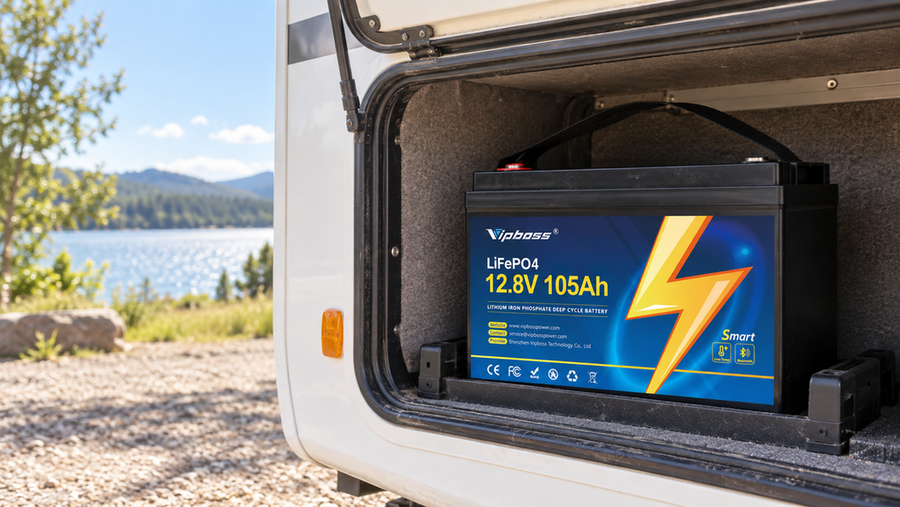
The Vipboss 12V 105Ah Bluetooth LiFePO4 battery includes a 100A BMS and is suitable when the complete battery-side calculation stays within that rating and all other system limits. Its Bluetooth monitoring can help you compare live current with your estimate, but it does not increase the permitted current. It is not a suitable single-battery choice for a sustained calculated draw above 100A.
Treat the lowest system rating as the real limit. A 100A BMS does not make undersized cable, terminals, a fuse, a breaker, or an inverter safe at 100A. The distinction between battery protection and external cable protection is also covered in this BMS and fuse protection guide. If those ratings or the battery’s peak-current behavior are not documented, have a qualified DC installer confirm the design before operating a high-current load.