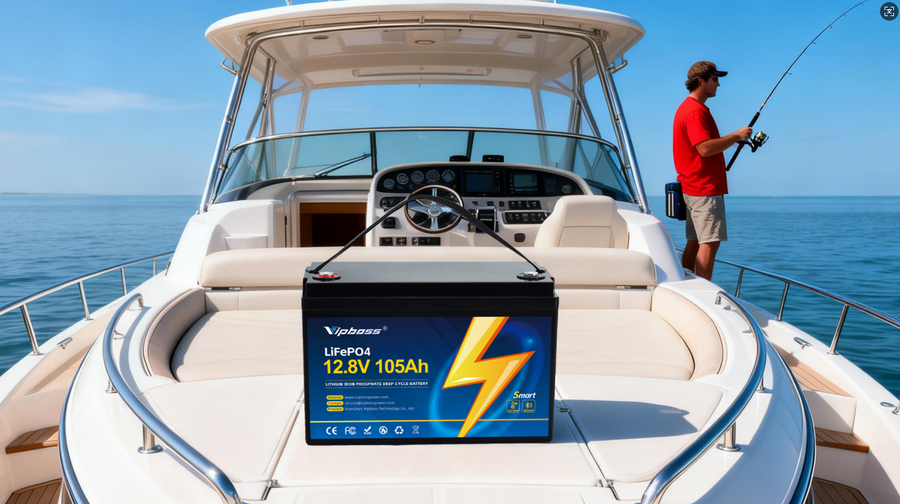
If you spend any time on the water, you know how important a reliable power source is for your trolling motor. In recent years, lithium batteries have become the go-to choice for serious anglers and boaters. Those using lithium iron phosphate (LiFePO4) chemistry, in particular, offer significant advantages: they're lighter, charge faster, and last significantly longer than traditional lead-acid batteries.
But the question remains: how long will one of these batteries actually last? The answer depends on two different metrics (runtime per charge and overall lifespan) and both are influenced by how you use and care for your battery.
What Makes Lithium Trolling Motor Batteries Different?
A lithium trolling motor battery stores electrical energy and releases it to power your motor. The key specification to understand is amp-hour (Ah) capacity, which tells you how much energy the battery can hold. A 100Ah battery, for example, can theoretically deliver 100 amps for one hour, or 20 amps for five hours.
LiFePO4 batteries have become the preferred chemistry for marine applications because they offer excellent thermal stability, a flat discharge curve (meaning consistent power output until the battery is nearly depleted), and the ability to handle deep discharges without significant degradation.
How Do You Calculate Trolling Motor Battery Runtime?
The basic formula for estimating runtime is straightforward:
Runtime (hours) = Battery Capacity (Ah) ÷ Motor Current Draw (A)
For instance, if you have a 100Ah battery and your motor draws an average of 20 amps, you'd get roughly five hours of runtime. However, this is a simplified estimate. In practice, several factors affect actual performance:
- Speed settings: Most trolling motors draw significantly less current at lower speeds. A motor might draw 50+ amps at full throttle but only 10 to 15 amps at cruising speed. Professional anglers report averaging around 30% of maximum power during typical fishing conditions.
- Water and wind conditions: Fighting current, waves, or wind forces the motor to work harder, increasing power consumption.
- Boat weight: Heavier loads require more thrust to maintain speed, which translates to higher amp draw.
- Motor voltage and thrust rating: Higher-voltage systems (36V or 24V) generally operate more efficiently than 12V setups at equivalent thrust levels.
Under typical conditions (moderate speeds, calm water, and reasonable loads) a 100Ah 12V lithium battery will power most trolling motors for 5 to 8 hours. Many users report even longer runtimes when fishing in favorable conditions and using spot-lock features intermittently rather than continuous operation.

How Many Years Will a Lithium Trolling Motor Battery Last?
Beyond daily runtime, the total lifespan of your battery matters for long-term value. LiFePO4 batteries are rated for 2,000 to 3,000 charge cycles at 80% depth of discharge before capacity drops to 80% of the original. Some high-quality cells can exceed 5,000 cycles under optimal conditions.
To put this in perspective: if you use your boat twice a week during a six-month season, that's roughly 50 cycles per year. At 2,000 cycles, the battery could theoretically last 40 years, far longer than you'll likely own the boat. Even heavy users who cycle their battery 200+ times annually can expect 10+ years of service.
By comparison, lead-acid batteries typically deliver 300 to 500 cycles when discharged to 50%, which translates to 2 to 4 years for most boaters. This difference in longevity is a major reason why lithium batteries, despite higher upfront costs, often prove more economical over time.
What Factors Affect Lithium Battery Longevity?
Several variables influence how long your lithium trolling motor battery will maintain its performance. Understanding these factors helps you get the most out of your investment and avoid practices that could shorten battery life.
Depth of Discharge
One advantage of LiFePO4 chemistry is its tolerance for deep discharge. While lead-acid batteries should ideally stay above 50% charge to maximize lifespan, lithium batteries can be safely discharged to 80% or even 100% without dramatic cycle life reduction. That said, shallower depth of discharge cycles do extend the overall lifespan marginally because the chemistry simply experiences less stress.
Temperature
Lithium batteries perform best between 32°F and 113°F (0°C to 45°C). Cold temperatures temporarily reduce available capacity and can prevent charging below freezing on some models. Excessive heat accelerates internal degradation. When possible, avoid leaving batteries in direct sunlight or in enclosed spaces that can become extremely hot.
Charging Practices
Using a charger designed for LiFePO4 batteries ensures proper voltage cutoff and prevents overcharging. Most quality lithium batteries include a built-in Battery Management System (BMS) that protects against overcharge, over-discharge, and short circuits, but using the right charger still matters for optimal cell balancing and longevity.
How Should You Store a Lithium Trolling Motor Battery?
Proper storage practices are essential for maintaining battery health during periods of inactivity. Whether you're putting your boat away for the winter or simply won't be on the water for a few weeks, following these guidelines will help preserve capacity and extend overall lifespan.
- Charge to 40 to 50% capacity: This state of charge minimizes stress on the cells during storage. Storing at full charge or near-empty both accelerate degradation.
- Store in a cool, dry location: Ideal temperatures range from 50°F to 77°F (10°C to 25°C). Avoid freezing conditions or hot garages.
- Check periodically: Every 2 to 3 months, verify the charge level hasn't dropped below 30% due to self-discharge. Top up to 40 to 50% if needed.
- Disconnect from loads: Even small parasitic draws from connected electronics can slowly drain the battery over months of storage.
How Does Lithium Compare to Lead-Acid Batteries?
For boaters weighing their options, the differences between lithium and lead-acid technology are significant. The table below summarizes the key specifications that matter most for trolling motor applications.
| Specification | LiFePO4 | Lead-Acid |
|---|---|---|
| Cycle life | 2,000 to 5,000+ cycles | 300 to 500 cycles |
| Usable capacity | 80 to 90% | 50% recommended |
| Weight | Approximately 1/3 of equivalent lead-acid | Baseline |
| Charge time | 2 to 4 hours | 8 to 12 hours + cooldown |
| Round-trip efficiency | 92 to 95% | 70 to 85% |

Is a Lithium Trolling Motor Battery Worth the Investment?
A quality lithium trolling motor battery represents a significant upgrade over traditional lead-acid options. You can expect 5 to 8 hours of runtime per charge under normal conditions, and with proper care, the battery should serve you well for a decade or more.
The higher initial cost is offset by longer lifespan, reduced weight, faster charging, and the convenience of deeper discharge capability. For anyone who spends serious time on the water, making the switch to lithium is an investment that pays dividends season after season.
FAQs
Q1. How long does a lithium trolling motor battery last on a single charge?
A typical 100Ah lithium trolling motor battery can last between 5 to 8 hours on a single charge under normal conditions. Actual run time will vary depending on factors such as motor speed, water conditions, and boat weight.
Q2. Can I use a lithium trolling motor battery in cold temperatures?
Lithium batteries can perform well in cold temperatures, but their efficiency may decrease below 32°F (0°C). Storing them at room temperature and using battery heaters in extreme cold can help maintain performance.
Q3. How often should I charge my lithium trolling motor battery?
It's recommended to recharge your lithium trolling motor battery when it reaches about 20-30% of its charge. Avoid letting it fully discharge to extend its lifespan and maintain its efficiency over time.
Q4. What is the difference between lithium and lead-acid trolling motor batteries?
Lithium batteries have a longer lifespan (2,000-5,000 cycles vs. 300-500 for lead-acid), charge faster, and are lighter. Lead-acid batteries are cheaper initially but require more frequent replacements and are heavier, reducing overall performance.
Q5. How should I store my lithium trolling motor battery when not in use?
Store your lithium battery at about 40-50% charge in a cool, dry location (50°F-77°F or 10°C-25°C). Avoid storing it fully charged or empty to prevent degradation and ensure optimal performance when ready to use.