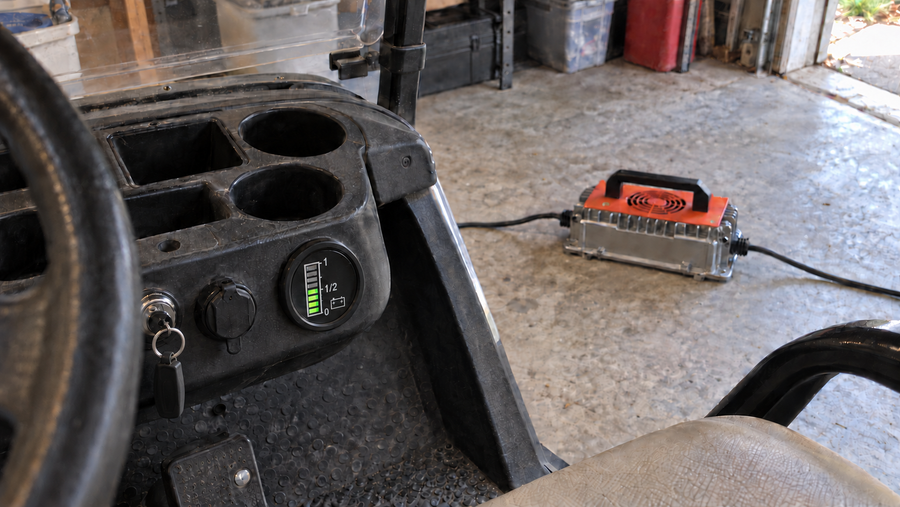

Keeping lithium batteries at 100% charge, especially when warm, quietly chews through their lifespan; letting them rest cool and around mid-charge is far kinder and safer.
You top off a new lithium bank, see that satisfying "100%", shut everything down, and walk away for the season, then come back months later wondering why the runtime already feels weaker. That pattern shows up again and again in off-grid cabins, RV upgrades, and portable power stations that should have lasted years longer than they did. This guide explains what is really happening inside a "full" battery and gives you clear targets for how full to keep your packs when they are working, resting, or in storage.
Full Charge, Full Stress: What 100% Really Does
When your display shows 100%, the cells inside are sitting at their highest voltage, like an engine parked at the redline. State of charge is simply how full the "tank" is, while depth of discharge is how much of that tank you empty in a cycle. Technical explanations of battery degradation show that spending lots of time at very high or very low charge levels, especially when combined with heat and heavy use, is one of the main ways lithium cells wear out.
At 100% charge, the electrodes and electrolyte are held at their most aggressive chemical state. Even when the battery is just sitting on a shelf, slow side reactions keep happening, forming deposits and breaking down materials. Lab data on lithium-ion cells stored for a year around 104°F and fully charged show capacity losses on the order of 30-40%, while similar cells stored cool and partially charged lose only a few percent over the same period. Even at more moderate room temperatures around 77°F, holding cells at full charge can cost roughly 20% of their capacity per year, whereas storing them near mid-charge cuts that to a small fraction of that loss.
How you cycle the battery matters just as much as how you store it. Deep 0-100% swings push the chemistry hard. Typical lithium-ion cells deliver on the order of 300-500 full 100% depth-of-discharge cycles before dropping to about 80% of their original capacity, while limiting each cycle to roughly half that depth can stretch life to around 1,200-1,500 cycles or more. LiFePO4 batteries used in many power stations and off-grid banks go even further: community data from manufacturers such as BLUETTI point to around 3,500 full cycles to 80% capacity for some units, and roughly double that when you only use about half the stored energy each time. On paper, that is the difference between a pack that feels tired after several years of hard use and one that is still strong well over a decade in.
The bottom line from these numbers is simple. Full charge is not "neutral." It is a stress state that accelerates the natural aging you cannot avoid. The more hours your battery spends pinned at that top end, the faster its useful life ticks down.

Why Parking at 100% Is So Hard on Stored Batteries
Daily cycling between partial charges is one thing; parking a battery at 100% for weeks or months is another. When you fill a pack, shut off the system, and walk away, you lock the chemistry at maximum voltage while it quietly ages, even though you are not getting any work out of it.
That is why so many manufacturer and platform guides now echo the same advice: keep lithium packs roughly in the middle of their range when they will sit unused for a while, often expressed as a "30-80" or "20-80" rule. Independent battery-care articles and operating-system vendors recommend long-term storage below about 50% rather than fully topped off, and lithium storage guides for outdoor gear highlight that about 40-60% charge is the sweet spot for month-plus downtime. In other words, you trade a little bit of "stored energy on tap" for a lot less calendar aging.
You can see the difference by looking at storage states side by side.
Storage state |
Typical scenario |
Effect on lifespan (qualitative) |
Better use case |
100% charge, warm room or shed |
Bank topped off and left all season |
Highest chemical stress; fastest capacity loss, especially in heat; in lab, can lose a large chunk of capacity in a year |
Only right before you actually need full runtime |
Around 40-60% charge, cool room |
Pack prepared for off-season |
Lowest stress; minimal calendar aging; good balance between safety margin and life |
Seasonal storage, backup units between tests |
Near 0% charge for weeks |
"Forgot to recharge" after shutdown |
Risk of over-discharge as self-consumption and BMS draw pull cells below safe voltage; can permanently damage cells |
Never intentional; acceptable only briefly before recharge |
The middle row is where you want your unused lithium batteries to live.

It lines up with storage recommendations in lithium longevity research, with practical battery-care articles for electronics and outdoor equipment, and with the way many off-grid installers now "park" packs between seasons.
Modern devices quietly reinforce the same principle. Many laptops, cell phones, and electric vehicles offer battery-care or charge-limit modes that cap routine charging around 80% or delay the final part of the charge until shortly before you unplug. EV-focused discussions of optimized charging and discharging protocols emphasize that daily driving should usually stay within a narrower state-of-charge window rather than bouncing between full and empty, both to slow degradation and to keep safety margins in reserve.
On the large-system side, grid and substation operators are pushing this idea even further. AI-driven controllers for DC battery systems use time-series forecasting to decide how and when to charge and discharge; one Dual Self-Attention Network model for substation batteries reported about 95.84% accuracy in battery state prediction and improved charging and discharging efficiency by around 20%, helping reduce unnecessary stress on the packs over time. The same philosophy applies in a cabin or RV bank: smarter control that avoids unnecessary full charges buys you both performance and longevity.
Temperature and Safety: Why a Full Pack Can Fail More Violently
State of charge is only half the story. Temperature acts like a multiplier on everything above. Guidance from device makers and system designers consistently recommends keeping lithium batteries near normal room temperature during use and storing them in cool, dry places rather than hot sheds or vehicles. Industry summaries of lithium-ion batteries note that high temperatures accelerate the side reactions that eat away at capacity, especially when combined with high charge levels.
Storage safety specialists warn that lithium packs can self-heat under the wrong conditions and that improper storage can escalate into thermal runaway. Overviews of how to store lithium batteries describe how a single overheating cell can trigger neighboring cells in a chain reaction, releasing flammable gases, smoke, and potentially explosions. When packs are stored in attached garages or other enclosed areas connected to homes, those gases and combustion products can migrate into living spaces and create serious health risks.
Fire-safety experts echo the same concern. Resources on lithium-ion batteries from national fire protection organizations point out that physical damage, incorrect charging, and improper storage all raise the chance of batteries overheating, catching fire, or even exploding. The message is not that lithium is inherently unsafe, but that how you charge and store these batteries is a critical part of your risk profile.
At grid scale, the stakes are much higher, which is why guidelines for battery energy storage systems stress robust system design, monitoring, and emergency planning. Large facilities that store megawatt-hours of energy now incorporate sophisticated battery management systems, thermal detection, and strict siting rules to reduce the chance that a single failing cell cascades into a larger incident.
In a cabin, RV, or home backup system you are not dealing with that level of energy, but the physics is the same. A fully charged pack simply contains more stored energy that can be released quickly if something goes wrong. Keeping batteries a bit below full when they are idle, and storing them cool and away from bedrooms or living areas, is a straightforward way to reduce both long-term wear and worst-case safety consequences.

How Full Should You Keep Lithium Batteries in Real Life?
Perfect lab conditions are one thing; living with an off-grid system or portable power station is another. The good news is that you do not need perfection to reap the benefits. You just need to make "100%" the exception instead of home base.
Everyday cycles in solar, RV, and home backup systems
For most lithium-ion and LiFePO4 banks, a practical everyday target is to run between roughly 20% and 80% where possible. Research and industry experience summarized in independent battery degradation overviews, lithium longevity studies, and outdoor-gear battery guides all converge on shallow to moderate cycling as the sweet spot: deep 0-100% swings shorten life, while staying in the mid-band slows capacity fade.
In off-grid and RV systems, you can get close to that behavior through settings and design. Charge controllers and inverter-chargers often let you set the maximum charge voltage or a "charge limit" percentage; dialing this back so that the bank normally peaks just below 100% reduces how much time it spends at maximum stress. Battery management systems in modern packs already hide a bit of buffer above "100%" and below "0%", but you still gain by not forcing the electronics to live at the extremes every single day.
Occasional full cycles still have their place. Many LiFePO4 power-station makers advise doing one or two full charge-discharge cycles when the unit is new and then a full cycle every month or two mainly to recalibrate the state-of-charge meter, not because the chemistry needs it. Treat those as checkups for the fuel gauge, not as a routine workout.
Short breaks: days to a few weeks
If you are stepping away from a system or portable unit for days or a couple of weeks, aim to park it somewhere around half full. For a solar bank, that might mean scheduling a controlled discharge on the last day rather than forcing an end-of-day float at 100%. For a power station, it may mean running a moderate load for a while after charging, until the display drops into the middle of the bar, before shutting it down for the trip.
That approach leaves you with enough energy in reserve that small self-consumption and monitoring loads do not drive the pack dangerously low, while still avoiding the constant high-voltage stress that comes with leaving it completely topped off.
Seasonal or long-term storage
When a battery will sit for a month or more, the target gets narrower and more important. Long-term storage guidance for lithium-ion packs across multiple sources converges on charging to around 40-60%, powering down, and storing in a cool, dry place out of direct sun. That strikes a balance between minimizing calendar aging, avoiding over-discharge, and protecting against cold-weather quirks.
For a cabin system that you shut down for the winter, that might look like this: in the last few days of the season, let the bank run down naturally to roughly half full instead of finishing with a full day of equalization. Then disable charging and load circuits so only the battery management system is powered, and leave the pack in a space that stays near normal room temperature rather than a hot attic or sealed metal box in the sun. In a portable unit, charge to mid-level, turn it completely off, store it in a closet rather than a hot garage, and plan to wake it up every few months to check that it has not drifted down near empty.
Avoid leaving lithium packs flat for extended periods. Even though some LiFePO4 units tolerate occasional deep dips to near empty, community guidance from manufacturers warns against parking them at 0% for weeks, because tiny standby loads can pull individual cells below their safe voltage. If you discover a pack that has slowly self-discharged into that zone, treat it as suspect and follow manufacturer instructions carefully rather than simply forcing a recharge.
Designing your system so 100% is the exception
Behind the scenes, advanced battery systems are already doing what you are trying to mimic manually. Cell-level control platforms such as Exro's Battery Control System manage voltage, current, and temperature for each cell, providing micro-protection and active balancing to extend life. Substation and grid-support batteries are increasingly managed by predictive controllers that decide when to charge and discharge in order to meet demand while avoiding unnecessary stress.
You do not need industrial AI to benefit from the same logic. In an off-grid retrofit or upgrade, you can size your battery and array so that typical daily use does not routinely hammer the pack from full to empty, set conservative charge limits in your inverter or BMS app, and plan your heavy loads so they run while solar is available instead of drawing deeply into the night. Those simple design choices move your system much closer to the "gentle use" profiles that lab tests and real-world fleets associate with long battery life.
FAQ: Common Questions About Full Charge and Storage
Is it ever OK to store a lithium battery at 100%?
Short periods at full charge are fine, especially when you actually need the energy. Charging your power station to 100% the day before a storm or a big trip is exactly what that capacity is for. The damage comes from making that state the default parking spot for weeks or months at a time. Whenever you are storing rather than actively preparing for use, drop the charge level down into the middle of the range first.
Does LiFePO4 handle 100% better than other lithium chemistries?
LiFePO4 is more tolerant in many ways. It typically offers longer cycle life and better thermal stability than older lithium chemistries, which is why it is popular in off-grid and RV banks. That said, data from LiFePO4 power-station manufacturers still show a big difference between full-depth cycling and partial cycling, with cycle counts roughly doubling when you avoid deep discharges every time. The same principles apply: 100% is safe to reach when you need it, but not the best place to park the battery for long stretches.
Should emergency backup batteries be kept full in case the grid fails?
For critical medical or safety equipment you may decide that keeping a pack closer to full is worth the extra wear; reliability comes first. For most home backup units, a good compromise is to keep them in the mid-to-high range during normal operation and allow them to charge the last slice toward full only when severe weather or other risks are forecast. That way you avoid grinding them down unnecessarily, but still have maximum capacity available when it actually matters.
Keeping batteries alive and strong over the long term is about treating "full" as a temporary performance mode, not a permanent parking gear. Dial your system, habits, and storage practices toward cool temperatures and mid-range charge levels, and your off-grid or backup power will reward you with more years of reliable service before you ever need to think about a replacement pack.