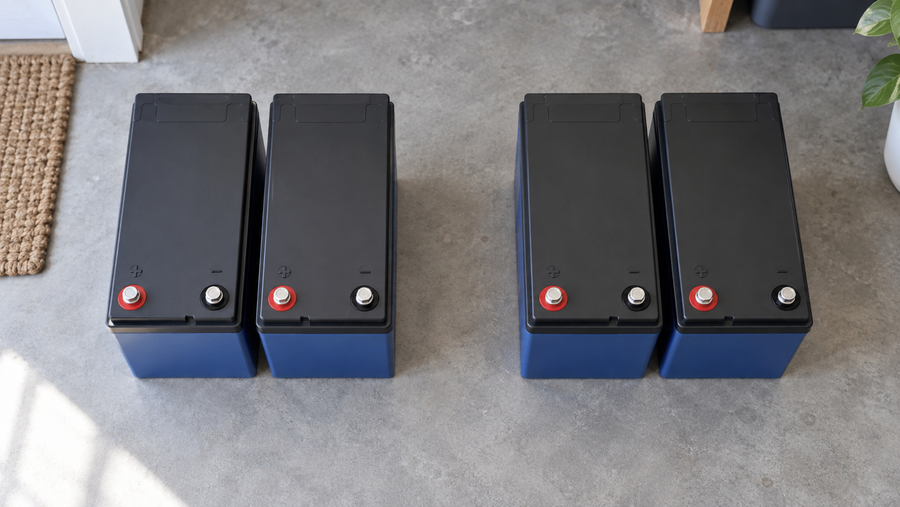

For a ski cabin you will not visit for six months, store your lithium batteries indoors in a dry space that stays above freezing, around half charged, with all loads and chargers disconnected. If the cabin cannot reliably stay above 32°F, move the batteries to a warmer location instead of letting them sit in deep cold.
You lock the cabin after spring slush, drive back to town, and six months later open the door to find your “maintenance‑free” lithium bank dead, swollen, or refusing to charge. Seasonal systems that sit through one or two winters like this often lose years of life or fail right when the first storm hits, even when the batteries were a premium brand. With a bit of planning, you can leave for half a year and come back to a battery bank that wakes up cleanly, powers your lights, and is ready for another season.
Why Six Months in a Cold Cabin Is Tough on Lithium Batteries
Cold weather slows the movement of lithium inside the cells and thickens the electrolyte, which cuts usable capacity, raises internal resistance, and makes the battery feel weaker just when you need it most. Guidance for cold‑weather lithium systems notes that these effects become especially pronounced as temperatures dip toward and below 32°F, and that charging and discharging windows tighten at low temperatures, particularly for high‑energy chemistries. Technical discussions of cold‑weather lithium packs highlight that while many batteries can still discharge at low temperatures, their charge acceptance and longevity suffer when they live in the cold.
The damage from cold is not only temporary loss of runtime. A Stanford‑linked study found that keeping lithium‑ion cells below freezing causes the cathode particles to shrink, crack, and detach more, leading to several percent more capacity loss over repeated cycles than cells stored warmer. Researchers showed that extreme cold increases micro‑cracking in and identified structural stress in cold storage as a real lifetime limiter. In a ski cabin that may sit unheated for months, those cycles of deep cold and mild thaw add up over seasons, especially if the batteries stay installed in an uninsulated crawlspace or under a deck.

On top of that, charging in the cold is a separate hazard. Below about 32°F, lithium begins to plate on the anode surface instead of intercalating properly, which raises the risk of internal shorts and permanent capacity loss. Cold‑weather best practice is to avoid charging lithium batteries when they are at or below freezing unless the pack and its battery management system are explicitly designed for cold‑charge operation and can pre‑warm the cells. Guidance for low‑temperature lithium packs underscores that even when discharge down to around 14°F or lower is allowed, charging should be blocked until the cells are warmed above freezing. Cold‑weather lithium system recommendations consistently stress “no charging below freezing” as a hard rule.
Decide Where the Bank Should Live: Cabin vs. Town
The most important decision is whether your long‑term storage location will actually keep the batteries in a safe temperature band. Manufacturers that build LiFePO₄ banks for seasonal use recommend storing them for more than three months in cool, dry, shaded spaces that stay roughly between 32°F and 77°F, with an emphasis on the lower, more moderate end of that range. Guidance for these systems notes that storing lithium fully idle below freezing accelerates aging and shortens overall lifespan compared with storage at moderate temperature. Seasonal storage recommendations for LiFePO₄ banks explicitly call for an above‑freezing, climate‑controlled spot when downtime stretches past three months.
If your cabin’s interior stays above freezing all winter, the simplest move is to leave the bank installed inside the thermal envelope in a dry mechanical corner, away from exterior walls and drafts. In that scenario, the batteries see slow seasonal swings rather than the brutal outside temperature curve, and you can rely on their normal long‑term storage behavior. If the interior occasionally drops just below freezing on the coldest nights but mostly hovers above it, putting the bank in an insulated battery box or closet helps flatten those dips and keeps you closer to the recommended range.
If the cabin spends weeks or months well below freezing with no backup heat, the calculus changes. Long‑term exposure to extreme cold drives more structural damage and capacity loss than moderate storage, as both lab work and field experience show. Cold‑weather safety guidance for lithium batteries stresses that prevention is much easier than recovering from damage. Winter storage recommendations for lithium packs highlight that repeated freezing can irreversibly damage internal structures and create safety risks. In that kind of cabin, it is usually smarter to pull the bank for the off‑season and store it in town in a basement or utility room that stays dry and comfortably above freezing.
Quick Location Guide
Cabin winter condition |
Where the batteries should live |
Key reason |
Interior reliably above freezing |
Leave bank installed in an interior, insulated, dry space |
Meets long‑term temperature targets and avoids deep cold storage |
Interior mostly above freezing with brief dips |
Leave installed but use insulated box or closet inside cabin |
Reduces short cold dips and limits moisture and condensation |
Interior spends long stretches well below freezing |
Move batteries to a warmer building for the off‑season |
Avoids structural cold damage and storage below recommended range |
Dial In the Right State of Charge Before You Leave
Once you decide where the bank will live, the next lever is how full to leave it. Battery makers that design lithium packs for seasonal storage recommend parking them at a mid‑range state of charge, roughly around half full, rather than either full or empty. Detailed storage guidance for LiFePO₄ systems suggests aiming for about 50% state of charge for any storage period longer than three months, since these chemistries tolerate partial charge well and do not need to be floated at 100% the way lead‑acid does. LiFePO₄ storage recommendations for long downtime emphasize this “half‑full” target.
Leaving batteries completely full all winter keeps cell voltage elevated for months, which stresses the chemistry and tends to shorten life, especially when combined with cold. At the other extreme, leaving them near empty invites slow parasitic draw from inverters, charge controllers, and monitoring gear, which can push them into deep discharge. Deep discharge over long periods is a known killer: storage guidance warns that fully discharged lithium batteries can lose capacity permanently or even become unrecoverable if they sit at very low voltage for too long. Long‑term storage advice for lithium banks specifically cautions against storing at very low charge.
In practice, the easiest way to hit a safe window is to charge the bank normally on your last day at the cabin, then watch your battery monitor or inverter display and run some loads until the system settles near the middle of its normal range. If your monitor reports percentage, aim for roughly 40–60%. If it reports voltage only, note the typical resting voltage you see around mid‑capacity during normal use earlier in the season, and target that as your parking voltage when you shut down.
For small power‑tool packs and handheld devices you leave at the cabin, follow the manufacturer’s specific instructions. Some tool makers recommend a full charge before winter because those packs are smaller and self‑discharge faster, while broader lithium research favors partial charge for multi‑month storage. If the manual is silent, a safe middle ground is to store those packs around half to three‑quarters charged, remove them from the tools, and then fully charge them when you return.
Control Temperature, Moisture, and Charging Sources
Temperature and moisture control are just as important as charge level. Seasonal storage guidance for LiFePO₄ batteries recommends keeping packs for more than three months in environments roughly between 32°F and 77°F, leaning toward cool, shaded, and stable rather than warm or swinging. Recommendations for seasonal storage of lithium batteries underline that cool, steady conditions slow chemical aging. Cold‑weather guidance focused on safety adds that storage below freezing elevates the risk of damage and should be avoided when possible. Cold‑weather lithium storage advice specifically warns against leaving packs in vehicles or exposed outdoor locations through winter.
Moisture is the other enemy. Lithium storage guidance for off‑grid and portable systems stresses that the space should be dry, well‑ventilated, and protected from leaks, since condensation and high humidity promote corrosion and can create surface paths for current. Recommendations for seasonal storage suggest using silica‑gel packs or a dehumidifier in damp spaces, particularly basements and crawlspaces where moisture can condense on cool battery cases. Best practices for long‑term lithium storage highlight moisture control alongside temperature and charge level.
For cabins that flirt with freezing, simple insulation goes a long way. Cold‑weather advice for lithium packs recommends surrounding batteries with insulating materials such as foam or insulated enclosures to help them retain a bit of heat and blunt rapid temperature swings. In harsher locations, purpose‑built battery blankets or heaters controlled by a thermostat can keep a stationary bank just above freezing without wasting much energy. Cold‑resistant lithium system guidance points to insulated enclosures with small heaters as a proven strategy in extreme environments.
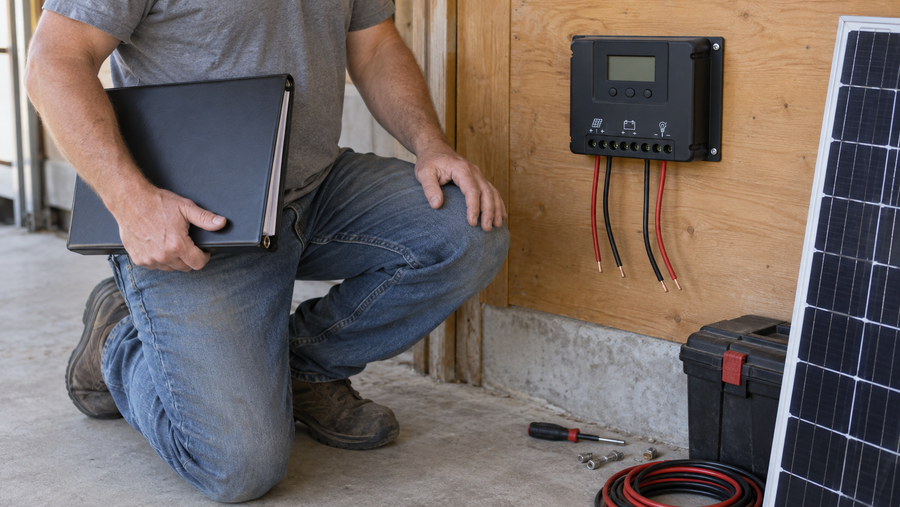
Charging in the cold needs special attention. Storage safety experts warn that charging lithium‑ion batteries at low temperatures, particularly between about –4°F and 41°F at higher currents, can trigger self‑heating and gas release that may lead to fire or explosion in worst‑case scenarios. Fire‑safety guidance for lithium battery storage notes that one overheating cell can set off a chain reaction in neighboring cells when many are stored together. For a ski cabin, that means you want to prevent any system from trying to push charge into a stone‑cold bank while you are away. The safest approach is to disconnect the batteries from inverters, solar charge controllers, and any shore‑power chargers before you leave, unless you know for certain that the system has temperature sensors and a low‑temperature charge lockout that physically prevents charging below freezing.
Make It Safe: Disconnect, Isolate, and Contain
Long‑term storage recommendations for LiFePO₄ banks consistently say the same thing: remove or disconnect batteries from devices that will not be used, even if those devices are turned off. Equipment often draws a small standby current, and over six months that parasitic load can pull batteries deep into an unhealthy low‑voltage zone. Seasonal storage practices for lithium banks specifically recommend physical disconnection.
Safety guidance for bulk lithium storage also emphasizes how a problem in one battery can cascade to its neighbors. When multiple batteries are packed tightly, a single overheating cell can trigger a chain reaction of melting, smoking, and fire in adjacent units. Lithium‑storage fire‑risk analyses stress that the risk increases when many cells or modules are stored together and that any failure can release flammable and toxic gases. For a cabin bank, that argues for a battery area that is clearly separated from fuel, paints, and other combustibles, has some ventilation, and uses enclosures that could help contain a localized failure long enough for heat to dissipate.
If your bank uses cobalt‑based chemistries like NCA or NMC rather than LiFePO₄, storage safety deserves extra respect. Manufacturers who compare chemistries point out that cobalt‑based cells carry higher thermal‑runaway risk and may justify fire‑resistant containers or cabinets, especially when multiple high‑capacity packs are stored together. LiFePO₄ storage guidance highlights reduced thermal‑runaway risk as one reason it is favored for stationary banks, but even these safer chemistries still benefit from careful placement and isolation.
Bringing the Cabin Back Online in the Fall
When you return after six months, resist the temptation to flip everything on at once. Start with a visual and tactile inspection of the battery bank. Storage guidance for lithium systems advises checking for swelling, leaks, corrosion at terminals, or any signs of heat damage before reconnecting loads. If anything looks or smells off, pause and investigate before putting the system under power.
Next, let cold batteries warm up to room temperature before charging or heavy use. Seasonal storage recommendations for LiFePO₄ call for warming a cold‑stored battery to a moderate temperature before bringing it back into service, both to protect against lithium plating during charging and to improve performance. Recommissioning advice for stored lithium batteries treats this warm‑up step as essential.
Once the bank is at a comfortable temperature, measure its voltage or state of charge. If it drifted down near the lower end of the healthy range, top it back up with a normal charge and then put a gentle load on the system for a few hours. Some storage guidance suggests cycling long‑stored batteries about every six months to keep them healthy; your first weekend back at the cabin naturally provides that cycle as you bring loads online. Keep an eye out for any abnormal voltage sag, error codes, or heating during this first re‑commissioning run.
Quick Reference: Six‑Month Ski Cabin Storage Settings
Parameter |
Recommended target for 6‑month storage |
Why it matters |
State of charge |
Around 40–60% |
Reduces stress compared with full charge and avoids deep‑discharge risk during downtime |
Storage temperature |
Around 32–68°F, steady and shaded |
Slows aging and avoids structural damage from long‑term freezing |
Environment |
Dry, ventilated interior space |
Minimizes corrosion, condensation, and surface leakage paths |
Connections |
All inverters, chargers, and loads disconnected |
Prevents parasitic drain and cold‑weather charging attempts |
Chemistry choice |
LiFePO₄ preferred for stationary banks |
Offers strong cold‑weather stability and lower thermal‑runaway risk |
FAQ: Common Ski Cabin Storage Questions
Can I leave my lithium batteries connected to solar all winter?
You can, but only if you are sure the system will never try to charge them while they are below freezing and if your charge controllers and battery management system are designed for cold‑temperature operation. Cold‑weather and fire‑safety guidance warns that charging lithium at low temperatures can cause gas generation and self‑heating inside the cells, especially at higher currents, which raises the risk of damage or fire. Lithium storage safety analyses treat uncontrolled charging as a critical hazard. For an unattended cabin, the safer approach is usually to disconnect the bank for the off‑season.
What if I cannot move the batteries and the cabin gets very cold?
If the bank must stay on site in a very cold cabin, do everything possible to keep it within a safer band: place it inside the insulated portion of the building, use an insulated enclosure or box, add a thermostat‑controlled heater or battery blanket, and block any charging below freezing. Cold‑weather lithium guidance for harsh environments recommends insulated enclosures with small heaters as a way to keep stationary systems in a survivable temperature window. Low‑temperature lithium system practices accept higher upfront cost for active heating in exchange for reliability. You may still see faster aging than in a milder location, but you greatly cut the risk of severe damage.
Does it matter whether my bank is LiFePO₄ or another lithium chemistry?
Yes. LiFePO₄ chemistries have very good thermal stability and long cycle life, which makes them popular for off‑grid cabins and other stationary systems that see wide temperature swings. Guidance from manufacturers and cold‑weather comparisons note that LiFePO₄ handles thermal stress better than many cobalt‑based chemistries, though it still loses capacity in the cold and must be protected from freezing and improper charging. LiFePO₄ seasonal storage advice emphasizes that correct charge level, temperature control, and moisture management matter regardless of chemistry.
Treat winter storage as part of your power upgrade, not an afterthought. Set the right charge level, give your batteries a dry and above‑freezing parking spot, disconnect everything that can nibble at them, and your ski cabin’s lithium bank will be ready to fire up the lights and the inverter on the very first powder day next season.