
LiFePO4 batteries charge much faster than lead-acid because they safely accept higher current with less wasted energy and heat.
LiFePO4 batteries often reach a useful full charge roughly four times faster than comparable lead-acid banks because they can safely absorb much higher charging current with far less wasted heat and loss.
If you are tired of listening to a generator drone for hours or watching your charge monitor creep from 60% to “almost full,” you are not alone. In real off-grid, RV, and small commercial upgrades, replacing tired lead-acid banks with LiFePO4 regularly turns four-hour charging marathons into about an hour of solid charging while also adding years of usable life. This guide breaks down why that speed jump happens and shows the design and charging choices that let you lock in that gain instead of abusing your new batteries.
What “4x Faster” Looks Like in the Field
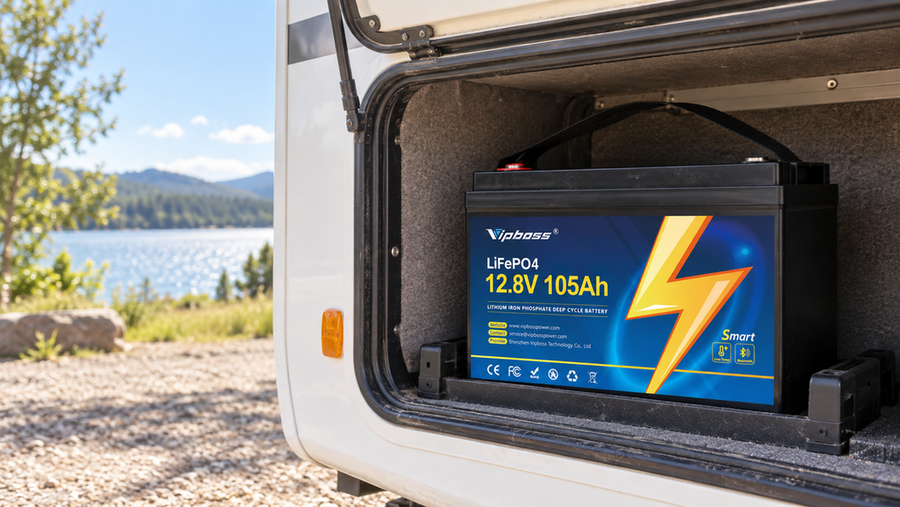
When installers say LiFePO4 charges about four times faster than lead-acid, they are really talking about how much charging current the bank can safely accept and how little of that current is wasted. LiFePO4 packs for solar and off-grid storage routinely accept high current and still recharge to full in about an hour to a few hours, something documented in solar lighting and storage systems that push LiFePO4 hard during the day so it is ready every night for lighting and backup power LiFePO4 solar lighting. For many 12 V LiFePO4 batteries, normal charging at about half to full “C-rate” (charging at current roughly equal to capacity) means a 100 Ah unit can go from low to full in roughly 2–4 hours with the right charger fast charging LiFePO4 examples.
Lead-acid banks of similar size simply cannot accept that kind of sustained current without generating gas, heat, and long “absorption” phases where much of the energy is wasted rather than stored. That is why a generator that quickly fills a LiFePO4 bank will often need several times longer to bring an equivalent lead-acid bank from the same starting state of charge up to the same usable energy level.

A Simple Example: Same Bank, Different Chemistries
Consider a 400 Ah house bank in an off-grid cabin, charged by a 100 A charger. With LiFePO4, manufacturers commonly allow continuous charge rates around 0.5C to 1C, which aligns well with that 100 A charger on a 200–400 Ah bank. Because LiFePO4 has very high round-trip efficiency—often well above 90% and up toward the high nineties in solar storage systems—the vast majority of those 100 amps go into actually storing energy, not heating electrolyte or bubbling gas.
With a lead-acid bank, you rarely get to push that same 100 A for long. As the voltage climbs, the bank starts to gas, plates run hotter, and you have to back off current sharply or let the charger sit in a long, slow absorption stage. Practically, the usable average current into the bank might only be a fraction of the nameplate charger rating, and the last part of the charge can drag on for hours. LiFePO4’s ability to stay comfortable at higher current through most of the charge curve, combined with its high efficiency, is what turns that into an effective three- to fourfold speed advantage in well-designed systems.
Chemistry That Loves High Current
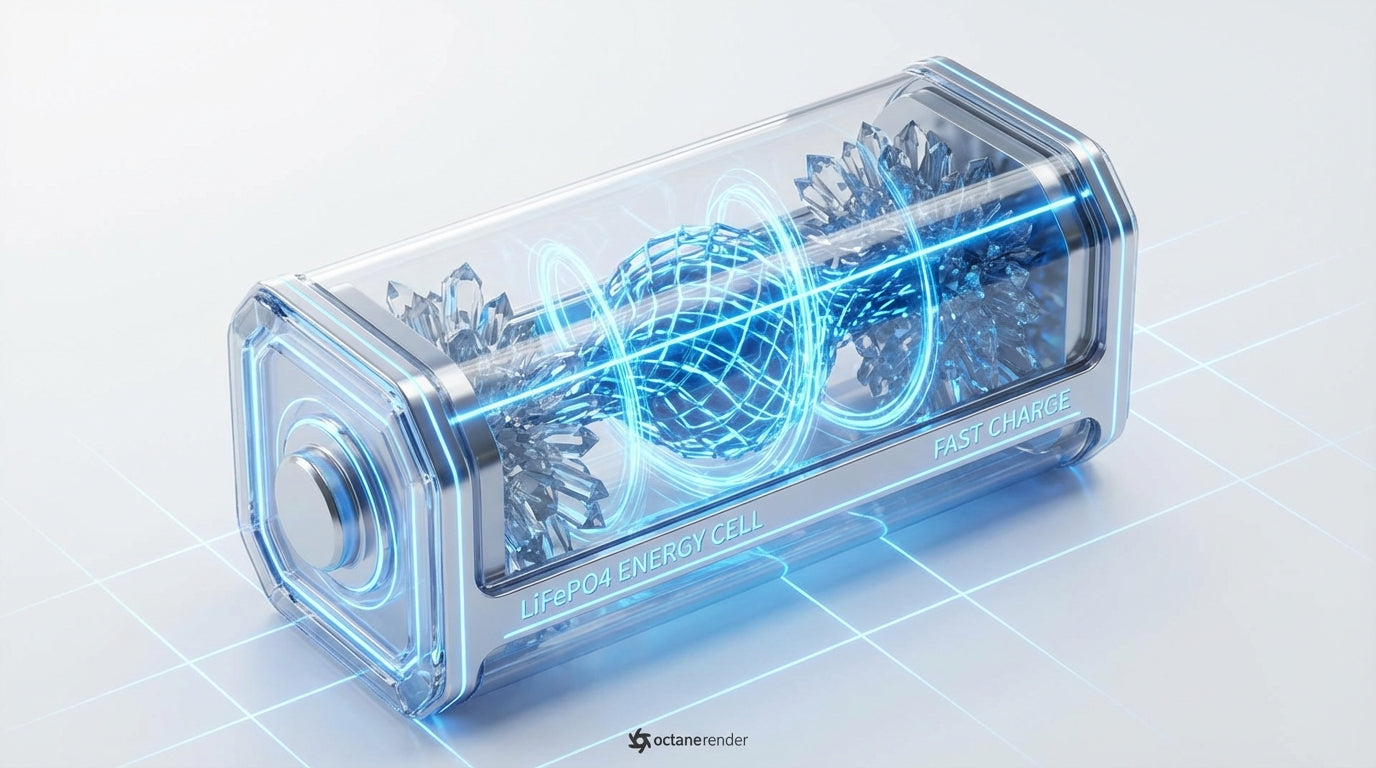
Beneath the fast-charging behavior is a cathode made of lithium iron phosphate with very strong iron–phosphate–oxygen bonds. That crystal structure is extremely thermally and chemically stable, which means the material does not readily give off oxygen or break down when you push current into it Fe–PO4–O stability and safety. The result is a chemistry that stays cooler and safer under load and is far less prone to the runaway reactions that limit how hard you can fast-charge other batteries.
LiFePO4 cells also tolerate high charging currents as a normal operating mode rather than an occasional emergency. Real-world LiFePO4 packs in solar, RV, and marine use routinely accept higher charge currents and are marketed explicitly on their fast-charging advantage over other chemistries fast-charging capability. Some designs go further, with systems that advertise one-hour full recharge for solar storage and street-light installations that must refill every single day within limited sun hours.

On the efficiency side, LiFePO4’s internal losses are low. Renewable energy analyses report charge/discharge efficiencies above 90% and often in the 95–98% range for LiFePO4 storage, which means almost every amp the charger delivers ends up available later as useful energy. That translates into shorter charge sessions for the same kilowatt-hours captured from your panels or generator.
Electrochemistry in Plain Language
Inside a LiFePO4 cell, lithium ions shuttle between a stable iron-phosphate cathode and a graphite anode. The pathways for ions inside the cathode structure are well-ordered and remain stable over thousands of cycles, so ions can move quickly without tearing the material apart. That is a big reason LiFePO4 packs regularly deliver two to four thousand cycles or more, far beyond the few hundred to roughly thousand cycles typical for lead-acid in similar service.
Because the cathode stays stable even at high state of charge, LiFePO4 cells can be charged all the way to 100% regularly without the same penalty on life that many other lithium chemistries experience. The strong phosphorus–oxygen bond suppresses oxygen release and keeps thermal runaway thresholds high, which is why EV makers lean on LiFePO4 packs where frequent full charges are expected. For you, that means there is no need to artificially cap charge at 80% just to preserve lifespan, and you can use the full current capability of your charger more often.

Why Lead-Acid Hits the Brakes
Lead-acid cells operate on very different physics. As they approach full, pushing them hard drives more current into gas production and heating rather than storing energy. Charge algorithms respond by stepping down into long absorption and float stages to keep plates from shedding material or warping, which is why the last 15–20% of a lead-acid charge can take as long as the first 60–70%. Energy that would become stored lithium in a LiFePO4 bank instead becomes bubbles and heat in a lead-acid bank, and that overhead simply takes time to work through.
This is also why you rarely see lead-acid banks in serious off-grid use designed for sustained high charging currents proportional to capacity. Flooded and AGM formats can tolerate short bursts, but as a steady diet they suffer accelerated water loss, more frequent equalization, and faster capacity fade. The net effect is that designers usually keep lead-acid charge current conservative, while LiFePO4 banks of the same amp-hour rating are intentionally paired with much punchier chargers. The result is a real-world speed gap that lines up well with the “about four times faster” rule of thumb when you look at average current over a full charge rather than just the peak.
Fast-Charging Lessons from EVs and High-Power Systems
The EV world has become a proving ground for how hard LiFePO4 chemistry can be pushed when the rest of the system is built around it. Modern EV packs using LiFePO4 routinely accept extremely high C-rates, with some cell designs reaching 5.5C or even higher—fast-charging levels that can add hundreds of miles of rated range in minutes under public DC fast charging high C-rate LFP packs. This kind of performance is only possible because the chemistry remains stable at elevated temperatures and high states of charge, and because battery management systems tightly control current and temperature.
Research on LiFePO4 cells under aggressive multi-step fast-charging profiles shows that, with carefully tuned current ramps and temperature windows, it is possible to charge repeatedly at very high rates while suppressing damaging lithium plating and maintaining acceptable capacity over many hundreds of cycles. Even under these harsh conditions, tests find that LiFePO4 cells can lose only about a fifth of their capacity after more than a thousand such cycles while preserving strong thermal stability at the cell level. For off-grid and backup applications that use gentler 0.5C–1C charging, that is a strong safety margin.
The lesson for system designers is straightforward: LiFePO4 can handle a lot of current if you respect its boundaries, especially around voltage limits and temperature. That is how EVs get away with repeated fast charges without constant pack replacements, and the same principles apply when you design an off-grid or retrofit system around a LiFePO4 bank.
How to Configure LiFePO4 So You Actually Get Faster Charging
The first step in unlocking LiFePO4’s speed advantage is using a charger with a profile built specifically for this chemistry. For a 12 V pack, that usually means a two-stage constant-current/constant-voltage profile that brings the battery up to roughly 14.4–14.6 V, then allows current to taper naturally, with no long-term float or “trickle” stage that holds the battery slightly overcharged correct LiFePO4 charge profile. Lead-acid chargers that include equalization or aggressive float modes can overdrive LiFePO4 cells and cause the battery management system (BMS) to shut down, wiping out any supposed speed advantage.
Next comes current. Many manufacturers recommend around 0.2C to 0.5C for best long-term life, which, for a 100 Ah battery, corresponds to roughly 20–50 A of charge current, even though some packs are rated to handle 1C or more on paper. More performance-oriented packs and EV-type modules can be charged even faster; in stationary systems and mobile power packs, manufacturers routinely advertise standard LiFePO4 charging at roughly 0.5C–1C and fast-charging options that can safely push toward 2C when thermal and voltage limits are respected.
Temperature is the final big lever. LiFePO4 should not be charged when the cells are below about 32°F to avoid lithium plating and internal damage, and charging above roughly 113°F accelerates wear. In the sweet spot between about 50°F and 95°F, the chemistry is both safe and efficient, which is where you want your batteries when you push higher charge currents. Many LiFePO4 packs are rated to operate across a broad temperature range down to about –4°F and up to about 140°F, which is helpful for discharge, but the fast-charging window sits firmly in the moderate middle.
Pros and Cons vs Lead-Acid for Off-Grid Upgrades
LiFePO4’s fast charging is only one part of the story. For a retrofit, the overall value comes from combining that speed with long life, high usable capacity, and low maintenance. Typical LiFePO4 packs deliver roughly 2,000–4,000 cycles, and some premium units reach 6,000 cycles at substantial depth of discharge, while common lead-acid banks tend to offer only a few hundred to about a thousand cycles in similar duty. On top of that, LiFePO4 requires essentially no routine maintenance: there is no watering, no acid cleanup, and no corrosion management, which translates directly into lower labor cost and less downtime over years of operation.
Environmental and safety benefits matter too. LiFePO4 chemistries avoid toxic lead and cobalt, relying instead on more abundant iron and phosphate, and they are highlighted as more eco-friendly and easier to recycle than many alternatives. That is a practical advantage for fleets, facilities, and homeowners who want clean power solutions that do not just shift pollution from the tailpipe to the mine.
The main trade-offs are higher upfront cost and the need for compatible electronics. LiFePO4 packs usually cost more per amp-hour than commodity lead-acid, and they demand chargers and solar controllers with LiFePO4 profiles. However, when you account for the fact that a LiFePO4 bank can last several times longer and is dramatically more efficient to charge, total cost of ownership often tilts in LiFePO4’s favor, especially where generator run-time or limited solar hours are big constraints.
Quick Comparison Snapshot
Aspect |
LiFePO4 |
Lead-acid |
Charge speed |
Comfortable at high current; often 0.5C–1C and higher-capability packs even faster |
Limited by gassing and heat; practical charge current much more restricted |
Efficiency |
High round-trip efficiency, often above 90% and up toward 97% in tuned systems |
Lower efficiency with more energy lost as heat and gas during charging |
Cycle life |
Thousands of cycles, sometimes 6,000 or more at useful depth of discharge |
Typically a few hundred to about a thousand cycles in similar service |
Maintenance |
Essentially maintenance-free with integrated BMS |
Requires periodic checks, cleaning, and often watering |
Environmental impact |
Cobalt-free, lead-free, uses abundant materials |
Contains toxic lead and acid, heavier recycling burden |
Upfront cost |
Higher purchase price but lower lifetime cost in many applications |
Lower purchase price but more frequent replacement |
FAQ
Does fast charging LiFePO4 always shorten its life?
All batteries age faster when you push them harder, but LiFePO4 is built to handle relatively high charging currents with far less penalty than lead-acid or many other lithium chemistries. Field data and manufacturer guidance show that when you stay within recommended voltage and temperature limits and keep most charging in the 0.2C–0.5C range, LiFePO4 packs can still deliver thousands of cycles even if you occasionally use higher fast-charging rates.
Will I always see exactly 4x faster charging after upgrading?
Not automatically. The “4x” figure assumes you actually let the LiFePO4 bank see more current and eliminate the long absorption tail that holds lead-acid back. If your charger is undersized, your wiring is thin, or your solar array is small, you will still benefit from higher efficiency and deeper usable capacity, but the time savings may be closer to two times than four. To see the full effect, you need a LiFePO4-capable charger sized to deliver a healthy fraction of your bank’s amp-hour rating and a system layout that keeps voltage drop low.
Is LiFePO4 worth the upgrade for off-grid and backup systems?
For most off-grid cabins, RVs, boats, and critical backup installations, the combination of faster charging, higher efficiency, long cycle life, and low maintenance makes LiFePO4 a strong upgrade from lead-acid, especially where generator fuel, panel space, or access for maintenance are constrained. When you pencil out the longer service life and shorter generator hours, the numbers tend to favor LiFePO4 over time.
The bottom line: if you are retrofitting a system and you are prepared to update your charging gear, LiFePO4 lets you turn limited solar windows or expensive generator run-time into stored energy far more quickly and cleanly than lead-acid, giving you a leaner, more responsive power system that keeps up with how you actually use it.