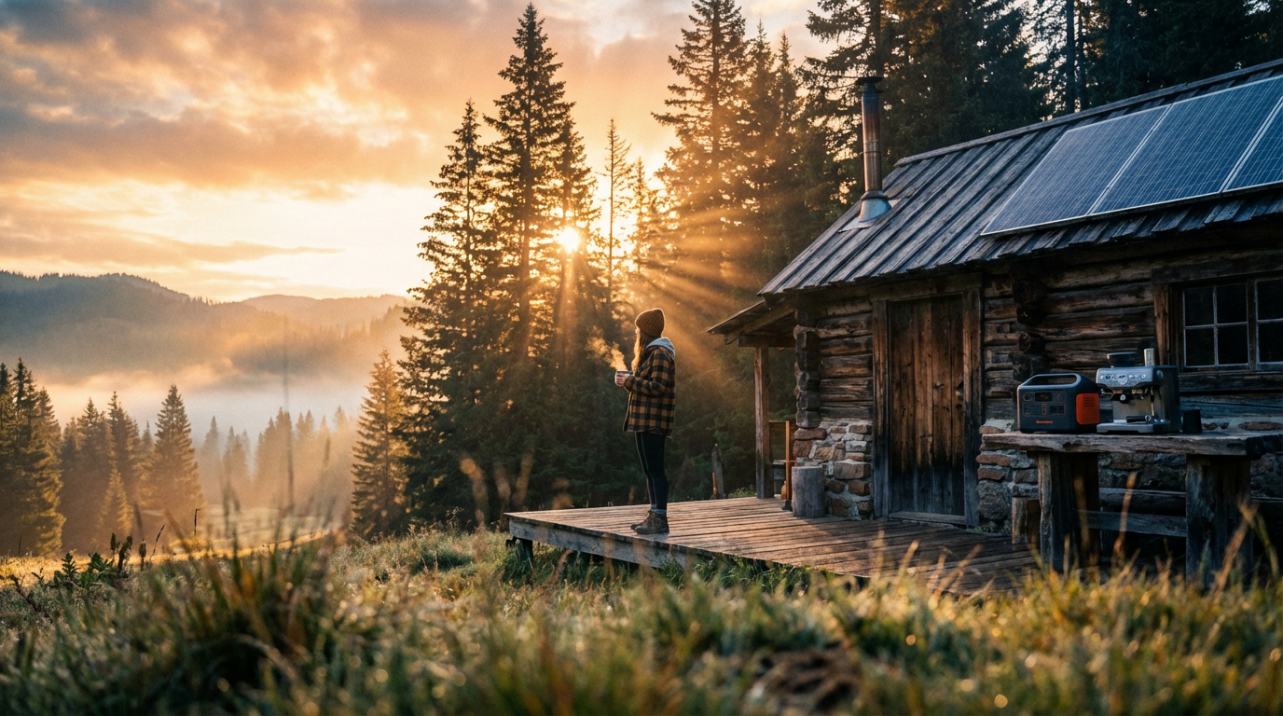

You can drink real espresso off-grid if you match your coffee gear to your batteries, inverter, and daily energy budget instead of treating it as an afterthought.
Picture sunrise at your cabin or trailhead: the sky is clear, your batteries are half full, and you're staring at a jar of instant coffee because you're afraid the espresso machine will tank your system. After working with setups that range from no-power hand pumps to self-heating USB-C espresso units and compact cart machines, one thing is clear: the right combination of gear and power planning makes that first shot completely stress-free. This guide walks you through how much espresso really costs in watts, which machines make sense off-grid, and how to build a coffee ritual that hits every morning without sabotaging your power.
What "Morning Coffee Freedom" Really Means Off-Grid
Morning coffee freedom is not about owning the fanciest machine; it's about getting the cup you actually crave, every day, without babying your batteries. Compact small espresso machines already show how far the tech has come, delivering cafe-level shots in bodies only a few inches wide and light enough for small apartments and tight counters, proving that high pressure and small footprints can coexist in real-world kitchens small espresso machines. In parallel, portable espresso makers have evolved from gimmicky gadgets into serious tools that generate 15–20 bars of pressure and ride comfortably in a backpack, glove box, or van cabinet.
The key distinction off-grid is how water is heated and how pressure is generated. Manual travel brewers and hand-pump espresso makers rely on your stove or campfire for hot water and your arm strength for pressure, which keeps electrical draw near zero. Modern battery-powered units, by contrast, carry their own heating elements and lithium packs, often charged via USB-C from the same sources you already use for a cell phone or GPS, and can pull multiple shots from cold water before needing a top-up portable espresso makers. For a fixed tiny house or serious rig, compact dual-boiler machines designed for mobile coffee carts sit at the other extreme: real commercial-grade espresso on a standard 120 V, 15 A circuit, but with a sustained 1,600 W draw that must be planned into your inverter and battery sizing.
Off-grid, freedom comes from choosing the spot on that spectrum that fits your lifestyle.

Backpacking into the backcountry, full-time vanlife with solar and lithium, or running a semi-permanent coffee cart from a battery bank all call for very different espresso strategies, even if the end goal is the same thick, crema-topped shot.
The Real Power Cost of Espresso Off-Grid
To understand what your system can handle, start with one honest question: how much energy does a single morning coffee session really take? A compact mobile-cart machine such as the La Marzocco Linea Mini runs at about 1,600 W on a standard 120 V, 15 A circuit and is designed to steam milk and pull shots all day without blinking. If you run a machine in that class for roughly ten minutes while it heats up, pulls two shots, and steams milk, you are burning on the order of a quarter of a kilowatt-hour. On a modest lithium bank that might represent a noticeable chunk of your usable daily capacity, especially in winter or during cloudy stretches.
Battery-powered portable espresso machines spread that consumption out differently. Instead of one big 1,600 W hit, they store energy in internal lithium packs and sip from your system slowly over USB-C. Higher-end models aimed at outdoor use now pair 15–20 bar pumps with integrated heaters that can raise cold stream water to brewing temperature, often delivering four to six hot shots per charge or well over a hundred shots if you supply pre-heated water portable espresso machines. The advantage is that you can charge them opportunistically from your existing solar, house batteries, or portable power station during the day, then "spend" that energy on coffee at dawn without firing the big inverter.
Fully manual units shift almost the entire power burden off your electrical system. By heating water on a stove and using mechanical pistons to generate 9–18 bars of pressure, they give you true espresso with almost no electrical draw beyond a small grinder if you choose to use one portable espresso machine review. In practical terms, a gas burner or alcohol stove boils the water, your arm supplies the pressure, and your batteries barely notice that you made coffee at all.

Four Practical Paths to Off-Grid Espresso
Battery-Powered Portable Espresso Machines
If you want "push a button, get a shot" with minimal wiring complexity, a self-heating portable machine is often the sweet spot. Outdoor-oriented models integrate a pump capable of around 20 bars of pressure, automatic heating, and USB-C charging, designed specifically to work from power banks, solar generators, or vehicle outlets while traveling. Real-world field tests show that, when you use pre-heated water stored in an insulated bottle, the internal battery can last through multi-day hiking or camping trips without dropping below its maximum charge indicator, which translates into dozens of shots with almost no battery anxiety.
The pros are clear: real espresso with thick crema, consistent extraction because the machine controls pressure and temperature, and the ability to brew anywhere you can carry water. Many of these units also accept both ground coffee and capsules, letting you choose between freshness and convenience depending on the trip. The cons are that you must manage one more lithium battery, keep an eye on charging opportunities during low-solar stretches, and accept that most units top out at small, espresso-style volumes rather than big mugs of drip coffee. For van and RV owners, this trade-off is usually worth it: you avoid a large inverter surge every morning while still getting a barista-style shot within a minute or two of pushing the button.
Manual Hand-Pump Espresso and No-Power Brewers
If your off-grid system is small or you often go places where even USB charging is scarce, manual gear gives you almost bulletproof resilience. High-pressure hand-pump espresso makers use compact pistons to reach roughly 9–18 bars of pressure with nothing but your hands, paired with an approximately 3 fl oz water chamber and a small basket for ground coffee or capsules. Off-grid reviewers who travel full-time consistently call their favorite manual espresso units the "holy grail" of travel coffee because they are durable, pocketable, and completely independent of electrical power while still producing shots comparable to home machines.
The main benefit is power independence. If you can heat water to around boiling on a stove or fire, you can pull espresso every morning, even if your batteries are low or your inverter is offline. Manual units also simplify maintenance: most break down into a few parts that rinse clean in seconds, then air-dry before going back into a pack. The downside is effort and discipline. You must manually pump the piston, you will not get the one-touch convenience of an automatic machine, and you must think ahead about grinding beans or packing pre-ground coffee that suits your chosen device. But if you value redundancy and you like hands-on brewing, a manual machine plus a simple pour-over or French press gives you multiple ways to get your morning cup without touching your lithium bank.
12-Volt Car Brewers for Road-Heavy Life
For drivers who rack up highway miles and stop at pullouts more often than they sit around a camp table, a 12 V coffee maker can be a surprisingly effective solution. Devices designed to plug into the vehicle's cigarette lighter socket heat water and brew a small 3 fl oz cup in roughly four minutes, using soft pods to avoid loose grounds rolling around the cabin 12V coffee machine for the car. The workflow is simple: fill with water, insert a pod, plug into the 12 V outlet, and wait for audio cues before flipping the unit to pour into your cup.
In power terms, these machines draw from the vehicle alternator rather than your house battery bank, which means you can often reserve your lithium storage for other loads. They also shine on long driving days when you want a predictable break routine: pre-load the machine before a rest area, switch it on while you drive, and pour when you stop. The trade-offs are that they generally make coffee closer to strong drip than textbook espresso and they tie your coffee routine to the vehicle rather than your cabin or tent. For many road-trippers, though, a 12 V brewer pairs nicely with a separate manual espresso device at camp, giving them a pod-based quick cup in the car and a more ritualized shot when they are parked for the night.

Full Countertop Espresso Machines on Big Off-Grid Systems
When you retrofit a serious off-grid home or a professional coffee cart, you may want a full dual-boiler espresso machine. Compact commercial-style units built for mobile carts bring features like PID-controlled brew boilers, powerful steam wands, and rotary pumps into a form factor that still fits in small spaces, all drawing from a standard 120 V, 1,600 W, 15 A circuit. When paired with a well-sized lithium bank and inverter, this gives you cafe-grade performance in an off-grid shell, with programmable pre-infusion, shot timers, and app-level control.
The pros here are obvious: if espresso is central to your lifestyle or business, nothing replaces the workflow and speed of a true multi-group machine. You can serve multiple drinks back-to-back, steam milk while pulling shots, and lean on commercial accessories like scales and tampers supplied with these systems. The cons are that you must treat the espresso machine like a major appliance in your electrical design. That means verifying inverter surge capacity, providing enough battery to ride out multiple drinks even on low-solar days, and building a maintenance schedule for descaling and cleaning that fits with off-grid water constraints. For many off-grid homes, a hybrid approach works best: a full machine for days when batteries are full and the sun is high, plus a manual or battery-powered portable unit that takes over during storms or shoulder seasons.
Comparing Your Options at a Glance
Option type |
Power source |
Key pros |
Key cons |
Best fit |
Self-heating portable espresso |
Internal lithium, USB-C, often 15–20 bar |
True espresso and crema almost anywhere, compatible with capsules and grounds, charges from solar or vehicle |
Limited shot volume, must manage battery and charging, higher upfront cost |
Vans, RVs, cabins with modest solar that still want button-press convenience |
Manual hand-pump espresso |
Stove or fire for water, human power for pressure |
Near-zero electrical draw, high pressure, rugged and compact |
Requires effort and technique, no self-heating, one shot at a time |
Minimalist backpackers, small battery systems, redundancy-focused setups |
12-volt car brewer |
Vehicle 12 V socket |
Uses alternator instead of house bank, simple workflow while driving, pod convenience |
Not true espresso, tied to vehicle, slower than countertop machines |
Road-warriors, commuters, vanlife with heavy driving days |
Compact dual-boiler espresso machine |
120 V, ~1,600 W inverter plus battery bank |
Full cafe performance, fast steaming and back-to-back shots |
Significant power draw, needs robust inverter and batteries, more complex plumbing |
Off-grid homes, commercial carts, serious coffee rigs with large lithium banks |
Designing Your "Morning Coffee Freedom" Power Plan
Once you know your preferred path, turn it into a repeatable power plan. If you are primarily stationary with a healthy solar array and lithium storage, map espresso into your normal energy budget the same way you would a microwave. One 1,600 W machine used for ten minutes becomes a predictable morning load that you can offset with extra solar or by shifting other heavy loads to later in the day. On stormy days, you can fall back to a manual brewer with stove-heated water to protect your batteries while still enjoying a solid shot.
For van and RV builds, think in terms of layers. A self-heating portable machine that charges over USB-C can plug into your existing charging ecosystem alongside phones, laptops, and cameras, and high-quality units are now engineered specifically to work with power banks and even small solar generators for multiple shots per day. Pair that with a no-power method such as a compact pour-over or manual press that uses the same kettle, and you now have at least two distinct ways to make coffee regardless of what your batteries are doing.
If you spend most of your time hiking or bikepacking away from your main power system, prioritize redundancy and simplicity. Manual machines that rely only on a lightweight stove and your own effort have repeatedly proven themselves on multi-day trips, with users reporting robust espresso and intact gear even after week-long hikes. In that context, carrying pre-ground coffee in airtight containers, an insulated bottle for hot water, and a minimal cleaning kit ensures your "coffee system" is as reliable as your shelter and sleep system.
Finally, if you are spec-ing a full coffee cart or off-grid cafe, treat the espresso rig as the cornerstone of your electrical and water design. The same compact dual-boiler machines that work beautifully in mobile carts rely on consistent 120 V, 15 A service and clean water, so you will want to pair them with robust inverters, water reservoirs, and filtration, plus a maintenance routine that accounts for descaling and cleanliness in a small space. From there, you can layer in battery-powered or manual backup gear for days when sunlight or generator runtime is constrained.
Quick FAQ
Can a portable espresso machine really make cafe-quality shots? Yes, but only if it can generate proper pressure and stable water temperature. Testing on compact home machines shows that well-designed small bodies can still deliver consistent, full-flavor espresso when pressure and temperature are controlled. Outdoor-focused portable units now combine 15–20 bar pumps, precise heating, and baskets for both capsules and ground coffee, which independent reviewers rate equal or superior in flavor and crema to many manual travel brewers.
Is it better to heat water in the espresso machine or on a stove off-grid? Heating water inside a portable espresso machine is convenient and makes brewing nearly automatic, but it is the most energy-intensive part of the process. USB-C rechargeable units that can also work with pre-heated water give you the best of both worlds: several fully automatic shots from cold water per charge, and the ability to stretch the same battery to hundreds of shots when you use stove-heated water instead. Many experienced off-grid users default to pre-heating water when batteries are tight, then let the machine handle both heating and extraction when solar is plentiful.
Can I run a full espresso machine from a portable power station? You can, but only within the limits of the power station's inverter and battery. Compact commercial-style machines draw roughly 1,600 W and are intended for dedicated 120 V, 15 A circuits, which matches what many mid-size inverters and power stations can technically supply. The real question is how many shots and milk drinks you will make back-to-back and whether that aligns with the watt-hour capacity of your power station. In many cases, combining a countertop machine for high-capacity days with a manual or battery-powered portable unit as a backup offers more flexibility than relying on a single large appliance.
Morning coffee freedom off-grid is entirely achievable when you treat espresso like any other major load and build a multi-layered plan instead of chasing a single magic gadget. Choose the machine that fits your power reality, back it up with a no-power alternative, and your batteries will stay happy while your coffee gets better than most city cafes.