
A premium long-life battery kit is not a splurge; it's a decade of calmer holidays, safer outages, and fewer last-minute runs for disposable cells.
Ever tried to enjoy a movie night or ride out a storm when the flashlight dies, the kids' toys quit, and someone is hunting through a junk drawer for "any batteries that still work"? Families that switch their most-used devices and lights to long-lasting lithium and quality rechargeables dramatically cut emergency swaps, dead gadgets, and wasted money over the years. This guide shows how to turn a scary price tag into a simple story about fewer hassles, lower long-term cost, and real power security your family can feel.
Why Your Family Thinks the Battery Is "Too Expensive"
From a kitchen-table view, a high-end lithium or rechargeable pack looks outrageous next to a big blister card of cheap alkalines. A low-cost alkaline pack seems like a bargain because the price per battery is tiny and the package is full, while a lithium option or rechargeable set costs several times more up front even though it may include fewer cells. That sticker shock is real, especially when nobody has seen the math over ten years.
There is also a hidden performance gap your family does not see on the shelf. In independent comparisons of AA cells, budget brands with the lowest price per battery often deliver the shortest runtimes, meaning more swaps and more frustration. Mid-priced options like Rayovac outlast them by more than an hour in continuous use despite costing more per cell, which leads to a better balance of runtime and cost per hour of power in practice, as shown in real-world head-to-head tests of AA cells. When devices die sooner, the "cheap" pack stops feeling cheap very quickly.
Finally, most people focus on the next weekend, not the next decade. They do not automatically connect each impulse purchase of AA or AAA cells with the growing pile of dead batteries in a drawer or a landfill. Modern guides to long-lasting batteries stress that the real win comes from matching chemistry to the job and looking at longevity, not just shelf price, as highlighted in best long-lasting batteries in 2025. That is how you cut both costs and downtime over years of use at home or in a cabin.
What You're Actually Buying: A Decade of Power, Not Just a Battery
When you reach for a premium lithium or a quality rechargeable kit, you're buying three things at once: stronger performance under load, a longer useful life, and far fewer weak or leaking cells.
Lithium cells pack more energy into the same size and hold their voltage far better in extreme heat or cold than standard alkalines, which is why they are consistently recommended for demanding electronics and outdoor use where failure is not an option, as explained in reviews of best batteries for electronics. In practice, that means camera flashes firing reliably all night, LED lanterns staying bright during an outage, and sensors or smart locks holding up when the weather turns nasty.
Under sustained heavy use, lithium AA and AAA cells repeatedly beat alkaline rivals in both runtime and consistent output. That is why products like Energizer's Ultimate Lithium line are marketed specifically for high-tech devices and hold records for longest-lasting performance in rigorous tests of high-drain gear such as cameras and portable lights, as summarized in evaluations of batteries for high drain devices and in the product listing for Energizer Ultimate Lithium AAA batteries. That extra performance is exactly what you want when the lights have to stay on.

Rechargeable nickel metal hydride (NiMH) and lithium-ion cells are the other side of the "10-year gift." Each high-quality NiMH cell can be charged hundreds to roughly a thousand times, and low self-discharge designs hold their charge in storage for years instead of months, meaning a single cell can effectively replace up to about a thousand disposables over its life in many household devices. Panasonic's Eneloop AA line, for example, is designed to retain a large share of its charge after up to ten years in storage, making it a realistic decade-scale solution for remotes, controllers, and emergency lights, as noted in overviews of best batteries for electronics.
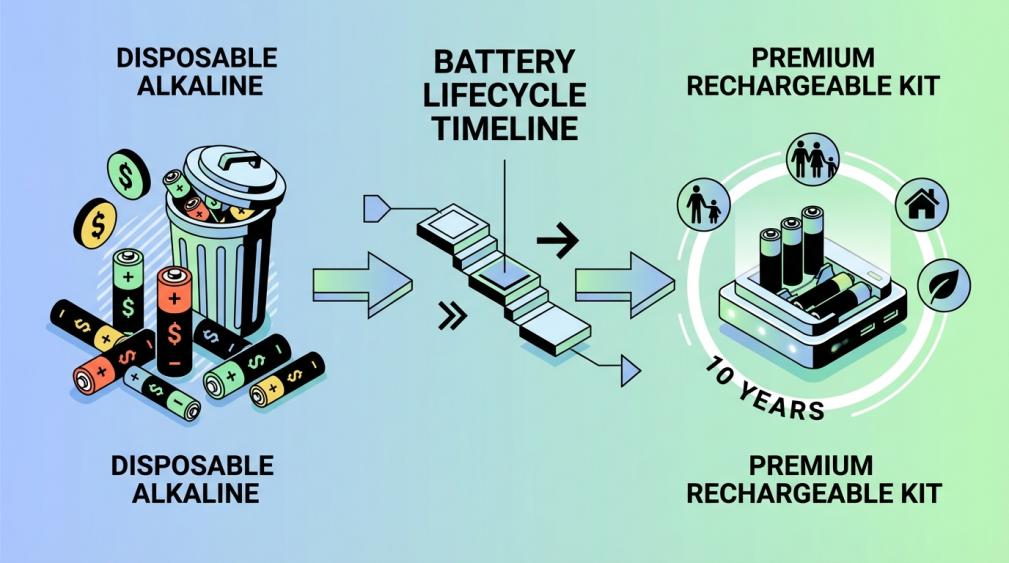
To make this tangible for your family, imagine two drawers. One holds a steady set of eight premium rechargeables and a smart charger that you rotate through flashlights, toys, and game controllers. The other holds an ever-changing pile of alkalines that need replacing every few weeks in the same devices. Over a decade, the first drawer barely changes while the second fills with dead cells, wasted money, and more trips to the store.
Cost Over Ten Years: Turning Sticker Shock into Simple Math
The fastest way to defuse the "too expensive" argument is to convert price into cost per year and cost per hour of power.
Cheap alkalines feel affordable because the price per battery is low, but runtime often is, too. In one simple comparison, dollar-store AA batteries cost about $0.25 each yet delivered barely five hours of runtime in a test device, while a better mid-priced brand around $0.62 per cell lasted more than six hours, giving a lower cost per hour and far fewer swaps despite the higher sticker price per battery, as documented in detailed tests of how long different brands last. That same pattern shows up again and again: the very cheapest cells usually mean more labor and more frustration.

Now add rechargeables to the picture. Independent reviews of AA rechargeables regularly find that good NiMH cells cost around a couple of dollars each and are rated for roughly 1,000 charge–discharge cycles or more, a standard also used in modern buying guides that focus on long-life AA and AAA cells for home use. If you actually use even half of those cycles in demanding devices, your cost per use drops into fractions of a cent, while a name-brand alkaline at around 0.80 each gives you one useful run and then heads to the bin. Even before power outages or camping trips, the math leans heavily toward the rechargeable kit.
For a simple family example, picture a pair of kids' game controllers that chew through sixteen AA alkalines every month of heavy play. At $0.70 per alkaline, that is roughly $11.20 per month, or over $130 per year, and well past $1,300 over ten years if habits stay the same. Replace that pile with sixteen good rechargeables in a smart charger costing, say, under $60 total, and even after a decade of use you may still be rotating the same cells, with only pennies of electricity and occasional replacements to top up the fleet. The upfront "ouch" becomes obvious long-term savings.
This same principle applies when you build an emergency power kit for storms or off-grid weekends. A box of long-life lithium primaries and a core set of rechargeables you trust costs more on day one, but over the next ten holiday seasons and outage cycles you avoid repeated last-minute spending, as highlighted in planning guides that match batteries to common holiday gifts and gear.
Reliability and Safety: Calming the "Will This Thing Blow Up?" Question
Any time the word "lithium" comes up around the table, someone will remember a viral story about a phone or scooter catching fire. That concern deserves a clear, confident answer grounded in how these batteries actually work.
Lithium batteries are extremely energy-dense, which is what lets them keep smartphones, cameras, and other high-drain devices running so long. That same density means you must respect charging and storage rules. Safety experts emphasize that most failures come from physical damage, internal short circuits, or bad charging practices, not from simply sitting in a remote or lantern. Polymer lithium cells in particular tend to vent or burn rather than violently explode when abused, and reputable packs include protection circuits to shut things down before damage escalates, as explained in technical discussions of lithium polymer safety and protection design. The practical takeaway is that well-designed cells from trusted manufacturers, used with the right charger, are built specifically not to be a "time bomb" in normal daily use.
You can also reassure family with simple habits. Use the charger that comes with your rechargeable kit or one explicitly rated for that chemistry, keep batteries out of high-heat spots like the dashboard of a parked car, and store spares in a cool, dry drawer rather than mixed loose in a toolbox where metal objects can short contacts. Consumer resources on battery safety and best practices consistently repeat the same advice: match the correct type and size to each device, avoid mixing old and new cells together, and recycle any battery that shows leakage or corrosion instead of trying to squeeze "a little more life" from it.
When you follow those rules, lithium and NiMH packs are what professionals reach for, not what they fear. Reviewers who test batteries for high-drain audio gear, photo equipment, and lighting repeatedly recommend lithium or modern rechargeables because they deliver steady voltage, long runtimes, and predictable behavior in demanding devices, as summarized in guides to AA batteries for high drain devices. That same reliability is exactly what you want in your flashlights, radios, and backup power gear.

The Simple Comparison: Cheap Pack vs 10-Year Gift
You can make the trade-offs concrete with a quick side-by-side comparison that fits on a napkin.
Option |
What it does well |
Hidden downside |
Best suited for |
Pile of cheap alkaline batteries |
Lowest sticker price per cell and easy to find in any store; good enough for basic remotes and clocks that many long-lasting battery guides still pair with carbon-zinc or cheap alkaline cells |
Weak performance in high-drain devices, more frequent replacements, higher leak risk over time, and more trips to buy "just one more pack" |
Low-drain devices that barely sip power, where convenience beats performance |
Longest runtimes and strong performance in high-drain and extreme-temperature conditions, with record-setting results in devices like cameras and portable lights documented for high-drain lithium batteries |
Higher cost per cell and single-use design, so poor choice for constantly cycled devices unless reliability is critical |
Critical high-drain gear, emergency kits, outdoor lights, and devices you cannot afford to have fail |
|
Quality rechargeable kit (NiMH or lithium-ion) |
Reused hundreds to about a thousand times per cell, drastically reducing waste and long-term cost while keeping devices ready year after year, as summarized for rechargeables in holiday electronics |
Higher upfront cost, requires a compatible charger, and needs a small amount of planning to rotate sets |
Everyday controllers, toys, flashlights, headlamps, and backup lights that chew through batteries all year |
Once people see that the "10-year gift" is the third column, not the first, the higher upfront price starts to look like a smart, grown-up decision rather than a splurge.
How to Have the Conversation at Home
Start with their pain, not the product. Ask about the last time a toy, flashlight, or remote died at the worst possible moment, or when someone had to rush out during a storm to grab whatever batteries were left on the shelf. That experience is exactly what long-life batteries and smart rechargeables are meant to erase, and it connects the dots between convenience and chemistry better than any spec sheet.
Next, reframe cost in everyday language. Instead of saying "This pack costs $60," explain that you are tired of paying over and over for flimsy cells that leak or quit, and that a one-time upgrade gives the family a stable pile of power that is ready every holiday and every outage. Consumer guides to the best AA and AAA batteries in 2026 show that top performers often cost more per cell but deliver higher capacity and better performance under load, which turns into fewer replacements and more reliable devices in real homes.
Then, anchor it as a gift of calm, not a gadget. Tie the battery plan to Christmas morning toys that work all day instead of for ten minutes, to storm nights where the lanterns stay bright, and to off-grid cabins or RV trips where the lights and audio just keep going. Holiday-focused battery advice now assumes decorations, toys, and small electronics all rely on a mix of AA and AAA sizes and strongly recommends planning the right batteries alongside the gifts so nobody is disappointed, as emphasized in articles about batteries for common holiday gifts and sustainable rechargeable choices. You are doing the same thing, just at a ten-year scale instead of a single season.
Finally, invite them into the plan. Let kids help label rechargeable sets for their controllers and toys, and show other adults how to check charge indicators on the charger instead of hunting for fresh disposables. When everyone understands the system, the "expensive" battery stops being mysterious and becomes the quiet piece of infrastructure that keeps daily life and off-grid weekends running smoothly.
Short FAQ for Family Debates
Is this really a "10-year" solution?
No battery is immortal, but the combination of high cycle life and long shelf stability makes a decade a realistic planning horizon when you choose well. Many modern NiMH rechargeables are designed for roughly 1,000 or more cycles, and low self-discharge chemistry lets them hold a useful charge for years in a drawer, while certain AA lines are engineered to retain a large share of their charge even after up to ten years of storage, as explained in reviews of long-lasting AA rechargeables. If your family charges a given cell once a month on average, you are comfortably within that lifetime.
Are these safe around kids' toys and holiday decorations?
Used correctly, premium lithium and NiMH batteries are the safer choice because they are less likely to leak and damage toys or lights, and they are designed to deliver steady power instead of sagging abruptly under load. Holiday battery guides strongly recommend removing all batteries from decorations before storage and using the right chemistry for each device to avoid leaks and overheating while still reducing waste, especially when you rely on rechargeables, as outlined for batteries for Christmas decorations and gifts. Keeping to those habits, plus recycling worn-out cells, helps ensure safety around children and pets.
What about low-drain things like wall clocks and simple remotes?
For truly low-drain devices that sip power for months or years, inexpensive alkaline or carbon-zinc cells can still make sense because they will age out before they wear out. Long-lasting alkaline and carbon-zinc lines are specifically positioned for remotes, clocks, and basic LED lights where cost matters more than maximum runtime, as described in best long-lasting batteries for everyday devices. The smartest strategy is to keep a small stock of budget cells for those roles and reserve your "10-year gift" kit of lithium and rechargeables for everything else that drains batteries fast or matters most in an outage.
When you frame your upgrade as ten years of fewer failures, calmer holidays, and less money poured into throwaway cells, that "expensive" battery stops being a gadget and becomes the quiet power upgrade your family will rely on without even thinking about it.