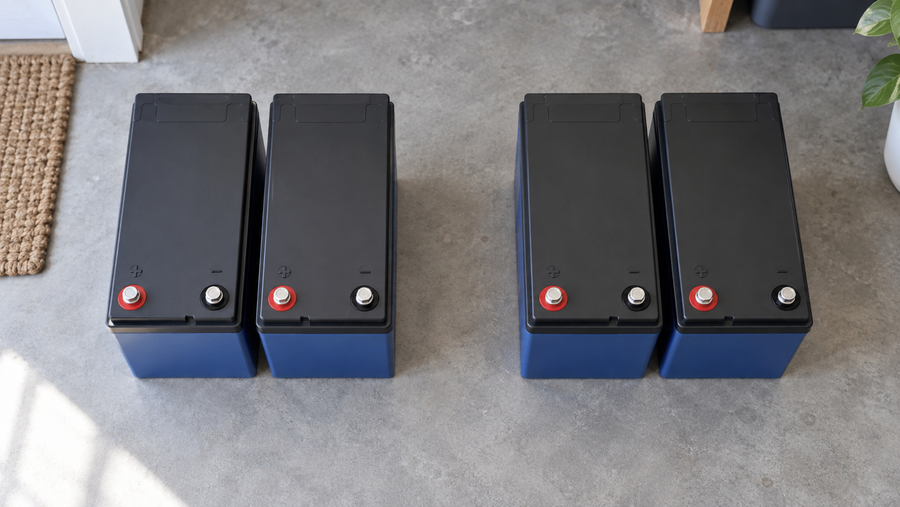

To choose a 12V battery for a solar system, first confirm that the inverter, charge controller, and loads support 12V operation. Then calculate daily energy use and divide it by the battery’s usable-energy fraction; if the resulting capacity and the battery’s continuous output rating both cover your demand, the battery can fit the system.
Match the battery to the system voltage
A 12V battery is the right starting point only when the solar system is built around 12V equipment. Check the nominal battery voltage listed for the inverter, charge controller, DC appliances, and any existing batteries. Do not connect a 12V battery to a 24V-only system to make up the difference.
For a system with 12V lights, communications equipment, a refrigerator, or occasional inverter use, 12V keeps the wiring and component choices simple. If the inverter is designed for 24V or 48V, use the matching battery bank instead. A higher-voltage system can also be more practical when the inverter must deliver substantial power, because the same power requires less current at a higher voltage.
Choose capacity from your actual loads

Battery capacity is usually shown in amp-hours, but your loads are easier to compare in watt-hours. Use this calculation:
Required battery energy = daily load in watt-hours x days of autonomy / usable-energy fraction
This is a planning calculation, not a guarantee of runtime. Include inverter losses and leave the usable-energy fraction at the value supported by the battery maker. For an illustrative example, assume 600Wh of daily loads, one day of backup, and 90% usable energy:
600Wh / 0.90 = about 667Wh
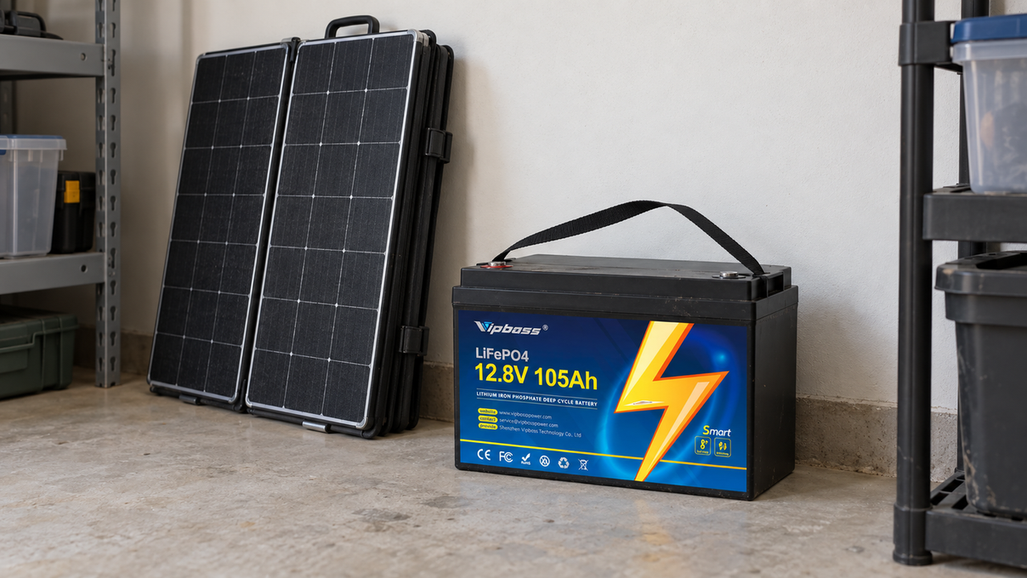
A 12.8V 105Ah LiFePO4 battery has about 1,344Wh of nominal energy before system losses, so it has enough nominal energy for that example provided its output rating, charging equipment, usable-energy rating, and operating temperature also fit the system. If your loads total 1,200Wh per day, or you need two days of backup, one 12V 105Ah battery is unlikely to provide enough usable energy. Choose more capacity or change the system voltage rather than routinely draining a small battery to its limit.
As a concrete option, the Vipboss 12V 105Ah Bluetooth LiFePO4 battery is rated at 12.8V and 105Ah, or about 1,344Wh of nominal energy, with a 100A BMS. It fits only when that energy and continuous-output rating cover the calculated loads and the inverter and charge controller are compatible. Its supplied low-temperature protection stops charging below 32°F (0°C) and resumes at 41°F (5°C), so confirm that behavior is suitable for the installation before ordering. These are vendor-supplied specifications, not a guarantee of runtime or universal compatibility.
Check peak power before choosing the amp-hour rating
Capacity tells you how long the battery may run a load. The battery management system’s continuous output rating tells you whether it can supply that load at all.
Add the running watts of loads that may operate at the same time, then check the inverter’s surge requirement separately. For example, a 1,000W inverter can draw roughly 78A from a 12.8V battery before accounting for losses. A battery with a 100A continuous BMS may support that operating range, but the inverter, cables, fuses, terminals, and manufacturer limits must also be compatible.
A battery can have enough watt-hours and still be unsuitable for a high-starting-current motor, compressor, or heating appliance. If the inverter shuts down when an appliance starts, the problem may be peak current rather than battery capacity. Use a battery and inverter combination rated for that starting demand.
Pick the chemistry that fits your use
For repeated solar cycling, LiFePO4 is often a practical choice because it is lighter than comparable lead-acid storage and does not require the same routine maintenance. It costs more at purchase, so lead-acid may still make sense for occasional, budget-limited backup use when its charging and usable-capacity limits fit the plan.
Choose LiFePO4 when you want a compact battery for regular cycling or need lower weight. Choose lead-acid only after checking the manufacturer’s limits for usable capacity, ventilation, charging, and installation. Do not compare batteries by amp-hours alone; chemistry, usable energy, cycle expectations, weight, output current, and temperature limits all affect the result.