
Start with the largest current your equipment can draw, then use the cable rating, device requirements, battery protection limits, and applicable installation requirements to narrow the fuse choice. Check the device’s continuous and surge ratings before selecting a suitable fuse; the battery’s amp-hour rating alone does not determine the answer.
Size the fuse from the load and cable

Use the highest continuous load on the circuit as the starting point. If the equipment lists watts instead of amps, divide watts by the system voltage. For example, a 1,000-watt device on a nominal 12-volt system draws about 83 amps before conversion losses and voltage variation:
1,000 W / 12 V = 83 A
Treat that result as a starting point rather than the final fuse value. The final choice must also fit the safe rating of the cable, terminals, disconnect, and other protected parts. A smaller cable can require a smaller fuse even when the battery and load could supply more current. Use the equipment instructions and applicable installation requirements to determine how the continuous load, surge current, cable rating, and available fuse sizes should be reconciled.
Do not use a fuse larger than the cable can safely carry. If the cable is rated for 100 amps and the calculation suggests a 125-amp fuse, the cable rating controls. Choose a suitable fuse at or below the cable’s protection limit, while checking the equipment maker’s requirements for nuisance trips and surge current.
For the supplied Vipboss 12V 105Ah Bluetooth LiFePO4 battery, apply the same load, cable, surge, and protection checks. Do not infer a fuse size from 105Ah capacity or treat a stated 100A BMS figure as the cable or fuse rating; suitability depends on the complete system and its applicable requirements.
Account for inverter and motor startup current
An inverter, pump, compressor, winch, or motor may draw more current briefly than its continuous rating. Identify the device’s stated surge requirement and select a fuse that tolerates the expected startup event without exceeding the cable rating. Do not solve nuisance trips by installing a larger fuse unless every part of the circuit supports it.
For a steady DC load, the continuous-current calculation may be enough. For an inverter, use its input-current specification when available. A 1,000-watt inverter may draw roughly 83 amps at 12 volts under an ideal calculation, but conversion losses and low battery voltage increase the real input current. The fuse and cable therefore need to be checked against the inverter’s instructions, not selected from the wattage calculation alone.
Determine fuse placement, cable protection, and any required interrupt rating from the equipment instructions and applicable installation requirements. Confirm those requirements before energizing the circuit rather than assuming that a general placement rule applies to every installation.
Change the plan for different battery arrangements
For one 12V battery feeding a single load, plan the main fuse from that load, its cable, and its starting surge. Confirm the fuse arrangement and rating against the equipment instructions and applicable installation requirements.
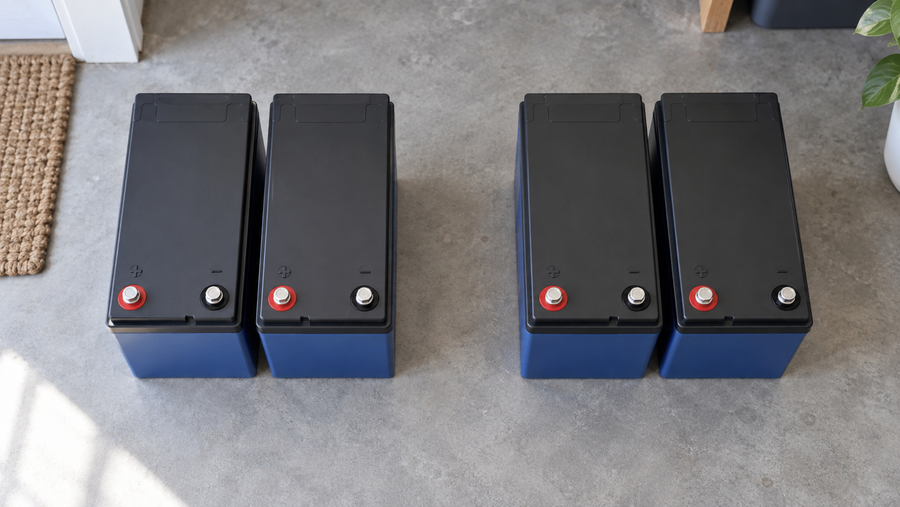
For batteries connected in parallel, assess each battery lead as well as the combined cable and main feed. The protection arrangement must account for the cable and current expected in each part of the system; follow the battery and system manufacturer’s connection instructions.
For a 12V battery with a stated 100A BMS figure, treat that figure as a system boundary to verify, not as an automatic fuse recommendation or a maximum cable rating. A fuse that is too large for the cable is unsafe, while a fuse that is too small for the intended load may open repeatedly. Confirm the BMS behavior, device requirements, cable rating, and applicable installation requirements before finalizing the value.
Before energizing the circuit, confirm that the selected fuse, cable, connected load, and installation arrangement are compatible. If the load, cable gauge, cable length, or surge rating is unknown, pause the installation and obtain those values before selecting a fuse.