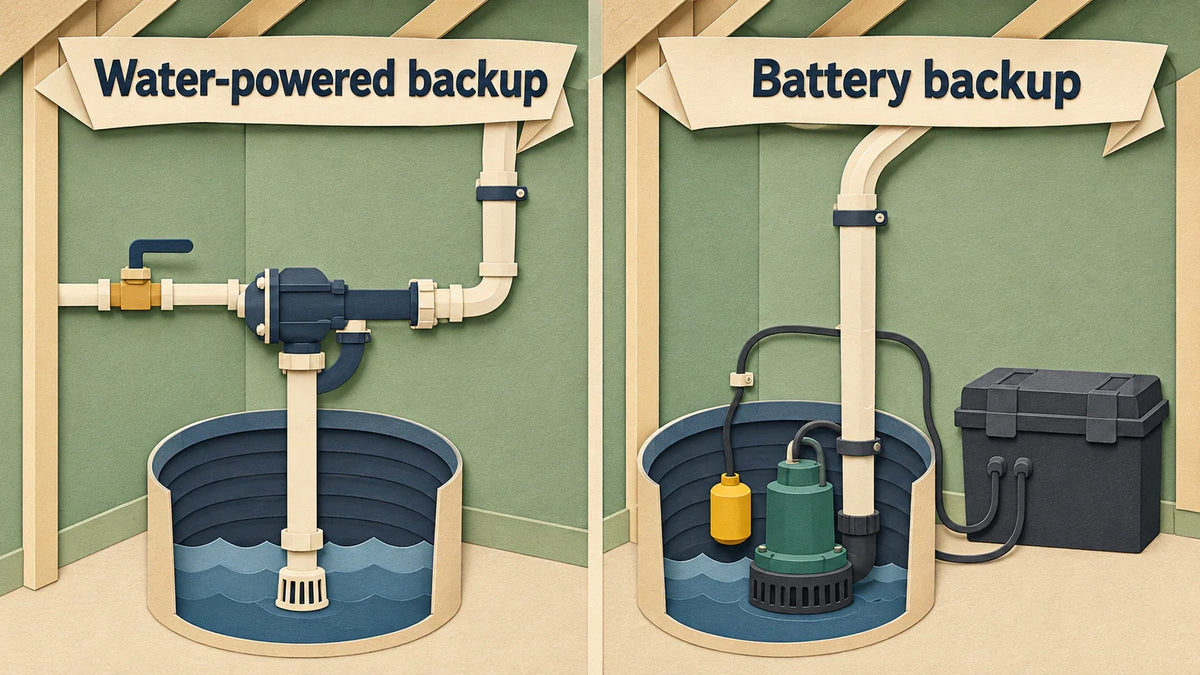

Neither type is universally better. Choose based on which resource is dependable during an outage and whether the proposed pump can handle water entering your sump and discharge it through your home's available route. A water-powered backup needs a suitable pressurized water supply; a battery backup needs enough stored energy for the pumping demand and expected outage.
Start with what remains available during an outage

A water-powered backup uses pressurized water to operate, so its usefulness depends on a sustainable supply with adequate pressure. The sump-systems association's comparison cautions against relying on this type in homes served by private well pumps. Check whether the water source you would rely on remains available when power fails; if it does not, this backup's main operating dependency may fail at the same time as the primary pump.
A battery backup instead draws on stored electrical energy. That avoids dependence on pressurized water, but its protection is limited by the battery and how often and how long the pump must run. Consider the outages your home needs to cover: a system that meets a short interruption may not meet a longer one if water keeps entering the sump and the pump cycles frequently.
Match pump capacity to the water and discharge conditions

Compare the proposed backup's pumping capacity at the lift or discharge head in your home with the amount of water entering the sump. Head is the vertical lift and resistance the pump must overcome to move water to its discharge point. A pump's capacity at a low head may not describe its capacity in your installation: the association notes that performance depends on discharge head and, for water-powered systems, incoming water pressure. One manufacturer's manual likewise shows declining flow as head rises in its specified model; that example illustrates why to use the selected system's performance information at the relevant head, not a generic flow figure.
Also consider whether the available discharge route can carry the pumped water away. If the route cannot handle the flow or is otherwise unsuitable for the proposed system, its rated capacity will not by itself solve the home's drainage need. No single capacity threshold applies to every sump; the relevant comparison is between the system's capacity under the home's conditions and the inflow it needs to manage.
Compare operating demands and readiness
Water-powered systems consume water while pumping, and their performance depends on water pressure as well as discharge head. The amount used varies by system, so treat water consumption as a tradeoff to compare in the proposed unit's specifications rather than assume a universal figure. If the needed supply is unreliable or the home's discharge arrangement cannot accommodate the system, this option is a weaker fit.
Battery systems have finite stored energy. Their actual operating duration depends on the selected battery and pumping demand; intermittent pumping and frequent pumping place different demands on that stored energy. For a battery unit, compare the system's stated battery, charging, runtime, and maintenance requirements with the outage duration you need to cover and the expected pump demand. If those requirements cannot be met, the battery option may not provide the duration you need. For a separate look at battery types and sizing, see this guide to batteries for sump-pump backup.
Make the choice
Choose a water-powered backup when a dependable pressurized supply is available during outages, its pressure and discharge conditions suit the proposed system, and water use fits your needs. A private-well supply is a reason to be cautious about relying on this type.
Choose a battery backup when stored electrical energy better fits the home's outage conditions and the selected system's capacity and battery requirements match the sump's inflow, discharge head, and likely pumping duration. If neither option meets those conditions, neither is a sound fit as proposed. In either case, compare the specific system's performance under your home's conditions; the backup type alone does not guarantee protection.
The association describes battery-backed pumps as operating intermittently as water rises, with protection duration dependent on battery and pumping demand. A particular manufacturer's manual also lists lower flow at greater discharge heads for its model. Those distinctions reinforce the same choice: assess the actual conditions the backup must handle, not just whether it runs on water or a battery.
FAQs
Why does a sump pump’s discharge head matter when comparing backup systems?
Discharge head is the lift and resistance the pump must overcome, and pump capacity can change as head increases. Compare the proposed system’s capacity at the head in your home with the amount of water entering the sump.
When is a water-powered backup sump pump a poor fit for a home with a private well?
The association cautions against relying on a water-powered backup in homes served by private well pumps because the backup requires a sustainable pressurized water supply during an outage.
What determines how long a battery backup sump pump can run during an outage?
Its protection duration depends on the battery and the pumping demand. Compare the system’s stated runtime and charging requirements with the outage duration and pumping needs you expect.