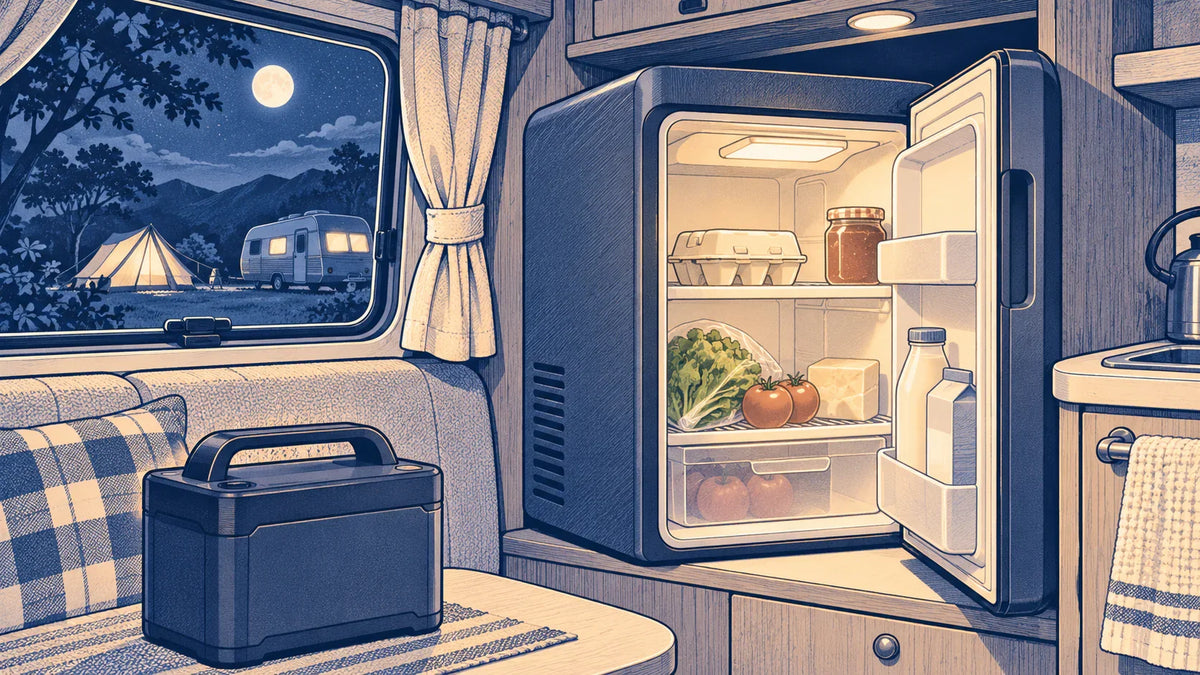

For a night that uses 600 Wh from the battery, you need at least 600 Wh of usable battery energy—about 50 Ah at 12 V. For example, a fridge using 400 Wh plus 200 Wh of other overnight loads totals 600 Wh. If that 400 Wh is measured at an AC outlet and supplied through a 90%-efficient inverter, the requirement rises to about 644 Wh, or 54 Ah at 12 V, before separate inverter idle use.
Those are assumed examples, not typical fridge consumption. The practical rule is simple: calculate your overnight battery-side Wh, then choose a battery whose documented usable energy exceeds that total. A nominal Ah label alone does not tell you how much energy will reach the loads.
Find the fridge's overnight energy use
Check the fridge's power mode and use its documented or measured consumption for the hours you plan to run it. A 12 V DC compressor fridge draws directly from the DC system. An AC fridge needs an inverter when shore power is unavailable. A propane absorption fridge may still use electricity for controls or other functions; include only the electrical demand documented for your model and mode.
Use overnight watt-hours (Wh), rather than assuming a cycling fridge draws its running watts continuously. If a load really is continuous, watts × hours = Wh: 50 W for 8 hours is 400 Wh. For a cycling fridge, measure a representative night or use applicable energy-use data instead of guessing its duty cycle.
Convert fridge use to battery-side energy

For a direct DC fridge, use its DC-side Wh. For a fridge measured at an AC outlet, calculate:
Fridge battery Wh ≈ AC fridge Wh ÷ inverter efficiency
Use the efficiency applicable to your inverter and load. Add separate idle or standby energy only when it is not already included in the measurement; do not count the same loss twice.
Add the loads sharing the battery
Add lights, fans and any other devices that will draw from the same battery during the planned hours:
Total overnight battery Wh = fridge battery Wh + other battery-side load Wh
Convert to approximate usable amp-hours with total Wh ÷ system volts. Use the voltage appropriate to your system; the 12 V figures here are example assumptions.
Compare the estimate with usable battery energy

The example gives two straightforward targets:
- Direct DC: 400 Wh fridge + 200 Wh other loads = 600 Wh, or 50 Ah at 12 V.
- AC through an inverter at an assumed 90% efficiency: 400 Wh ÷ 0.90 + 200 Wh ≈ 644 Wh, or 54 Ah at 12 V, before separate inverter idle use.
Choose a battery with documented usable energy above the calculated requirement. For the 600 Wh example, a battery can cover the night if it can deliver at least 600 Wh under the applicable conditions and its output can run the loads. Its nominal capacity alone is insufficient: battery discharge limits and system cutoffs can leave part of that capacity unavailable.
If the estimate is close to the available usable energy, refine the measurement or choose more usable capacity rather than planning to exhaust the battery. If demand exceeds it, reduce runtime or other loads, or increase usable battery capacity.
FAQs
Is a 100 Ah battery enough for this example?
It is enough for the 600 Wh direct-DC example if its documented usable energy is at least 600 Wh and its output can run the loads. That does not establish that every 100 Ah battery will run every fridge overnight; use your fridge's actual overnight demand and the battery's usable-energy figure.
How do you estimate battery capacity for a cycling travel-trailer fridge overnight?
Use measured or documented energy over representative overnight hours. Convert an AC-side reading to battery-side Wh, add other overnight loads, then divide by system voltage if you need an Ah figure.