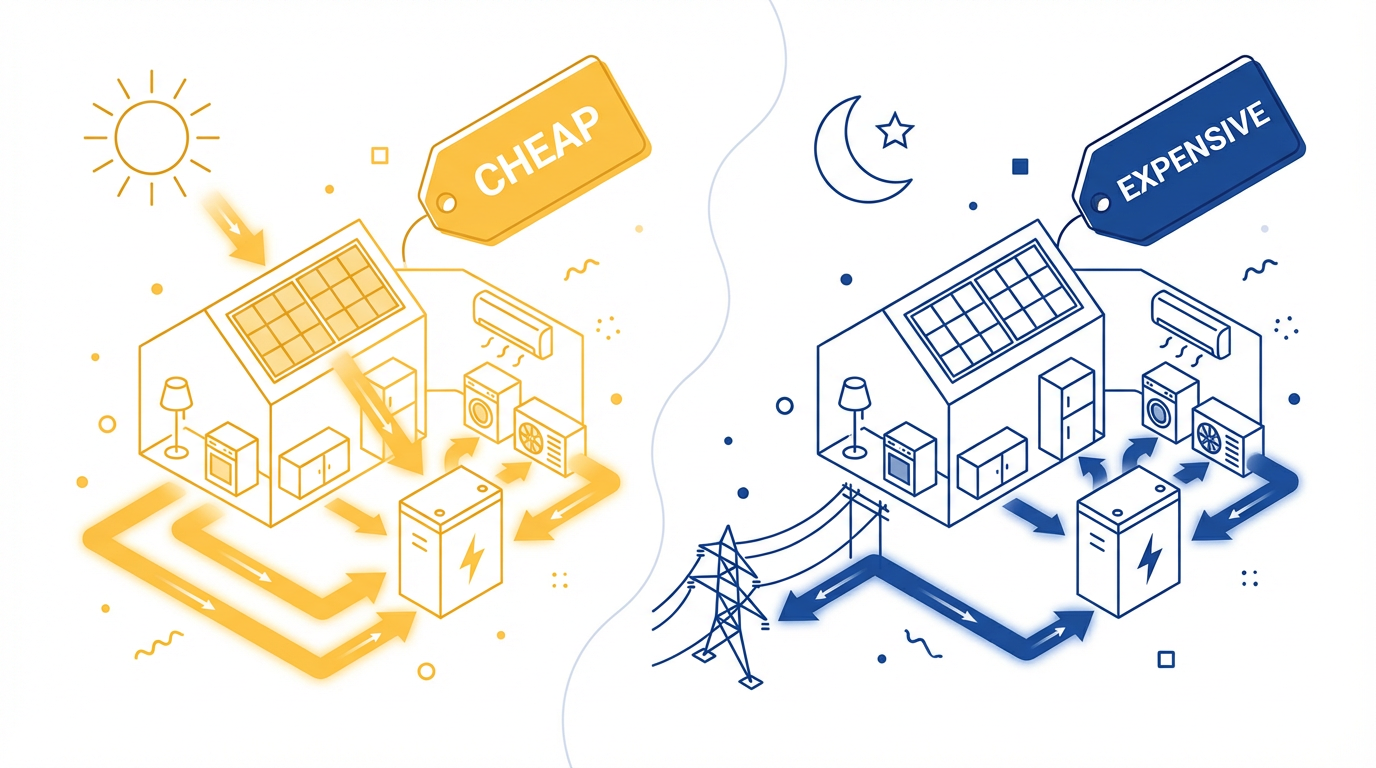

With the right electric rate plan and a smartly programmed home battery, many households can realistically save about $500 per year by buying cheap electricity and using it when prices spike.
Picture the worst summer bill you have had: air conditioner roaring, oven on, laundry going, and the statement that arrives a few weeks later looks more like a car payment than a utility bill. Now imagine keeping those same habits, but letting a quiet box on the wall automatically soak up cheap electricity and feed your home during the most expensive hours, so the bill drops instead of climbing. This guide walks through how that works, when it pays, and the simple math to see if a $500-per-year win is within reach for your home.
What Time-of-Use Arbitrage Really Is
Most utilities now offer time-based electric rates where power is cheaper at some hours and more expensive at others, instead of a single flat price for every kilowatt-hour. These time-of-use plans usually make late afternoon and evening on weekdays the priciest window, often around 4:00–9:00 PM, and keep overnight and early morning hours much cheaper when demand is low and the grid is less stressed. Programs in California and other states are built this way to reward customers who shift when they use energy rather than just how much they use overall, and many offer online tools and smart meter data to help you see the pattern on your own bill. Time-based rates with off-peak discounts are now common across the U.S., and some providers are steadily moving most residential customers onto them.
Time-of-use arbitrage is simply using a home battery to turn that price difference to your advantage. Instead of running your house directly on expensive peak power, you charge the battery when prices are low and then discharge it into your home during the most expensive window. In effect, you are buying low and using high. Utilities and energy providers actively encourage this timing shift because it cuts strain on the grid during the evenings, and several clean energy suppliers emphasize that moving flexible loads into cheaper windows can lower bills without major lifestyle changes. Plans with flexible off-peak windows from about 10:00 PM to 6:00 AM are designed so you can schedule high loads and storage overnight and coast through the evening peaks. Flexible time-of-use plans with cheaper night rates and weekday 4:00–9:00 PM peak pricing examples show how consistent this pattern is.
A home battery turns time-of-use arbitrage into a mostly automatic process. Instead of remembering to run everything at odd hours, your system can be set to charge itself from the grid or from rooftop solar when power is cheapest, then cover a chunk of your home’s late-afternoon and evening demand when prices are highest. Providers that focus on time-based savings highlight batteries as a way to both cut bills and add backup power for outages, and they point out that pairing solar and storage lets you avoid buying premium evening power in the first place while using more clean electricity overall. Home batteries charged off-peak and discharged during peaks are quickly becoming a standard tool for this.

When a Home Battery Can Really Save Around $500 a Year
Whether you can hit something like $500 a year in savings comes down to three levers: how big the price spread is between your cheap and expensive hours, how many kilowatt-hours your battery can shift each day, and how many days per year that pattern repeats.
Many time-of-use plans create a noticeable spread between off-peak and peak prices. In one real electric vehicle rate from a California utility, super off-peak power in the middle of the night costs about $0.09 per kilowatt-hour, while on-peak power from 4:00–9:00 PM costs about $0.53. That is a gap of roughly $0.44 for every kilowatt-hour you can move out of the expensive window and into the cheap one. The same utility’s previous tiered plan charged closer to $0.27 for baseline usage and $0.48 above that, so switching to time-of-use and shifting usage not only changed the timing but actually lowered average cost per kilowatt-hour even after the family added an electric car. This kind of real-world bill data shows how important the spread is: where the gap is small, arbitrage savings will be modest; where the gap looks like that $0.44 difference, it can be significant. Example time-of-use rates with $0.09 super off-peak and $0.53 on-peak prices are a useful benchmark.
The second lever is how many kilowatt-hours the battery can reasonably cover in your peak window. The U.S. Department of Energy notes that a typical household uses around 1,000 kilowatt-hours per month, which works out to roughly 33 kilowatt-hours per day. Not all of that lands in the expensive evening; much of it is spread across the day and night, but things like air conditioning, cooking, hot water, and laundry can stack several kilowatt-hours into that 4:00–9:00 PM band. If your battery can reliably take 3 kilowatt-hours of that five-hour block and shift it from peak to cheap off-peak time, and your price spread looks like the $0.44 example above, the arbitrage math is straightforward: about 3 kilowatt-hours times $0.44 equals $1.32 saved per day. Over 365 days, that is roughly $480 per year, and slightly higher daily coverage can push it toward $500. In markets where peak energy can be around $0.30 per kilowatt-hour and off-peak around $0.15, shifting a larger chunk of evening use can still add up, even though the spread is around $0.15 instead of $0.44. Examples where peak electricity is roughly twice off-peak show how flexible that math can be.
The third lever is consistency. Many utilities keep the core pattern of expensive weekday evenings and cheaper nights and weekends, but they also tweak seasons, mid-peak windows, and holiday rules. Some customers on time-of-use plans who do not actually change when they use power end up paying more, which is exactly what you want to avoid. Providers that focus on behavior shifts under time-based rates stress that success comes from sticking with a routine: charging cars at night, running dishwashers on delay cycles, and letting thermostats do pre-cooling or pre-heating before the expensive window starts. A battery adds power and flexibility, but it still needs the same consistency: a schedule that repeats most days of the year, with seasonal fine-tuning rather than constant manual overrides. Behavior-based time-of-use savings strategies and simple three-step routines for learning your own plan are what turn theoretical savings into real bill reductions.

A Simple $500-Style Example
To see whether a home battery can credibly deliver around $500 a year for you, start with your own numbers. Look at a recent bill or your utility’s online portal and find both your time-of-use schedule and your peak and off-peak prices. You are looking for at least a 0.20 difference per kilowatt-hour, and ideally something closer to the 0.40 range seen in some electric vehicle and evening-focused plans. Then estimate how many kilowatt-hours of your late-afternoon and evening usage a battery could actually cover without running out too early. Even a modest share of that 4:00–9:00 PM window, consistently shifted every day, often closes in on the $500 mark when the rate spread is strong.
A household on a plan with peak rates about 30–40 percent higher than off-peak, for example, might see peak energy at $0.30 and off-peak at $0.18. If a battery lets that family move 6 kilowatt-hours per day from peak into off-peak, the savings are the 6 kilowatt-hours times the $0.12 spread, or $0.72 per day. Over a year that is about $263, which is helpful but not yet $500. In a jurisdiction with a price spread closer to the $0.44 example, the exact same 6 kilowatt-hours delivers roughly $964 per year, so even a smaller shift of 3 kilowatt-hours per day produces about half that, near the $480 level described earlier. Providers that outline how off-peak power can be 20–50 percent cheaper than flat rates and how peak power can be 20–100 percent more expensive make it clear that your local tariff drives this math more than anything else. Guides to time-of-use plans that spell out these spreads and utility examples where peak prices are substantially above off-peak give you realistic ranges to compare against.
How to Set Up Your Battery for Time-of-Use Arbitrage
Once you have a suitable rate and a clear view of your own load pattern, setting up the battery to do the heavy lifting is mostly a one-time job with occasional seasonal tweaks.
The first step is defining your cheap and expensive hours in the battery or energy management app. If your plan has very cheap super off-peak power after midnight, you want the battery to prioritize charging then, either from the grid or from solar if you have a surplus. Energy providers that focus on time-of-use emphasize using delay timers and smart controls to cluster flexible loads in those windows, and your battery should be treated as the biggest flexible load of all. Many controllers let you define a state-of-charge target for the beginning of your peak window, making sure the battery is topped up by, say, 4:00 PM on weekdays. This is the digital equivalent of filling your gas tank when prices are low, knowing you will drive through a high-price zone later that day. Advice that highlights midnight-to-early-morning charging for electric vehicles applies just as well to the battery itself.
Next you define how the battery behaves during the expensive hours. Most modern systems let you set a discharge schedule tied to time-of-use periods, so you can tell it to discharge aggressively from, for example, 4:00–9:00 PM on weekdays and more gently or not at all at other times. The trick is to let the battery carry as much of your natural load in that window as possible without hitting empty too early. Utilities and energy advisors often recommend using thermostats to pre-condition your home before the peak and then letting it coast, which lowers how hard your air conditioner or heater has to work when prices are highest. The same idea applies to arbitrage: pre-cool or pre-heat using cheap energy, then let the battery cover remaining loads while your HVAC runs less. Case studies show that this combination of pre-cooling and night-time charging can actually reduce average cost per kilowatt-hour even when overall consumption goes up because of added devices like electric cars. Detailed examples of pre-cooling and night charging under time-of-use electric vehicle plans are a useful model.

If you have solar, the battery also has to decide whether to charge from the array or the grid at different times. Many solar-plus-storage homes hit a “duck curve” problem where panels produce the most in the middle of the day, but the utility pays relatively little for exported energy then and charges much more for evening imports. Storage flips this: instead of exporting midday surplus at low credit values, you charge the battery and use that power during the expensive evening peak. In some newer export credit structures, particularly in solar-heavy markets, the value of exporting during defined peaks can be several times the off-peak rate, so some homeowners even use batteries to store cheap or solar power and then export it when the price signal is highest. That is still arbitrage; the difference is that the value shows up as bill credits rather than avoided purchases. Discussions of solar-plus-storage under modern net billing that highlight high evening export values reinforce how powerful this timing shift can be.
Finally, pair the battery schedule with a basic load-timing strategy. Running dishwashers, laundry, and car charging overnight or mid-day, while leaving the battery more room to cover things you cannot easily shift like cooking or lighting, stretches its value. Energy efficiency groups and utilities consistently recommend using smart plugs, programmable thermostats, and appliance timers to do this automatically instead of relying on memory. Tips for shifting big appliances and HVAC into off-peak windows and time-of-use guides that emphasize smart plugs, thermostats, and timers fit perfectly alongside a battery-focused arbitrage plan.
Pros and Cons Beyond the Dollar Amount
Time-of-use arbitrage with a home battery delivers more than pure bill savings, but it also comes with tradeoffs you should weigh.
On the plus side, arbitrage makes your battery work for you every single day, not just when the grid goes down. Instead of sitting idle waiting for an outage, it acts like a financial engine that constantly converts cheap kilowatt-hours into avoided expensive ones. That everyday workload can shorten the apparent payback period compared with using storage purely for backup. It also helps the grid and the environment by cutting your demand exactly when the system is under the most stress, which reduces the need for peaker plants that burn costly fossil fuels during high-demand periods. Time-of-use structures were designed to encourage this behavior, and shifting flexible loads into cheaper, cleaner hours is one of the most effective ways to both save money and support a more stable grid. Resources that describe how time-based rates lower peak emphasize this system benefit.
You also gain resilience. A battery sized and configured for arbitrage is still a battery that can keep lights, refrigeration, and critical outlets running during outages. That extra layer of security against blackouts or storms is hard to price but very real, especially as weather extremes become more common. For households already facing high energy burdens, having a tool that reduces peak bills and provides backup power can be especially valuable, though the upfront cost remains a barrier. Regulators and researchers examining how to tackle energy insecurity point out that rate design, including time-of-use pricing, can be paired with targeted discounts and protections such as bill protection periods and lifeline rates to keep vulnerable customers from being harmed when new pricing structures roll out. Work on using rate design and discounts to reduce energy insecurity underscores the need to match technology upgrades with supportive policies.
The downsides start with that upfront cost and complexity. A lithium home battery and compatible inverter are still a major investment, and the arbitrage savings alone rarely justify the purchase on a simple payback basis unless your rates are very favorable and your peak usage is high. Arbitrage should be seen as one pillar of value alongside backup power, solar optimization, and long-term bill protection against rising rates. There is also some operational tradeoff: every additional charge-discharge cycle uses a bit of the battery’s lifetime, so you want installer settings that align with the warranty’s cycle assumptions rather than chasing every tiny price difference. Finally, time-of-use rate structures can change. A plan that is very attractive today could be revised in a few years, reducing the spread that arbitrage depends on. That is another reason to make sure the overall package—bill savings, resilience, and clean energy use—still makes sense even if the raw arbitrage margin narrows.
Common Traps That Keep People From Hitting $500
There are a few patterns that repeatedly hold households back from reaching that $500-per-year territory, even when they have a battery and a time-of-use rate.
One trap is underestimating how much of your usage actually sits in the peak window. If most of your big loads are already running overnight or mid-day, there may simply not be enough evening demand left for the battery to displace. Utility and third-party guides warn that some customers on time-of-use plans see little savings or even higher bills when they do not adjust their schedules, which is why analyzing your existing load profile before making changes is so important. Smart meters and online dashboards that show hourly usage make this much easier, and basic home energy monitors can fill the gap when utility tools are limited. Suggestions to use smart meter data and audits can reveal whether you have enough peak demand to attack with a battery.
Another trap is choosing the wrong rate plan or not fully understanding its details. Some time-of-use structures include mid-peak blocks, seasonal adjustments, or demand charges that bill based on your highest instantaneous load as well as your total kilowatt-hours. Retail energy providers and consumer-focused guides repeatedly caution customers to read the fine print on contract length, seasonal schedules, weekend rules, and base charges before switching, and to carefully watch the first few bills. If your plan has only a small price difference between peak and off-peak hours, or if you are hit with a high fixed fee, the arbitrage opportunity shrinks. Time-of-use plan checklists that stress reading peak windows, spreads, and fees are as relevant to battery owners as they are to anyone else.
A third trap is leaving the battery on “set and forget” factory defaults that do not match your actual time-of-use schedule. Installers sometimes prioritize backup behavior or generic settings over precise arbitrage tuning, especially when the rate structure is complex. Over time, rate changes, new appliances, or a new electric vehicle can all shift your load pattern enough that the original programming is no longer optimal. Energy providers and clean energy advocates consistently recommend revisiting your time-of-use strategy at least once or twice a year, especially as seasons and usage patterns change. Aligning your battery’s charge and discharge windows with your current rate schedule, and coordinating them with your appliance timers and thermostat schedules, can be worth hundreds of dollars per year. Practical advice to monitor, review, and adjust time-of-use habits regularly applies just as much to your battery as to your dishwasher.

Quick FAQ
Do you need rooftop solar for time-of-use arbitrage with a battery?
No. A home battery can arbitrage purely between off-peak and peak grid power by charging when electricity is cheap and discharging when it is expensive. Solar makes that arbitrage more powerful by letting you store your own midday production instead of exporting it at low credit values, then use or even export it during high-priced evening hours, but the core buy-low-use-high strategy works either way. Many utilities describe time-based rates as especially beneficial for electric vehicle owners and night-time chargers even without solar, and the same logic applies to a battery that charges at night. Time-based rates that highlight off-peak overnight charging for electric vehicles and examples of low super off-peak prices paired with high on-peak prices show why.
Is a home battery worth it if your peak and off-peak prices are close together?
Probably not for arbitrage alone. If your peak price is only slightly above your off-peak price, the amount you save per kilowatt-hour shifted will be small, and even a big battery will not move the needle much. Consumer guides note that off-peak rates are often 20–50 percent cheaper than standard prices and that peak rates can be 20–100 percent higher; arbitrage becomes interesting when your plan sits closer to the high end of those spreads. If your spread is modest, time-of-use still rewards shifting habits and using smart controls, but it may not justify the extra cost of storage. In that case, focus first on efficiency, smart thermostats, and appliance timing, then revisit storage if your utility introduces more dynamic or sharply tiered rates. Overviews of how spread size drives savings on time-of-use plans help frame that decision.
A home battery tuned for time-of-use arbitrage is one of the sharpest tools available for cutting evening power costs, especially when paired with solar, smart thermostats, and a clear-eyed look at your own usage. Get your rate plan, your battery schedule, and your big loads working together, and that $500-per-year target shifts from a marketing promise to a realistic, measurable upgrade in how your home buys and uses electricity.