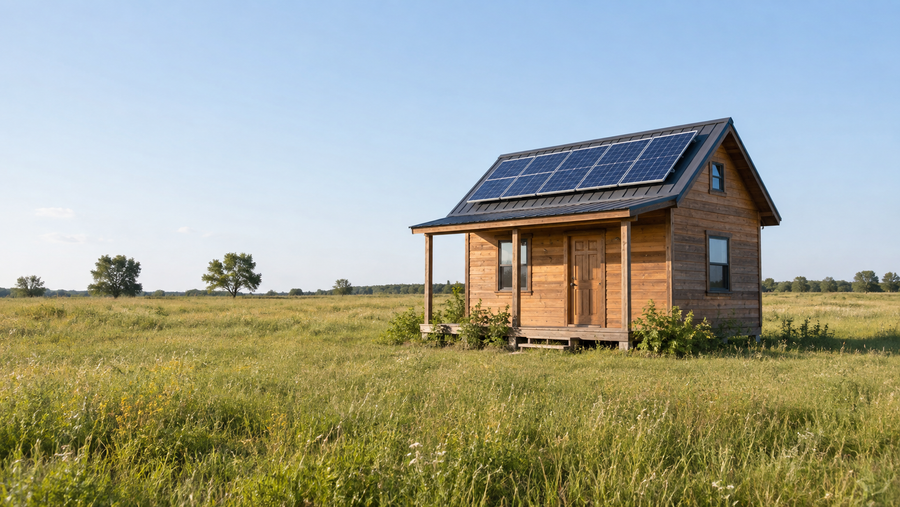

For a quick estimate, divide the battery bank's watt-hours by your usable peak-sun hours and then divide again by an assumed system efficiency. For example, a 1,344 Wh battery charged during five usable sun hours at 80% efficiency needs about 336 watts of solar, so a 350 W array is the nearest practical starting point. Use your local sunlight conditions and the battery and charge-controller manuals before choosing the final panel combination.
Start with the battery bank's watt-hours
Convert the bank to watt-hours before choosing panels:
Battery watt-hours = nominal volts x amp-hours
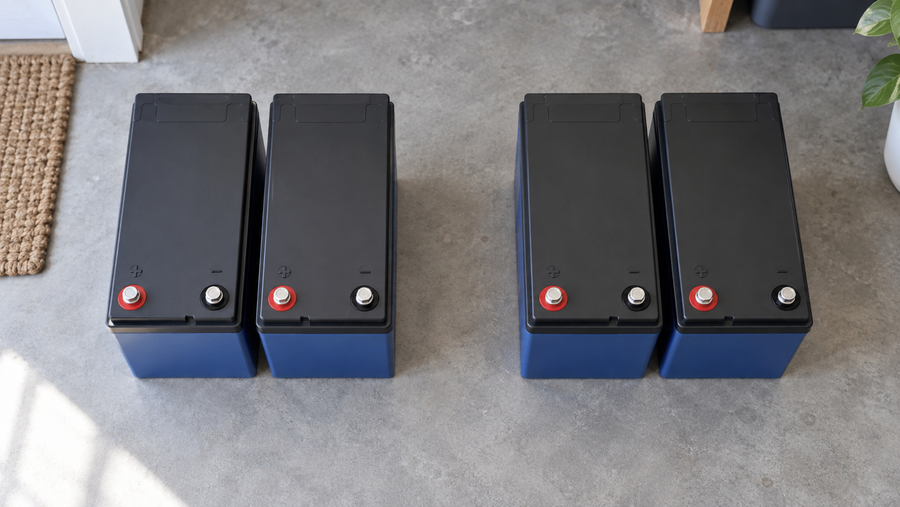
A single 12 V, 105 Ah battery has a nominal capacity of about 1,260 Wh using that simple calculation. The Vipboss 12V 105Ah Bluetooth LiFePO4 battery is listed at 1,344 Wh, so use 1,344 Wh when sizing that specific battery rather than replacing it with a generic estimate. A bank with two identical batteries in parallel has approximately twice the energy; a series connection raises voltage while the total watt-hours still add together.
If you are sizing for daily use rather than a full recharge from empty, use the energy you actually need to replace. Include the day's loads, inverter losses, and charging losses. Solar sizing should account for available solar resource, daily energy needs, system derating, and panel efficiency, as outlined in this solar sizing guide from New Mexico State University.
Use the sunlight available at your location

The number of panels depends on usable peak-sun hours, not simply the number of daylight hours. A shaded, cloudy, winter, or poorly aimed array produces less energy than its nameplate rating suggests.
Use a conservative value for the season in which the battery must reliably recharge. If you do not have a location-specific value yet, calculate several cases instead of treating five hours as universal:
- At four usable sun hours, a 1,344 Wh bank with 80% efficiency needs
1,344 / (4 x 0.8) = 420 W. - At five usable sun hours, it needs
1,344 / (5 x 0.8) = 336 W. - At six usable sun hours, it needs
1,344 / (6 x 0.8) = 280 W.
These are transparent estimates, not a guarantee of daily output. The 80% figure is an illustrative planning assumption for panel, wiring, controller, temperature, and charging losses. Replace it with the losses or design factor specified for your system when those values are known.
Convert watts into a panel choice

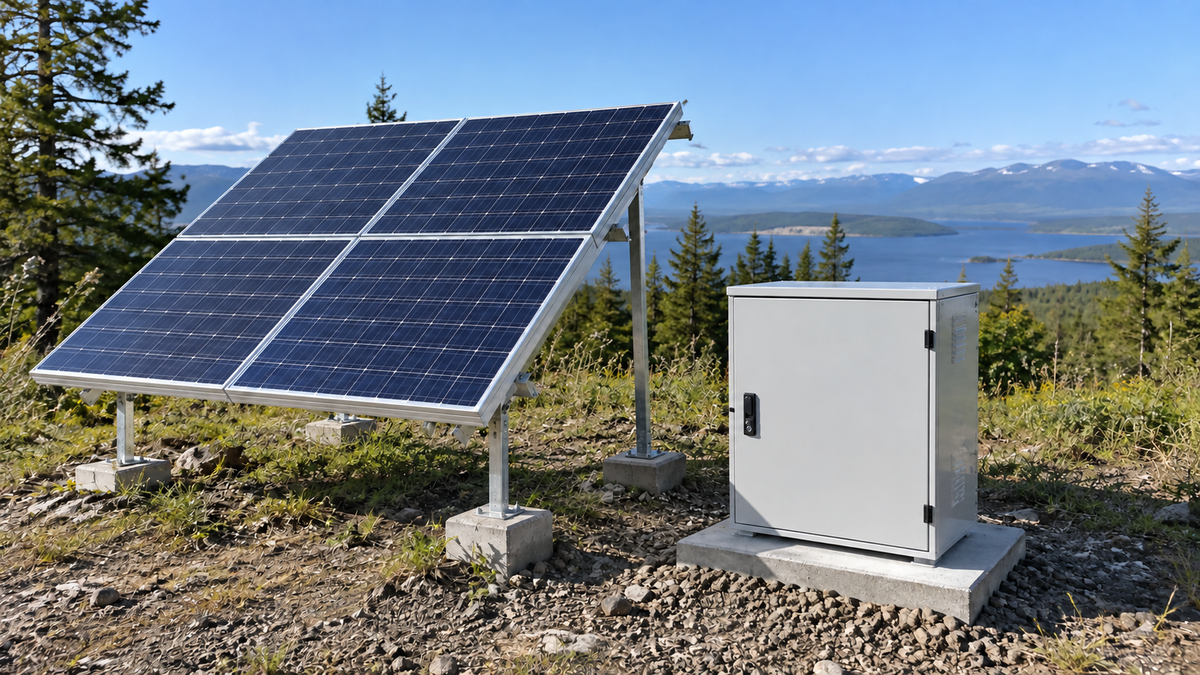
After calculating the required array wattage, choose a practical combination whose total nameplate rating meets or slightly exceeds it. For the five-hour example, one 400 W array provides a modest margin over the calculated 336 W requirement. Four 100 W panels would provide the same nominal array size, subject to the panels' electrical specifications and the controller's input limits.
The result changes when the battery bank, sunlight, or charging conditions change. Increasing the battery capacity increases the energy that must be replaced and the required array wattage by the same proportion. If the array must recharge after a cloudy day, size for the energy deficit that must be recovered, not only for one average day's use.
Before wiring the array, check the applicable battery and controller manuals for their stated voltage, current, temperature, and configuration limits.
Apply the calculation to the supplied 12 V battery
For the supplied Vipboss 12V 105Ah Bluetooth LiFePO4 battery, the listed storage figure is 1,344 Wh. Using the illustrative five-sun-hour and 80%-efficiency assumptions gives this result:
1,344 Wh / (5 hours x 0.8) = 336 W
A roughly 350 W array is therefore the calculated minimum for that example, while a 400 W array gives more allowance for ordinary losses. That recommendation applies only to the stated battery capacity and assumptions. Confirm the final array and controller settings against the battery documentation, especially if you connect multiple batteries or expect charging in cold conditions. For this battery, charging stops below 32°F (0°C) and resumes at 41°F (5°C), so an array cannot recharge it while that protection condition prevents charging.