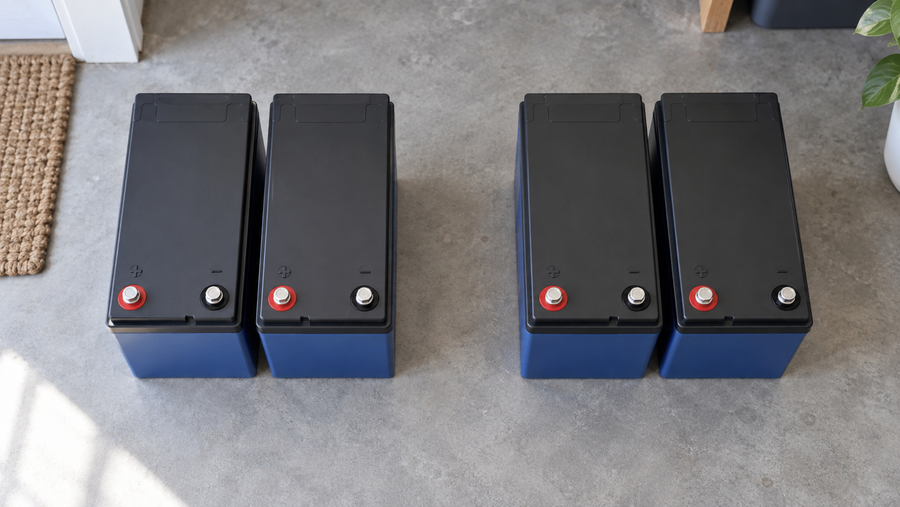

A 100Ah lithium battery can run a trolling motor for about 5 hours at a steady 20A draw, before other loads and operating conditions are included. To estimate your own runtime, divide the battery's usable amp-hours by the motor's average current draw; add lights, a fish finder, or pumps to that draw before dividing. Higher speed, wind, waves, current, cold temperatures, and battery limits can shorten the result.
Use the battery's usable capacity and total current draw
The basic calculation is:
Runtime in hours = usable battery capacity in amp-hours / total current draw in amps
For a 100Ah battery powering a motor that draws 20A continuously:
100Ah / 20A = 5 hours
That is an illustrative estimate, not a guarantee. Use the usable capacity allowed by the battery maker rather than assuming every battery can deliver its full label rating in every condition. Total current draw includes the trolling motor and anything else connected to the same battery.
If your motor's manual gives watts instead of amps, convert the load using amps = watts / volts. Use the motor system's actual voltage for that calculation.
Recalculate when the motor or other loads change
Your result changes as the motor's average draw changes. A motor drawing 10A would produce a 10-hour mathematical estimate from 100Ah. A 40A draw would produce 2.5 hours. These examples assume a steady draw and are illustrative; actual motor demand varies with speed and load.
Accessories reduce runtime because they increase the total current draw. For example, an illustrative setup with a 20A motor, 5A of lighting, and a 2A fish finder draws 27A in total:
100Ah / (20A + 5A + 2A) = 3.7 hours
That is about 3 hours and 42 minutes at that continuous combined draw. Replace the example currents with the readings or specifications for your own equipment.
For a short trip with slow maneuvering, use the motor's average draw during that type of use, not its maximum draw. For strong wind, current, waves, a heavy boat, or extended high-speed operation, use a higher average draw or leave more reserve. A maximum-current figure is useful for checking battery and wiring limits, but it may overstate the energy used during ordinary intermittent operation.
Check voltage and product fit before relying on the estimate

Before installation, use the motor, battery, charger, and applicable installation manuals to check the system voltage, permitted current, charging requirements, connections, and installation conditions. Apply the runtime estimate only after those requirements match the equipment being considered.
The Vipboss 12V 105Ah Bluetooth LiFePO4 Lithium Battery is a near-100Ah example rather than an exact 100Ah battery. The battery stores 1,344Wh of energy, includes Bluetooth monitoring, and has a built-in 100A BMS. These specifications do not prove a particular runtime or compatibility with every trolling motor. Check the motor voltage, expected current, charger, and installation requirements first. The battery's stated low-temperature charging protection also matters if it will be charged in cold conditions.