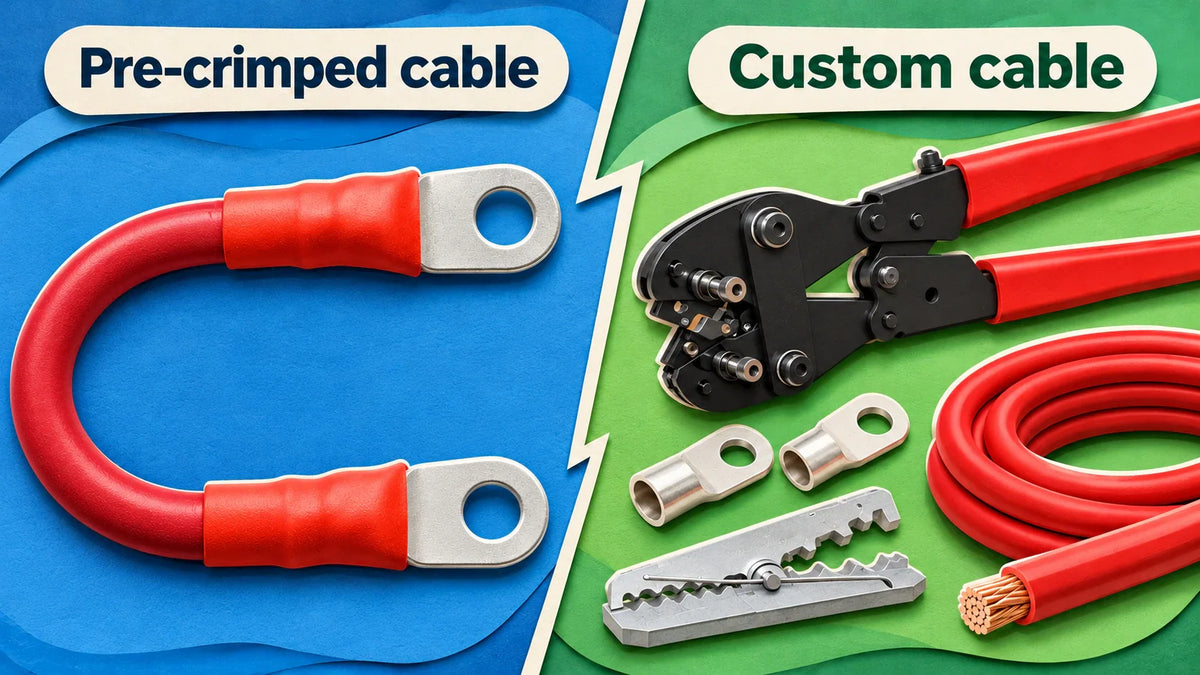

Buy a documented pre-crimped battery cable when its stated characteristics match your project and its termination quality is supported by useful evidence. Make one when a genuine custom-fit need exists and you have a suitable cable, lug, tool, and die combination plus a way to assess the finished connection. If either route leaves a decisive fit or quality question unanswered, resolve that question before choosing.
Compare the cable with the project
Start with the requirements already established for the intended connection: conductor size and length, the lug interface and stud size, routing and clearance, and any applicable electrical or environmental requirements. Compare those requirements with the finished cable's documentation, not just its product name or a photograph. A cable is a fit only when its documented assembly characteristics match the project's needs.

A required length or end interface that is unavailable in a suitable finished assembly can make a custom cable useful. But customization is a reason to consider making one, not evidence that the result will be sound. If a ready-made option meets the requirements, making a cable adds the need to source and assess a compatible termination system.
Weigh documentation and inspection
Separate three kinds of evidence. Assembly specifications identify what the cable and terminals are and describe their relevant dimensions or ratings. Process or test evidence can show whether a termination was made or assessed against applicable requirements and conditions. Visual inspection can reveal visible workmanship problems, but cannot establish the quality of a hidden crimp by itself.

General crimp-quality guidance identifies warning signs such as a twisted or damaged terminal, a distorted or asymmetrical barrel, cracks or excessive flash, and conductor strands or insulation in the wrong part of the crimp. These are examples, not an exhaustive battery-cable acceptance standard; the applicable product and application requirements govern. A clean-looking exterior is useful to inspect, but it does not prove that the cable, terminal, and crimp are compatible or that the connection meets its requirements. Use general crimp inspection guidance as a visual aid, alongside relevant assembly documentation.
For a cable you make, merely owning a crimper is not enough. The cable, terminal, tool, and die need to form a combination supported by applicable guidance. You also need a meaningful way to assess the resulting termination against the relevant specification or test conditions. The IEC description of crimp-connection testing explains that applicable methods assess specified crimped connections under defined mechanical, electrical, and environmental conditions and can compare results made with differently designed tools. That is a bounded point about those test methods, not a certification of arbitrary battery cables or tool combinations.
Make the choice
| Route | Choose it when | What must be demonstrated |
|---|---|---|
| Buy a pre-crimped cable | A finished assembly meets the required length, size, interface, routing, and applicable ratings | Its documented assembly characteristics fit the project and its termination evidence is adequate |
| Make a custom cable | A genuine custom-fit need exists and the cable, lug, tool, and die form a documented combination | The finished termination can be assessed against applicable criteria |
| Hold the decision | A decisive fit, rating, compatibility, or quality requirement is unknown | Resolve the missing requirement; appearance or tool ownership cannot substitute for it |
Buying a suitable finished cable avoids assembling and assessing a termination system yourself. A custom length alone is not evidence that a handmade termination is sound.
FAQs
What should you compare before buying a pre-crimped battery cable?
Compare the required conductor size and length, lug and stud interface, routing clearance, and applicable electrical or environmental requirements with the finished cable's documentation. Buy it only when its documented characteristics fit the project and its assembly evidence supports judging the termination.
Is a clean-looking crimp enough to establish that a battery cable is suitable?
No. Visual inspection can reveal visible workmanship problems, but it cannot establish hidden crimp quality or prove that the cable, lug, and crimp meet the project's requirements.
What do you need before choosing to make a custom battery cable?
The cable, lug, tool, and die need to form a system supported by applicable guidance, and you need a way to assess the finished termination against relevant criteria. A custom length alone, or simply owning a crimper, does not establish that the connection will be sound.