There is no universal balancing-current requirement for a series battery bank. If a measured charge mismatch and the available active balancing time are known, divide the mismatch in amp-hours by the active hours to estimate the effective corrective current needed. Then select a compatible device whose actual corrective current under those conditions can meet that estimate. If only terminal-voltage difference is known, you cannot calculate the required amperes from it alone. Ongoing imbalance must be assessed separately.
Match the current rating to the task
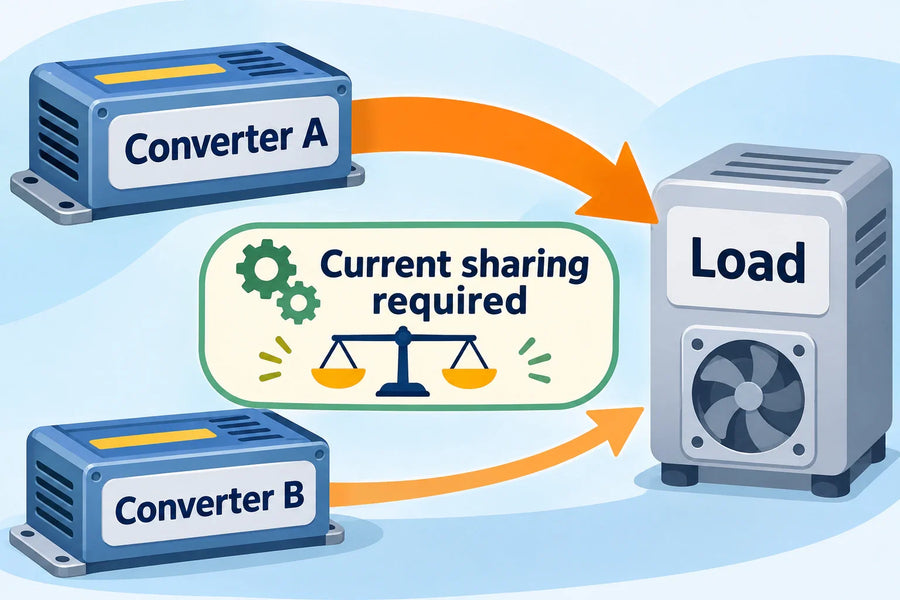
An external balancer works across finished batteries in a series string; cell-level balancing inside a battery’s BMS acts among cells within that battery. Their current ratings describe different balancing jobs, so a BMS cell-balancing figure does not by itself tell you whether an external device can balance finished batteries.
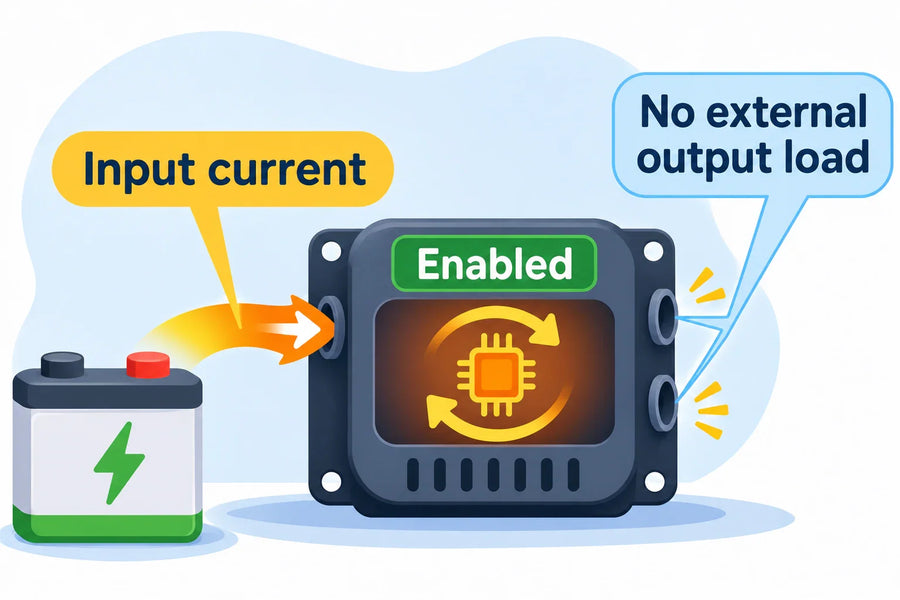
Read the external device’s documentation for its mechanism, what imbalance it acts on, and the conditions under which it operates. A rating may be a maximum reached only under specified conditions, not a continuous current available throughout the correction period. For example, one documented design transfers charge from the higher-voltage battery to create a current difference between two series-connected batteries; its stated maximum applies only under specified voltage-deviation conditions. Treat that as an example of why a rating needs its operating context, not as a general method or setting for other banks.
Calculate the current needed for a known initial correction

If the charge mismatch is known in amp-hours (Ah) and you have a target number of active balancing hours, estimate the minimum effective corrective current as:
Required effective corrective current (A) = charge mismatch (Ah) ÷ available active balancing time (hours)
For instance, correcting a known 2 Ah mismatch within four active hours calls for an average effective corrective current of at least 0.5 A: 2 Ah ÷ 4 h = 0.5 A. This is a sizing estimate, not a device performance guarantee. It assumes the current represents charge actually corrected in the needed direction across that interval. Losses, changing current and activation conditions can make a higher documented capacity or more time necessary.
If a device is active for only part of the available calendar time, calculate active hours first:
Available active hours = elapsed hours × fraction of time balancing is active
For example, an eight-hour window with balancing active half the time supplies four active hours; the same known 2 Ah mismatch still requires about 0.5 A effective corrective current. An uncertain active fraction makes the estimate uncertain. Use the device’s documented activation conditions to judge when current is available; do not treat a maximum rating as continuous effective current.
If you already know a device's effective corrective current, reverse the equation: estimated active hours = known mismatch (Ah) ÷ effective corrective current (A). A 0.5 A effective current would take about four active hours for the same 2 Ah example, subject to the assumptions above.
A terminal-voltage difference alone does not provide the charge mismatch in Ah. Without that mismatch and an applicable effective-current figure, this time estimate cannot be calculated from voltage readings alone.
Assess maintenance separately
Initial correction addresses a known mismatch; maintenance must keep up with whatever imbalance continues to develop. If that ongoing mismatch can be measured as Ah gained per operating cycle, divide it by the active balancing hours available in that cycle to estimate the average effective maintenance current needed. For example, 0.2 Ah of recurring mismatch with two active hours calls for about 0.1 A of effective correction during those hours. If the recurring mismatch is unknown, no defensible maintenance-current figure follows from voltage spread alone. A current adequate for one initial correction does not establish that maintenance will keep pace.
For background on how series and parallel connections affect bank voltage and capacity, see this series-or-parallel guide.
FAQs
How do you calculate the balancing current needed for a known mismatch?
Divide the known mismatch in amp-hours by the active balancing hours available. A 2 Ah mismatch to be corrected in four active hours requires about 0.5 A of average effective corrective current, assuming the current continues to correct charge in the needed direction.
How does limited balancing time affect the current you need?
Multiply available elapsed hours by the fraction of time the balancer can actually operate, then divide the known Ah mismatch by those active hours. Fewer active hours require more effective corrective current for the same correction deadline.
Why does a terminal-voltage difference alone not determine the balancing time?
The current estimate requires a charge mismatch in amp-hours and the active time available. A terminal-voltage difference alone does not provide the Ah mismatch, so it cannot determine a required current by itself.
Why can a current adequate for initial correction be insufficient for maintenance?
Initial correction addresses a known mismatch, while maintenance must keep pace with imbalance that continues to develop. If recurring imbalance can be measured in Ah per cycle, divide it by active balancing hours per cycle to estimate the effective maintenance current needed; otherwise, no numeric requirement is established.