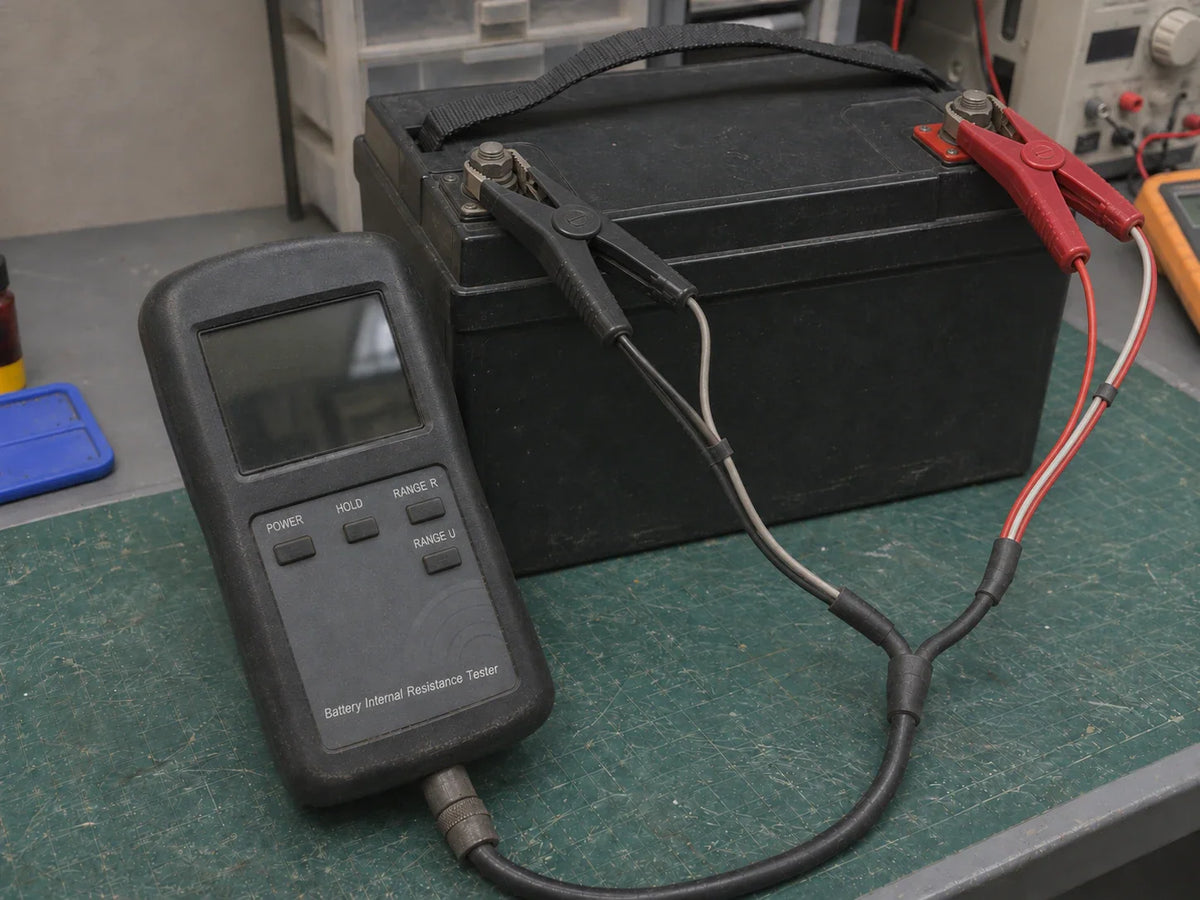

Use a battery impedance tester, also called a battery tester, for a direct AC resistance-related measurement of a LiFePO4 battery. Choose a tester whose documented battery-measurement method matches what you want to measure. An ordinary multimeter can check voltage, but an ordinary resistance meter or LCR meter is not a substitute for battery measurement.
Choose a battery-capable tester
Check the instrument's documented function: it must explicitly support measuring batteries, and its method must fit the reading you need. Battery testers typically measure battery voltage as well as impedance. A meter displaying ohms alone does not establish that it can measure a battery.

For shipping and acceptance inspection, 1 kHz is a typical AC impedance measurement frequency, with the resistive component displayed as effective resistance. This is a specific inspection practice, not a universal frequency requirement for every LiFePO4 battery or tester, as explained in this technical overview of battery impedance measurement.
AC impedance and DC resistance are different tests
AC-method readings are commonly called AC internal resistance, or AC-IR. DC resistance testing instead calculates resistance from changes in current and voltage; these readings are called DC-IR. Because the methods differ, their readings are method-specific: do not assume the numbers are interchangeable or compare them as though they came from the same test.
When comparing readings, keep the measurement method consistent. If you need an AC-IR reading, use a battery-capable impedance tester and follow its documented method. Interpret a DC test as DC-IR, not as an AC tester reading. A single resistance value does not, by itself, provide a universal pass/fail threshold for a LiFePO4 battery.
FAQs
Does a LiFePO4 battery impedance tester need to use 1 kHz?
No single frequency is stated as a universal requirement for every LiFePO4 battery or tester. A 1 kHz measurement is typical for shipping and acceptance inspection, so choose a tester method suited to your intended measurement.
Can you compare AC-IR and DC-IR readings as the same measurement?
No. AC-IR and DC-IR come from different measurement methods, so compare readings using the same method rather than treating the numbers as interchangeable.