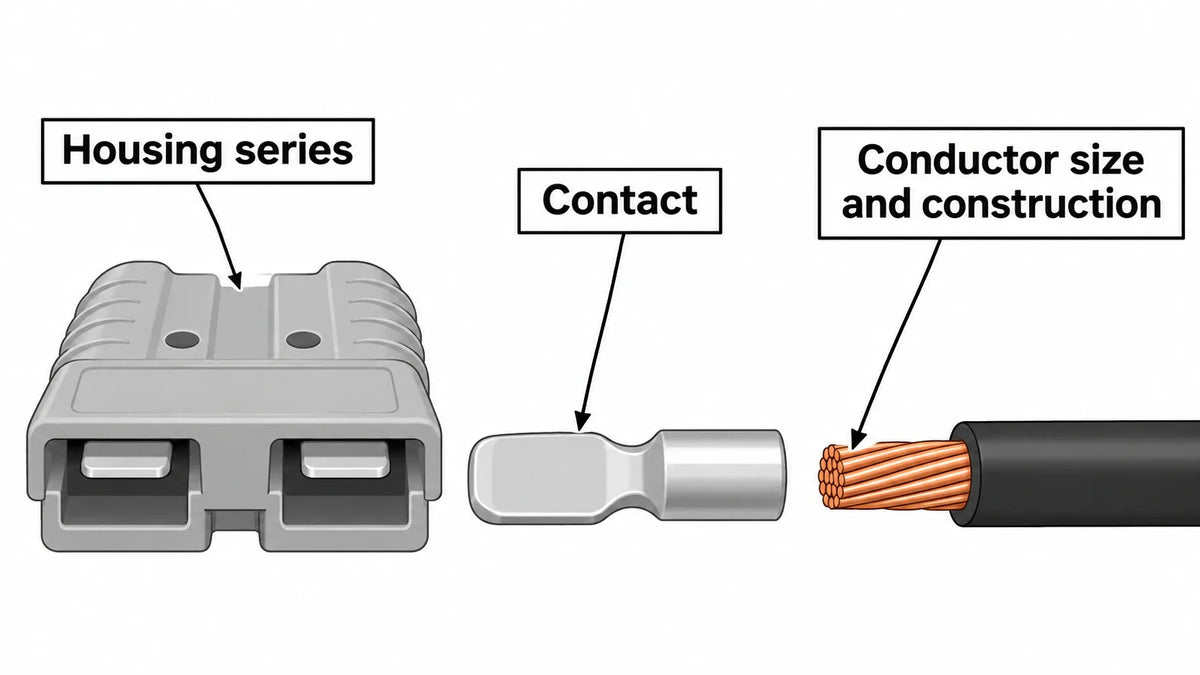

Match an Anderson contact to a battery cable by first identifying the housing’s exact series, then checking that the contact is documented for that series and for the cable’s conductor size and construction. These are separate requirements: a contact can match the housing but not the conductor, or the conductor but not the housing.
Confirm the housing series
Read the series marking on the housing or identify it from the housing’s documentation. Then check the candidate contact’s documentation for that exact series. A similar shape or a shared product family name does not establish that a contact is compatible with the housing.
If the marking is missing or unclear, identify the housing from its documentation before selecting a contact. Until the exact series is known, the housing-side match is unresolved.
Match the cable conductor
Use the cable’s documented conductor gauge, or its documented cross-sectional area where the contact specification uses that measurement. Compare it with the wire range stated for the exact contact. Also check conductor material and construction when the contact documentation specifies them. Insulation outside diameter is not a substitute: it describes the cable covering, not the conductor size the contact is specified to accept.

For example, the assembly sheet for the listed 50-size contacts shows different AWG ranges: #6–8, #6–10 and 12, and #6–14 and 16. These ranges apply only to those listed contacts, not other series or construction classes.
Decide whether the match is established
Confirm both conditions in the exact contact documentation:
- Housing fit: The contact is listed for the housing's exact series.
- Conductor fit: The cable's conductor size and specified construction fall within that contact's requirements.
If either specification is unknown or outside the documented range, the match has not been established. Find the missing housing, contact, or conductor information before choosing; do not infer a match from visual fit or alter the strands to make them fit.
FAQs
Is matching the Anderson housing series enough to select a contact?
No. The exact contact must also cover the cable’s conductor size and any specified material or construction requirements.
Can cable insulation diameter substitute for conductor size?
No. Insulation diameter describes the covering; compare the documented conductor gauge or cross-sectional area with the exact contact’s wire range.
What if the housing series or cable marking is unclear?
Treat the match as unestablished until you identify the housing and conductor from their documentation. Do not infer compatibility from a similar shape or alter strands to force a fit.