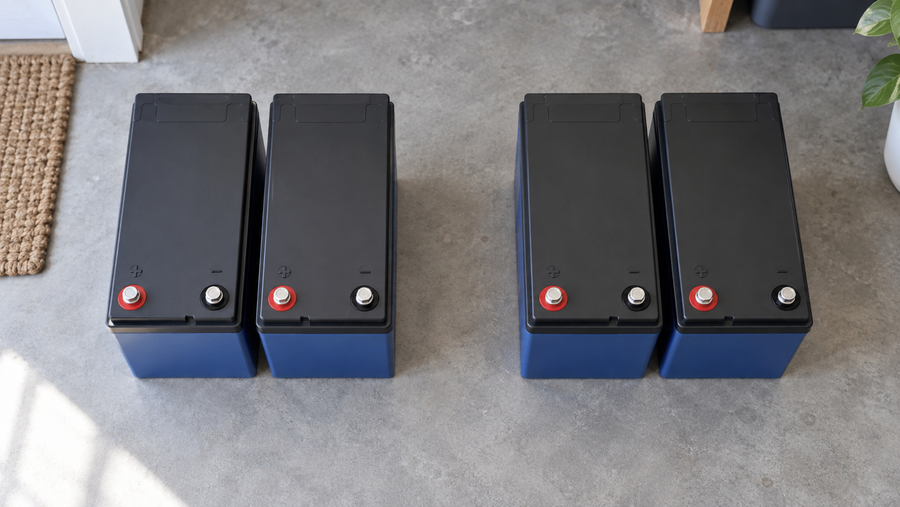

This article explains how quickly lithium-ion batteries for pallet jacks typically pay for themselves and how to calculate ROI for your own warehouse, so you can build a budget case with confidence.
Most warehouses that switch pallet jacks from lead-acid to lithium see the upgrade pay for itself in roughly two to five years, with harder-running fleets recouping the investment fastest.
Every week, you see trucks parked with their tongues down, operators hovering near chargers, and orders waiting because batteries are tired instead of your team. Operations that move to lithium-powered pallet jacks often see battery-related downtime and maintenance drop sharply while usable battery life stretches to several times what they were used to.

If you make the shift the right way, you can turn that wasted time, labor, and floor space into a clear payback window you can defend in the next budget review.
The Short Answer: How Fast Does Lithium Pay Back?
Lithium-ion forklift and pallet jack batteries typically earn back their higher upfront cost in about two to five years, with multi-shift fleets usually landing around the two- to three-year mark and lighter single-shift fleets closer to five years. That payback comes from a mix of longer battery life, higher energy efficiency, and the disappearance of daily maintenance tasks like watering and equalizing that come with lead-acid power.
If you are still relying on manual pallet jacks, moving to powered units is its own ROI story before you even talk about battery chemistry. Electric pallet jacks can improve handling productivity by up to about 30% compared with manual tools and often recover their higher purchase price in one to two years through labor savings and fewer strain injuries. On top of that, specifying lithium batteries instead of basic lead-acid extends runtime and service life, so the gains you unlocked with your first powered trucks do not erode under battery problems.
Put simply, if your pallet jacks work hard for long distances, support more than one shift, or already depend on a battery room and spare packs, the ROI on lithium usually sits toward the front of that two- to five-year window. Operations with lower daily hours still see the lifecycle savings, but you may choose to time the switch to the natural replacement cycle of your existing lead-acid batteries rather than swapping everything at once.
What Actually Changes When You Go Lithium on Pallet Jacks?
A lithium pallet jack replaces the vented lead-acid battery with a sealed lithium pack that is lighter, more compact, and essentially maintenance-free. Instead of topping off water, cleaning corrosion, and scheduling equalization charges, your team plugs in during breaks and keeps running, with no fumes or spill risk and no need for a vented battery room.
Compared with the traditional eight hours of use, eight hours of charging, and eight hours of cool-down common to lead-acid power, lithium systems can run through a shift, recharge in about one to three hours, and then go back out. That fast and flexible charging profile is what makes true opportunity charging workable in practice, which is the key to multi-shift ROI.

Lithium chemistry also changes how the truck feels to your operators. Lithium iron phosphate batteries deliver a flat discharge curve, which means the pallet jack runs and lifts with similar power at the end of a shift as at the beginning instead of getting sluggish as voltage sags. That steadier performance lets you plan to the end of the shift instead of guessing how much battery is left.
Why Lithium ROI Is So Strong
Maintenance and Battery Rooms Almost Disappear
Traditional electric pallet jacks with flooded lead-acid batteries demand a steady diet of watering, cleaning, and corrosion checks, and they vent explosive gases during charging that force you to create a dedicated battery room. Lithium-ion packs for pallet jacks are sealed, require no watering or equalization, and do not off-gas under normal conditions, which takes that whole maintenance routine off your daily checklist.
Vendors like BSLBATT and Flux Power emphasize that eliminating battery rooms, wash stations, spill kits, and spare battery racks is not just a safety win; it frees floor space and maintenance hours that you can redeploy to storage or value-added work. The labor you are currently spending on battery care instead supports throughput, which quietly accelerates the payback on the upgrade.
More Uptime, Fewer Trucks
Lead-acid duty cycles often force you into a pattern where each truck has two or three batteries in rotation, along with long, uninterrupted charging windows and cooling time. Lithium packs for pallet trucks can run roughly eight hours, recharge in about an hour, and then run another full shift, making near-continuous operation possible without battery swaps. In testing, lithium systems like Flux LiFT Packs have delivered up to 45% longer runtime per charge than similarly rated lead-acid batteries, which translates directly into fewer interruptions and higher picks per shift.
For multi-shift fleets, lithium’s fast charging and higher usable depth of discharge mean one battery can often stay in the truck full-time instead of rotating multiple heavy lead-acid blocks through a change-out station. When you can remove spare packs and change-out equipment from your plan, the savings in hardware, space, and change-out labor become a major contributor to the two- to three-year ROI band.
Battery Life That Outlasts Your Procurement Cycle
Lead-acid batteries are usually good for only a few hundred to perhaps 1,000 cycles in demanding warehouse service before they must be replaced, especially if watering and charging are less than perfect. Lithium pallet jack batteries routinely deliver around 3,000 to 5,000 cycles, and lithium LiFePO4 packs aimed at pallet jacks are often rated at 4,000 cycles or more. That cycle-life advantage translates into real calendar years: BSLBATT reports users commonly see eight to ten years of service from their lithium pallet jack batteries, compared with roughly three to eight years for lead-acid.
Over a five- to seven-year span, lithium solutions can deliver about 20-40% total cost-of-ownership savings versus lead-acid, and in some high-usage cases even more, thanks to fewer replacements, less downtime, and higher efficiency.

If your current lead-acid program for a fleet costs a certain amount over seven years, cutting that by 20-40% means you effectively recover between one-fifth and two-fifths of that spend as cash savings, before you even count labor and productivity gains.
Lithium’s integrated battery management systems also guard against abuse that shortens lead-acid life. Smart BMS electronics monitor temperature, voltage, and current to prevent overcharge, over-discharge, and short circuits, which helps the pack actually achieve its rated cycle life in real-world use rather than failing early because of charging mistakes.
Energy Savings and Sustainability That Show Up on the Bill
Energy losses during charging and discharging are another hidden cost of lead-acid batteries. Lithium systems for pallet jacks can use about 30% less energy than equivalent lead-acid systems because they have higher round-trip efficiency, so more of what you buy from the utility turns into usable work on the floor. Since the average warehouse spends a meaningful portion of its operating budget on electricity, even small percentage improvements in energy use can create noticeable savings over the life of the equipment.
The environmental side of the equation matters too. Lithium pallet jacks produce zero emissions at the point of use and can help cut a facility’s operational carbon footprint, sometimes by significant double-digit percentages when they replace fuel-powered options. Combined with the reduction in the number of batteries manufactured and recycled over time, as highlighted by Flux Power’s lifecycle analysis, this makes the ROI conversation stronger for companies with formal sustainability targets.
How to Run the ROI for Your Warehouse
Step 1: Capture Your Lead-Acid Costs
Any credible ROI model starts with a clear picture of what you are spending today. Lead-acid powered pallet jacks bring costs in several buckets: the batteries themselves, chargers, the space and safety gear for a battery area, and the labor hours for charging, inspections, watering, and cleaning. Your downtime when trucks sit because batteries are cooling, equalizing, or being swapped is another cost, even if it does not appear as a line item.
Suppliers that focus on lithium retrofits, such as BSLBATT, suggest mapping daily usage hours, load weights, number of shifts, and any need for spare batteries per truck. That same map will help you choose the right lithium capacity later and ensures you do not undersize a pack just to hit a price point, which could delay or even erase your expected payback.
Step 2: Price the Lithium Scenario Correctly
Once you know what you are spending today, you can build the lithium scenario. Many lithium pallet jack packs are drop-in replacements weighted to keep the truck within spec, so the hardware scope often comes down to the battery, a compatible charger, and in some cases a small amount of ballast or a simple meter.
When selecting packs, guidance from lithium suppliers is to match the truck’s voltage, usually 24 V for Class 3 pallet jacks, size amp-hour capacity to your duty cycle, and verify physical dimensions, connector style, and required certifications such as UL 2580 or IEC 62619. Cheaper low-voltage battery setups that look attractive on paper but last only a year or so in busy service are flagged as a false economy; they can extend payback rather than shorten it.
Step 3: Compare Annual Savings to the Extra Upfront Cost
With both pictures in hand, the basic ROI math is straightforward. Industry analyses of lithium conversions suggest using two to five years as a reasonable payback target, grounded in savings from reduced maintenance, fewer replacements, higher energy efficiency, and reclaimed labor and space. To see where your facility lands, divide the additional upfront investment for lithium by your estimated annual savings; the result is your payback period in years.
The savings inputs should include the longer lifespan and lower maintenance burden outlined in lithium TCO studies, which show 20-40% lifecycle cost reductions over five to seven years. For example, if your analysis of parts, labor, and energy shows that switching to lithium will cut your battery-related costs by about a quarter each year, and your upfront premium is equal to roughly one year of your current spend, your payback will sit at about four years. That kind of simple, transparent calculation is what convinces finance leaders and owners.
Who Gets the Fastest ROI?
High-Usage and Multi-Shift Warehouses
Facilities that run pallet jacks hard for many hours per day stand to benefit the most. Lithium pallet truck case studies show that in two- or three-shift operations, fleets that once needed multiple lead-acid batteries per truck can often operate with a single lithium pack and opportunity charging during breaks. When you remove spare batteries, chargers dedicated to each pack, and change-out labor, it becomes realistic to hit a two- to three-year payback.
Because electric pallet trucks also boost productivity and reduce strain injuries compared with manual tools, every hour the trucks are available and at full power multiplies the labor savings. In this type of high-throughput warehouse, you may also be able to trim the total number of pallet jacks in the fleet while maintaining or even increasing output, which shortens the ROI clock even more.
Cold Storage and Temperature-Stressed Operations
Cold environments are a stress test for any battery. Lead-acid batteries can lose a significant portion of their capacity and power in cold storage, while lithium batteries maintain more of their performance in low temperatures. That means pallet jacks in your coolers or freezers stay closer to their rated runtime and power, so you do not need a separate oversized cold-storage fleet or constant battery swaps.
Lithium suppliers serving material handling include options with onboard heaters and cold-weather optimization, as noted in RELiON’s pallet jack integrations. For these temperature-stressed operations, the ROI is powered not just by cost savings but by the ability to maintain service levels where lead-acid trucks would bog down or require expensive workarounds.
Sites Chasing Safety and Floor Space Gains
In industries like food, beverage, and pharmaceuticals, the hygiene and safety profile of your equipment is part of your license to operate. Lithium pallet jacks eliminate lead and liquid acid from the battery compartment. Combined with the removal of heavy manual battery changes, that shift can support safety programs aimed at cutting injuries and OSHA recordables.
At the same time, lithium-powered pallet jacks free up space by removing battery-changing equipment and rooms, allowing you to reclaim square footage for storage, staging, or value-added services. While those benefits may be harder to quantify than an energy bill, managers who can assign a value to each square foot or to avoided incidents will see the ROI accelerate.
Common Pitfalls That Delay Payback
One of the biggest mistakes is treating every pallet jack the same and buying a one-size-fits-all battery. Best-practice sizing guidance stresses matching voltage, amp-hour capacity, and duty cycle for each use case and avoiding cheap low-duty batteries that will not survive busy warehouse life. Underpowered packs force more frequent charging and can actually increase downtime, while oversized ones add cost without benefit.
Another pitfall is keeping old charging habits. Lithium systems are designed for frequent opportunity charging during breaks, but operators accustomed to lead-acid may still run batteries near empty and leave trucks unplugged at lunch or between shifts. A simple change to standard work—plugging in whenever the truck is parked for more than a few minutes—keeps state of charge high and lets you realize the uptime and fleet-size reductions that are built into your ROI case.
Finally, operators still need solid training and clear procedures even though lithium reduces some hazards. Electric walkie pallet jacks can move heavier loads faster and with less effort, which means poor driving or complacency can do more damage, not less. Building lithium-specific charging routines and inspection steps into your operator training keeps safety gains aligned with your financial ROI.
FAQ
How do I know if my fleet is a good candidate for fast ROI?
If your pallet jacks support long shifts, frequent trips, or multiple operators per day, you are already in the sweet spot. High-intensity, multi-shift operations that currently burn time on battery swaps and maintenance generally see the fastest payback, often in the two- to three-year range. Lower-utilization fleets still benefit, but you may plan conversions to coincide with natural replacement points rather than doing everything at once.
Do I need to buy new pallet jacks, or can I retrofit?
In many cases you can retrofit. Drop-in lithium packs designed for pallet jacks are weighted to keep trucks within their design limits and use familiar connectors, so conversion can be as simple as removing the lead-acid battery and installing the lithium pack plus a compatible charger. Still, follow selection criteria from lithium vendors carefully and consult your equipment supplier to confirm compatibility, ballast needs, and warranty implications before you finalize budgets.
Bottom Line for Warehouse Managers
Switching your pallet jacks from lead-acid to lithium is not a gadget upgrade; it is a structural change in how energy, labor, and space work in your building. When you factor in longer battery life, higher efficiency, minimal maintenance, and reduced downtime, the most realistic ROI window is about two to five years, with heavier-use fleets seeing payback sooner and low-use fleets catching up over the life of the batteries. If your trucks are already the bottleneck a few hours into the shift, now is the time to run the numbers in detail and turn your next battery purchase into a power upgrade instead of another bandage.