
A lithium golf cart charger that will not start usually needs an ordered check: confirm the outlet, inspect and reseat the connections, then verify that the charger is made for the cart battery's voltage and lithium charging profile. If the charger or battery becomes unusually hot, smells strongly, smokes, changes shape, or shows visible damage, stop charging and have the system inspected instead of testing it further.
Check the outlet, charger, and plug first
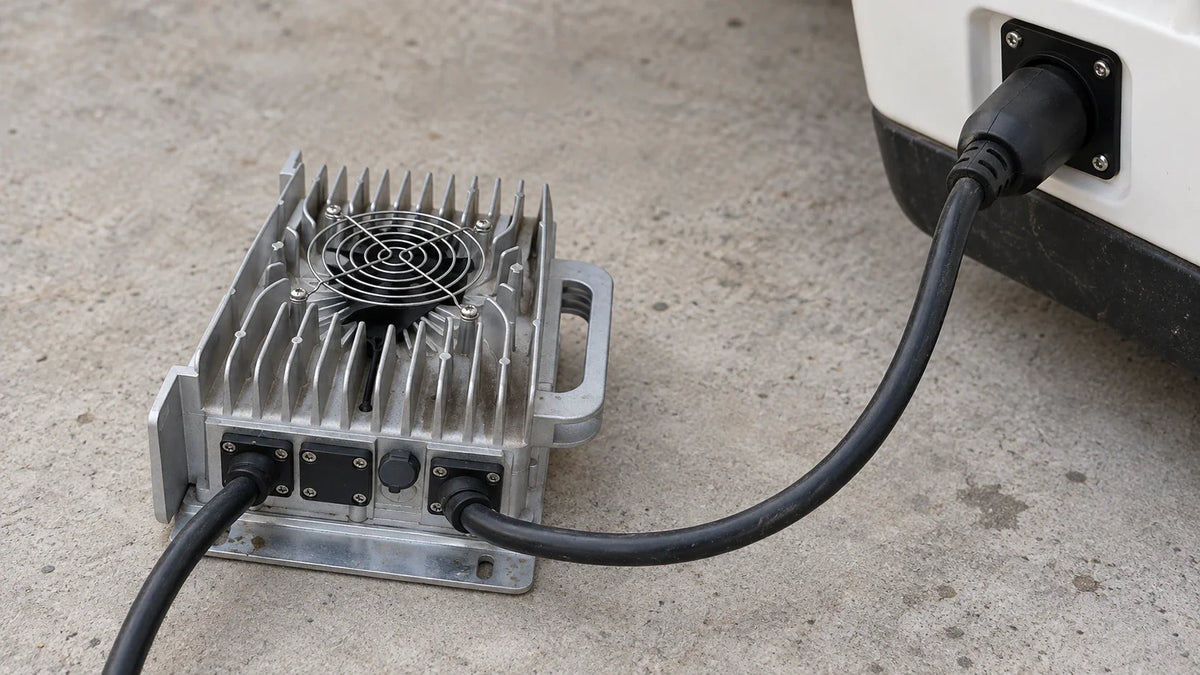
Start with the simplest failure point. Confirm that the charger is firmly connected to a working outlet and that any switch supplying the outlet is on. Look over the charger housing, cable, plug, and cart receptacle for cuts, melted insulation, bent contacts, corrosion, or moisture.
Disconnect power before cleaning or reseating anything. Use a dry, lint-free cloth on accessible contacts. Then reconnect the charger firmly at both ends. If the indicator remains dark, flickers unexpectedly, or shows a fault, note the exact light pattern before disconnecting it again. Charger lights and fault codes vary by model, so use the charger's own instructions for interpreting them.
Do not bypass a damaged plug, exposed conductor, fuse, or safety feature. A failed outlet or visibly damaged cable needs repair or replacement before another charging attempt.
Confirm the charger matches the lithium pack
A charger can appear to work while still being wrong for the battery. Read the voltage shown on the charger and compare it with the golf cart battery system. A 36V cart needs a charger designed for that system; a charger for a different voltage is not an acceptable substitute.
The charger must also use a charging profile approved for the lithium battery. Lithium packs rely on electronic protection and charging controls, and the charger settings must match the pack's specified voltage and current. MIT's lithium-ion battery safety guidance recommends using a charger designed for the pack and confirming both voltage and current settings before charging.
If you recently converted the cart, check the charger label, battery documentation, connector type, and wiring together. Do not assume that a plug that fits proves compatibility. The Vipboss 36V 105Ah Lithium Golf Cart Battery Conversion Kit is supplied as a conversion package with a charger, cables, connector parts, and a monitor. That makes it a relevant option when the goal is to replace a 36V system with a coordinated kit, but the cart's voltage and the final wiring still need to match the kit requirements.
Use the symptom to choose the next check

If there are no lights at all, focus on the outlet, charger power cord, charger fuse or protection device, and visible cable damage. Do not open the charger unless you are qualified to service mains-powered equipment.
If the charger powers on but does not begin charging, check that the cart connector is fully seated and that the battery pack is connected correctly. A pack that is deeply discharged, disconnected, or protected by its battery-management system may prevent normal charging. Follow the battery maker's approved recovery procedure rather than applying an improvised power source.
If charging starts and then stops, look for a loose or corroded connection, blocked charger ventilation, unusual heat, or a fault indicator. Let the equipment cool in a dry, ventilated area, then consult the charger and battery instructions. Repeated shutdowns point to a compatibility, connection, battery, or charger fault that needs targeted service.
If charging is unusually slow, verify the charger rating and the battery's condition before assuming the charger is defective. A mismatch, poor connection, or aging battery can produce the same symptom. A qualified technician can separate charger output from battery or cart wiring problems with the appropriate meter and service procedure.
Stop charging when the equipment looks unsafe
Stop immediately if the charger or battery emits smoke or a strong chemical smell, becomes excessively hot, leaks, swells, changes shape, makes unusual sounds, or has damaged insulation. Disconnect power only if you can do so without touching a damaged or energized component. Keep the cart away from combustible materials and arrange professional inspection.
If the outlet, connections, voltage, and lithium charging compatibility all check out but the charger still fails, the next useful step is a charger-and-battery system diagnosis. Bring the charger label, battery model, cart voltage, indicator behavior, and any recent conversion or wiring changes to the technician. That information helps identify whether the charger, battery protection system, connector, or cart wiring is responsible without repeated trial-and-error charging.