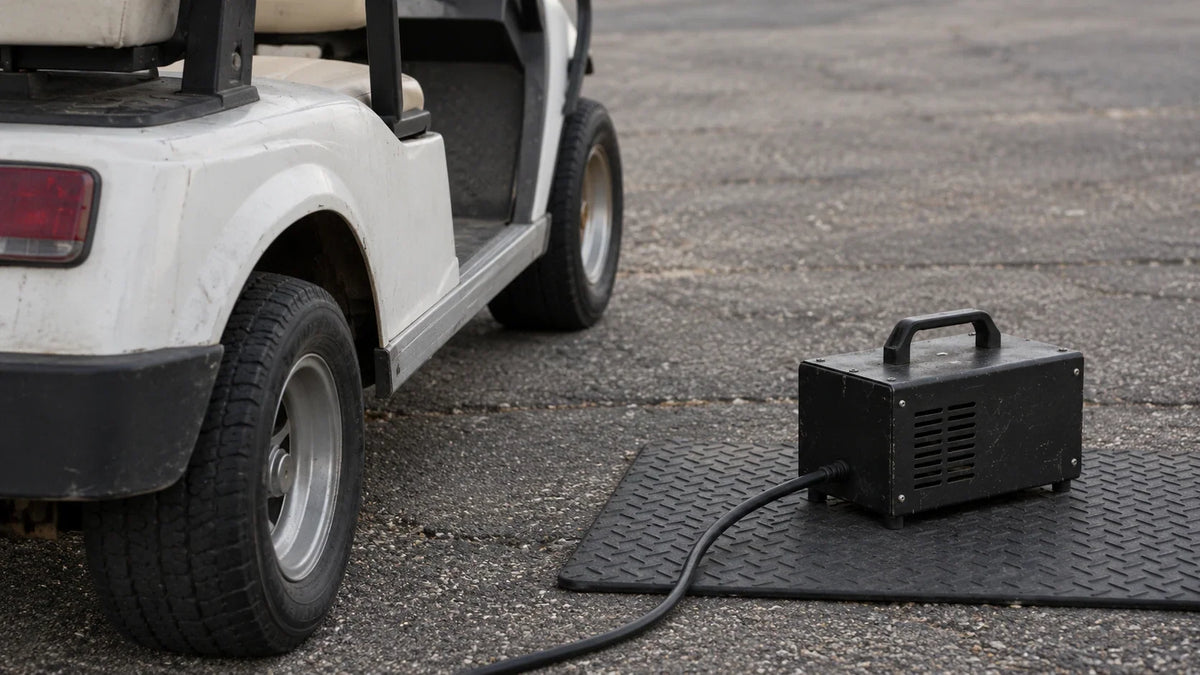

Usually, yes—but only when the charger matches the battery’s voltage, lithium chemistry, charging profile, connector, and cart charging circuit. Start with the battery label or manual: if it does not identify the charger as suitable for that exact pack, do not connect it just because the plug fits. When the voltage, profile, or charging path is uncertain, stop before charging and verify the complete setup.
Match the charger to the battery, not just the plug

A compatible charger must match the battery’s nominal system voltage and chemistry. For a golf cart lithium battery, it also needs the charge profile specified for that pack. A charger designed for lead-acid batteries is not automatically suitable for lithium, even when it has the same voltage label or connector.
Check these four items on the battery and charger labels or manuals:
- System voltage: Confirm that both are designed for the same cart voltage, such as 36V or 48V.
- Battery chemistry: Confirm that the charger is approved for the battery’s lithium chemistry and pack design.
- Charging profile: Look for the voltage, current, and charging mode specified for the battery. Do not substitute a guessed setting.
- Connector and polarity: The plug must match the battery or cart wiring, but a physical fit proves only that the connector fits.
The charger must also be appropriate for the battery’s built-in protection system and any communication or control requirements. If the manual names a specific charger or charger family, use that information instead of relying on a generic lithium label.
Check the golf cart’s charging circuit

The battery and charger can be individually suitable but still fail as a cart system. Some golf carts route charging through an onboard control system, charge port, or model-specific harness. The required connection can vary by cart make, model, year, and previous modifications.
Identify the cart and record its voltage, model year, charge-port type, existing charger, and any onboard charging control. Then compare those details with the battery and charger instructions. Do not assume an older charger can remain in place after a lithium conversion, and do not bypass a cart control unless the approved installation instructions call for it.
If the cart has been modified, check the wiring rather than trusting the original plug. A connector that looks correct can still have different polarity, current capacity, or control wiring. When the charge path cannot be identified confidently, have the system checked before energizing it.
What this means for the Vipboss 36V conversion kit
The Vipboss 36V 105Ah Lithium Golf Cart Battery Conversion Kit is described as a golf-cart lithium conversion package that includes a charger, cables, connector parts, and a monitor. That makes it a relevant option when you are replacing a compatible 36V golf-cart battery system as a complete conversion, rather than trying to pair an unknown charger with an existing pack. Before ordering or connecting it, confirm that your cart is a 36V system and that the included charger and connector arrangement match your cart’s charge path.
Signs the charger is not a confirmed match
Do not continue charging when any of these conditions applies:
- The charger voltage does not match the battery system.
- The battery manual does not approve the charger or its settings.
- The connector fits, but polarity or wiring has not been confirmed.
- The charger starts and stops unexpectedly, reports a fault, or does not complete its cycle.
- The battery, cable, connector, or charger becomes unusually hot, damaged, or swollen.
Disconnect power and follow the battery maker’s instructions when a fault appears. Do not modify the charger, force a connector, or use a different charging profile to make the system start.