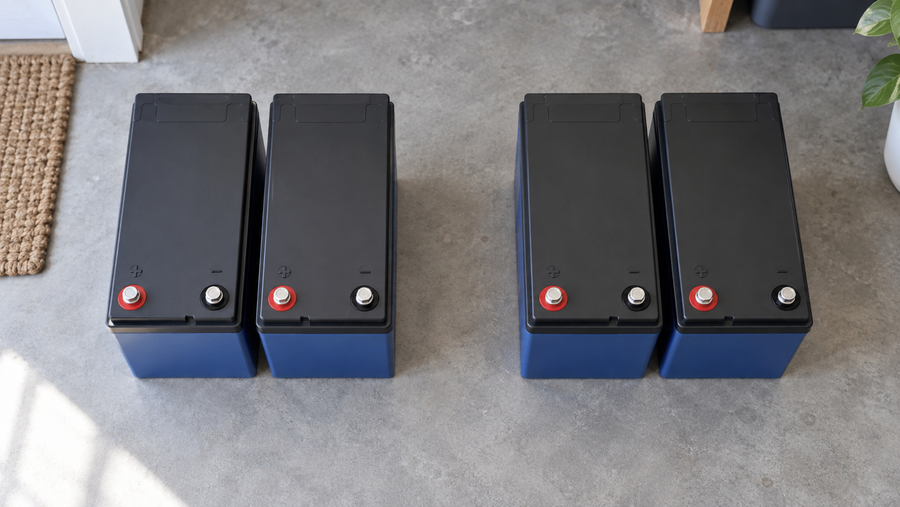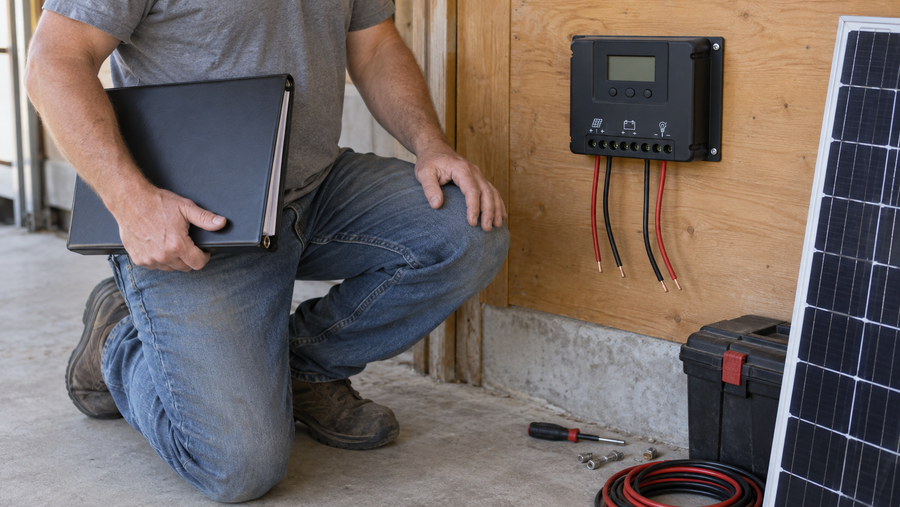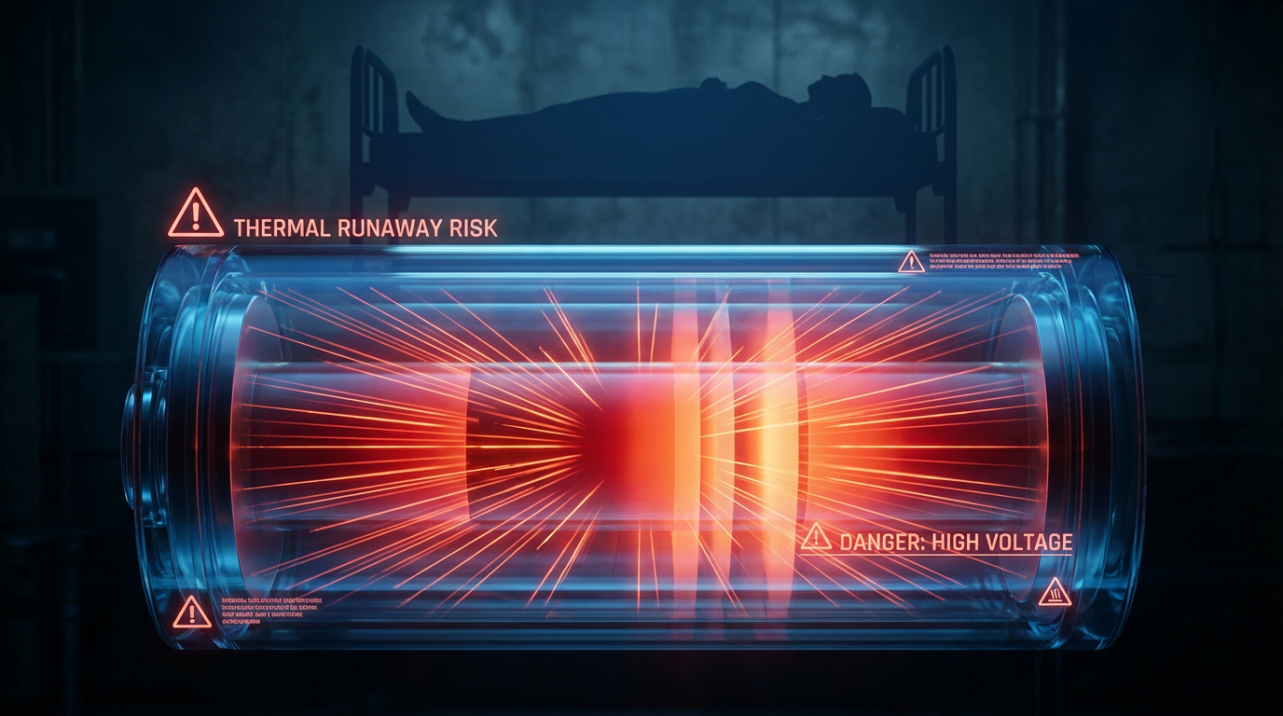

Sleeping directly above lithium batteries is not considered safe. To keep thermal runaway and fire risk acceptably low, you need physical separation, non-combustible containment, ventilation, and conservative charging and storage practices.
Picture a van, converted bus, or tiny cabin where the mattress sits just above a powerful lithium battery bank that quietly runs your lights, fans, and fridge through the night. The layout saves space, but one overheated cell can turn that cozy platform into a source of intense heat and toxic smoke long before anyone in the bed is fully awake. This guide explains how lithium batteries fail, how that risk changes when your sleeping space is directly above them, and which design choices move you from “space-efficient but risky” toward “robust enough for real-world use.”
What Happens When Lithium Batteries Fail
Lithium-ion batteries are popular because they pack a lot of energy into a compact footprint, from cell phones and laptops to e-bikes and off-grid storage banks. Fire agencies, NFPA guidance, and university safety programs all point to the same core problem: when these batteries are damaged, overcharged, or exposed to the wrong temperatures, they can overheat, catch fire, or even explode.
Fire protection specialists describe this failure as a heat problem that feeds on itself. If a cell gets hot enough from abuse, internal defects, or improper charging, the liquid electrolyte inside begins to boil and build pressure. At that point the cell can enter a self-heating chain reaction where temperature and pressure rise faster than the pack can shed the heat. When the casing fails, it releases flammable and toxic gases that can ignite, creating both fire and blast hazards in a very short window.
City fire departments that have investigated lithium battery incidents report aggressive, fast-moving fires that are hard to control, along with a frequent pattern of re-ignition hours or days after the visible flames seem to be out. Standard household extinguishers are often not effective, and many fire-safety bulletins advise getting out, closing the door if you can do so safely, and calling 911 rather than trying to fight a burning pack yourself.
For larger multi-cell systems like e-bike packs or home storage banks, there is a second layer of risk: propagation. If one cell goes into that runaway state, the intense heat and hot gases can drive neighboring cells into the same failure mode, even if they are not being actively charged at that moment. Industrial and energy-storage guidance therefore focuses heavily on preventing failures from spreading between cells and on using engineered fire and gas-management systems around large packs.
In a living space, you rarely have industrial-grade suppression and venting.

That makes layout and everyday use your main control levers for how much danger you are actually sleeping over.
Why Sleeping Above a Battery Bank Raises the Stakes
Every major fire-safety source on lithium batteries comes back to the same theme: location and use pattern matter as much as chemistry. Lithium-powered wheelchairs, e-bikes, and other mobility devices are explicitly not supposed to be charged in small resident rooms because confined spaces make thermal runaway fires deadlier and evacuation harder. Guidance for everyday devices adds direct warnings not to charge phones, tablets, or e-cigarettes under pillows, on beds, or on couches, and not to charge while sleeping at all.
When you place a lithium battery bank directly under a bed platform, you are doing several things that run against those recommendations. You are surrounding the pack with combustibles like plywood, mattress foam, pillows, and bedding. You are putting your primary escape path directly on top of the hazard. You are also placing the most vulnerable people in the structure, the sleeping occupants, in the exact zone where heat, flames, and gases will first arrive if something fails.
Fire organizations that study lithium storage advise keeping batteries away from anything that burns and maintaining space around them. Some guidance for stored or charging packs calls for about 2 feet of clearance to other materials, while recommendations for charging larger-format batteries point to several feet of separation from walls and combustibles. When the pack is directly under your mattress, that clearance collapses to essentially zero. If a cell vents sideways or upward, the first things hit are the wooden platform and the bed.

There is also the gas and smoke side of the equation. Chemical storage experts note that vented battery gases can be flammable, toxic, and corrosive, with potential health effects that range from nausea and breathing difficulty to more severe outcomes if exposure is intense. If a pack fails in a compartment inches below your head, there is almost no distance or time buffer between those gases and your breathing zone.
Consider a simple comparison. An e-bike pack charging on a non-combustible surface in a detached, ventilated shed with several feet of clearance gives you time to see, smell, and react to a problem. The same watt-hours of energy in a pack bolted into a wooden box directly under your mattress gives you very little margin for early warning or escape.
Understanding Thermal Runaway in Plain Language
For practical design decisions, you do not need a deep electrochemistry lecture, but you do need to understand what makes thermal runaway more or less likely.
Technical and fire-safety sources consistently flag three main triggers: improper charging, physical damage, and temperature extremes. Using the wrong charger, overcharging, or charging at too high a current can damage cells internally and cause metallic deposits that short parts of the battery from the inside. Dropping, crushing, puncturing, or otherwise abusing packs can do the same thing mechanically. Storing or charging at temperatures outside the recommended band adds extra stress on top of those other factors.
Federal and fire-service guidance for household use puts the safe charging range for many lithium packs roughly between 32°F and 105°F, and other technical sources recommend keeping stored packs somewhere around 40–80°F. Several safety and battery-care references also warn against leaving lithium batteries fully charged or on continuous charge for long periods. Fully topped-off batteries experience more internal stress, are quicker to heat, and, as some industrial guidance notes, present a higher hazard level in storage, which is why newer fire codes sometimes treat packs at or below about 30% state of charge as a lower-hazard category.
Specialized battery resources for off-grid and backup systems recommend middle-of-the-road storage charge levels, typically in the 40–60% range at room temperature, rather than sitting full or empty for months. That approach slows degradation and keeps cells further from the edge of failure.
Taken together, a picture emerges. The highest-risk window is when a battery is being charged or immediately after charging, especially if the pack is full, warm, and in a confined or combustible space. That is exactly the window many people unconsciously choose when they plug in bikes, power stations, and DIY packs under or next to where they plan to sleep.

Risk Levels for Common “Bed Over Battery” Setups
The question is not only “Can I sleep over lithium batteries?” but “Under which conditions is the residual risk low enough that I am willing to live with it?” The same pack can present very different hazard levels depending on how you mount, charge, and monitor it.
Setup scenario |
Relative risk near the bed |
Key reasons |
Large DIY or refurbished pack under a wooden bed platform, charging overnight, no venting |
High |
Combustibles on all sides, peak stress while charging, no space or vent path |
Certified lithium pack in a wood box under the bed, only charged during the day, but no vent or inspection access |
Elevated |
Reduced charging exposure at night, but difficult inspection and trapped heat and gases if something fails |
Certified pack in a metal or other non-combustible compartment beside the bed with several feet of clearance, not charged while you sleep, at mid state of charge |
Lower (not zero) |
Better separation from combustibles, easier inspection, less stress on the cells, and more time to detect a problem |
These categories are not exact measurements, but they reflect patterns seen over and over in fire investigations and safety guidance: charging and overcharging multiply risk, confined combustible spaces around the pack amplify consequences, and physical separation, non-combustible materials, and moderate charge levels reduce both the odds and the severity of a failure.
Designing a Safer Sleeping Platform Over Lithium Batteries
Many off-grid and mobile builds use the volume under a bed or bench for batteries because it is the only space with enough depth and structure to carry the weight. If you are determined to keep that layout, focus on changing the risk profile rather than pretending the hazard does not exist.
The first step is containment. Storage guidance from industrial and fire-safety organizations emphasizes keeping lithium packs in arrangements where they cannot be crushed, dropped, or stacked, and where items are not stored directly on top of them. Applying that mindset to a home or vehicle means housing your battery bank in a dedicated compartment rather than letting the mattress, gear, or storage bins rest directly on the pack. Non-combustible construction for that compartment, such as metal cabinets or boxes designed for batteries, aligns with recommendations to keep packs away from fuels and to use metal bins with lids when storing or discarding damaged batteries.
The second step is separation and ventilation. Recommendations for stored and charging lithium batteries frequently call for spacing between packs and other combustibles, and for placing charging stations on hard, non-combustible surfaces rather than on beds, carpets, or sofas. For a bed-over-battery build, that translates to maintaining a real air gap between the top of the battery compartment and the underside of the mattress and keeping the compartment sidewalls some distance from curtains, upholstery, and other fuels. Vent paths to the outside, rather than into the sleeping space, help carry heat and gases away if a cell vents.
The third step is operating discipline. Fire and safety agencies repeat the same rule: do not charge lithium batteries while sleeping or when they cannot be monitored, and unplug or disconnect once they are full. That is even more critical when the pack is directly under you. Charge during the day when you are awake, in temperatures close to normal room conditions, and avoid pushing batteries to full charge unless you truly need the capacity for a particular trip or outage. For storage periods, follow the mid-range state-of-charge guidance rather than storing banks full.
Finally, plan for detection and escape. Fire services that deal with lithium incidents emphasize having working smoke alarms or, in more specialized spaces, heat alarms in areas where batteries are stored and charged. Where local codes permit, interconnected alarms that sound in sleeping areas when something happens in a garage or under-bed compartment give you time that a closed door or heavy curtains would otherwise steal. Equally important is a clear, unblocked path out of the sleeping space that does not rely on climbing over the battery compartment itself.
A practical example from many off-grid cabins and van conversions is moving from a mattress directly on a wooden lid over the batteries to a design where the batteries sit in a vented, metal-lined compartment beside the bed, with cables routed cleanly through grommets and charging controlled by a properly configured battery management system.

The usable storage may drop slightly, but the distance between people, foam, and a potential failure grows dramatically.
When You Absolutely Should Not Sleep Above Lithium Batteries
Some scenarios are simply not worth the risk, no matter how space-constrained the project feels.
If the batteries are damaged, swollen, leaking, or giving off unusual odors or noises, authoritative guidance from fire departments and federal agencies is unequivocal: stop using them immediately, move them away from anything that can burn if it is safe to do so, and arrange for proper recycling rather than keeping them in service. A battery with those warning signs should never live in the same room as your bed, let alone under it.
If the pack is made from uncertified, mismatched, or modified cells, especially when assembled without the original manufacturer’s battery management protections, the risk of internal defects and overheating climbs sharply. Fire-safety campaigns aimed at e-bikes and other mobility devices highlight defective and substandard packs as a major driver of recent urban fires, even when the user thought they were handling them carefully. Sleeping on top of that kind of pack is stacking unknowns on top of an already elevated hazard.
If you cannot avoid charging while people are asleep, particularly in care settings or shared buildings, the warning from state fire marshals about not charging lithium-powered wheelchairs and scooters in resident rooms is a strong signal. Charging should move to a cool, dry, well-ventilated area away from sleeping spaces and flammable furnishings, on a stable, non-combustible surface, as multiple safety bulletins recommend.
If your only way to “protect” the bank is to bury it deeper in combustible structure with no realistic access for inspection, sensing, or emergency response, the system is telling you that the layout is wrong. At that point, redesigning the layout or downsizing the bank is a more responsible path than simply hoping that a rare but severe failure never happens.
FAQ: Common Questions About Sleeping Near Lithium Batteries
Is it ever completely safe to sleep over lithium batteries? No setup can be called completely safe, because the chemistry itself carries a small but real chance of failure. What you can do is push that risk far down by using certified equipment, keeping packs at moderate temperatures and mid charge, avoiding charging while asleep, and putting the bank in a non-combustible, ventilated compartment with real space between it and any sleepers or bedding.
Are lithium iron phosphate (LiFePO₄) batteries safe to place under a bed? Lithium iron phosphate chemistries are generally more stable and tolerant than many other lithium-ion types, and technical resources highlight their long cycle life and relatively forgiving behavior. However, they still contain significant stored energy and need the same basics: middle-of-the-road storage charge, cool and dry conditions, protection from physical damage, and separation from combustibles. The safer chemistry narrows the odds of a runaway event, but it does not cancel the need for good layout and operating discipline.
Is a big lithium power station in a plastic case safe to keep under the bed at night? Portable power stations use integrated battery management and enclosure designs tested by reputable labs, which is a meaningful safety advantage over loose or improvised packs. Even so, multiple fire-safety sources advise against charging any lithium device on beds or near bedding and recommend storing them at room temperature and away from flammable materials. Parking a power station under the bed while it is idle and partially charged is less risky than charging it there overnight, but moving it to a clear, ventilated location off the escape path is the more conservative choice.
If a sleeping platform over a battery bank is non-negotiable in your build, treat it like any other high-energy system under a living space: give it non-combustible structure, breathing room, controlled charging, and honest alarms, and do not ignore warning signs from the batteries themselves. The goal is not to be fearless; it is to be deliberate enough that you and your power system can share the same footprint without competing for survival when something goes wrong.
References
- https://fire.amarillo.gov/dangers-of-lithium-ion-batteries-fire-safety-tips/
- https://operations.cufo.columbia.edu/content/lithium-ion-battery-safety
- https://discover.pbc.gov/pbcfr/CRRD/Pages/Lithium-Battery-Safety.aspx
- https://ehs.ucsc.edu/fire-safety-and-prevention/community-outreach/lithium-ion-battery-safety/
- https://healthcare.utah.edu/healthfeed/2025/12/are-lithium-batteries-dangerous
- https://www.usfa.fema.gov/prevention/home-fires/prevent-fires/batteries/
- https://nj.gov/health/eoh/rtkweb/documents/fs/1119.pdf
- https://www.dhses.ny.gov/system/files/documents/2024/07/li_batteryconsumersafetyguide.pdf
- https://www.nyc.gov/assets/fdny/downloads/pdf/codes/dangers-of-lithium-ion-batteries.pdf
- https://www.mehca.org/blog_home.asp?display=1806