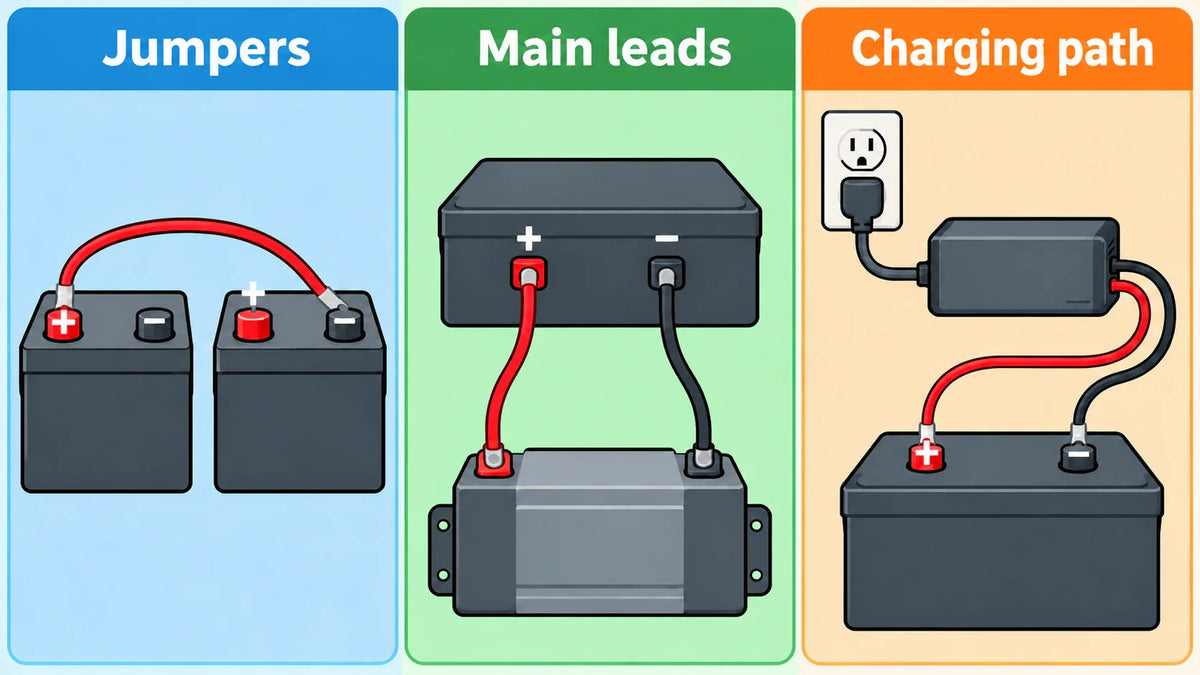

Identify a golf cart battery cable by where its two ends go. A series jumper links two batteries inside the pack. A main supply lead connects a pack endpoint to the vehicle's electrical system. A charging cable forms part of the path between the charger or charging receptacle and the battery system. Color and thickness can help you follow a cable, but they do not establish its function.
Separate the three cable roles
| Cable role | What to trace | What that tells you |
|---|---|---|
| Inter-battery jumper | From a terminal on one battery to a terminal on another | How the individual batteries form the pack |
| Main supply lead | From a pack endpoint toward the vehicle's power circuitry | How the completed pack supplies the cart |
| Charging cable | From the charger connection or onboard charger into the battery system | How charging power reaches the pack |
Several cables can share a terminal. For example, a pack endpoint may carry a main supply lead and another connection belonging to the charging system. Treat them as separate paths even when their ring terminals sit on the same post. Do not assume that every wire on a positive battery terminal is a series jumper.

Trace the jumpers within the pack
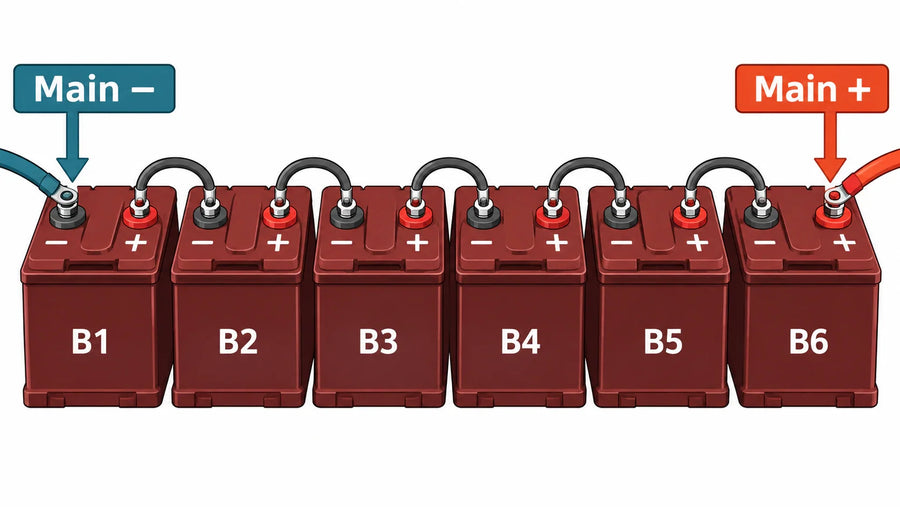
In a series-connected pack, each jumper joins one battery's positive terminal to the next battery's negative terminal. The series wiring principle explains why those connections add the battery voltages.
For a simple six-battery series string, there are five inter-battery jumpers. Follow the string until you reach the two ends that are not linked onward to another battery. Those endpoints provide the pack's main negative and main positive connections.
Battery placement can make the cables look like a loop across the tray. That physical shape does not make the circuit parallel. Classify the connection from the terminal markings at each end, not from whether the cable runs left, right, forward, or backward.
Follow the main leads out to the vehicle
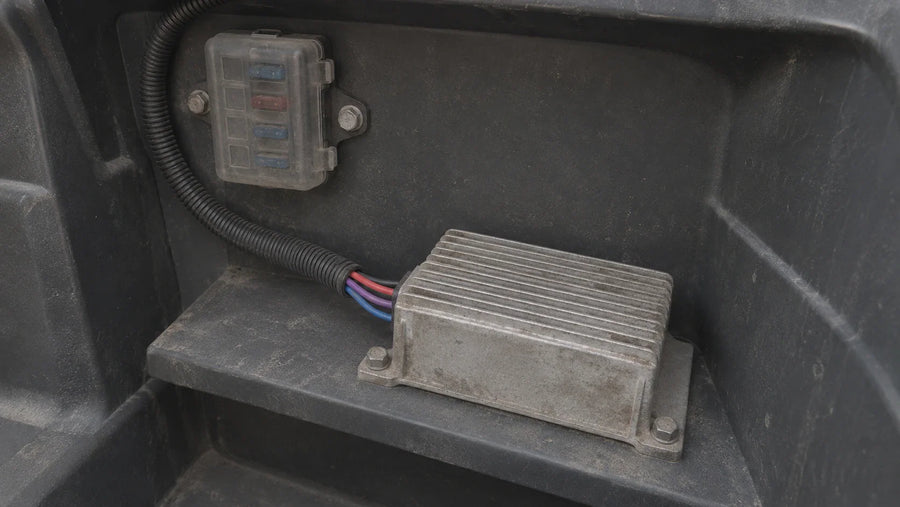
The main leads carry power between the completed pack and the cart. Trace the main positive and negative from the pack endpoints toward their labeled destinations in the vehicle diagram. Depending on the cart, that path can include protection, switching, or control equipment.
A cable does not have to run directly from the battery to the motor to be part of the main supply. Likewise, a negative cable is not automatically a chassis-ground connection. Use the vehicle diagram to identify its destination rather than assuming the cart's frame is the electrical return.
Mark each cable by both its origin and destination. A label such as “pack negative to vehicle return” remains useful if the cable color is faded or a replacement cable uses a different color.
Identify the charging path separately
Start at the vehicle's charging receptacle or onboard charger and trace the power conductors toward the battery system. Keep the charger-to-battery path distinct from the mains supply cord feeding a charger. Connector pins can also have functions other than carrying charging current, so a receptacle's pin count is not a count of battery power wires.

Some installations share pack connection points with the vehicle supply; others route charging through designated equipment or connections. The correct arrangement comes from the cart and charger documentation. A generic battery-series drawing cannot identify every charging connector or additional control wire.
Do not identify a charging lead solely because it is smaller than a main cable. Confirm its destination before labeling, moving, or replacing it.
Use the diagram as a cable checklist
First compare the actual pack configuration with the drawing. Then trace each cable and record its two endpoints and role. This separates a missing jumper from a disconnected vehicle lead or an unidentified charging wire.
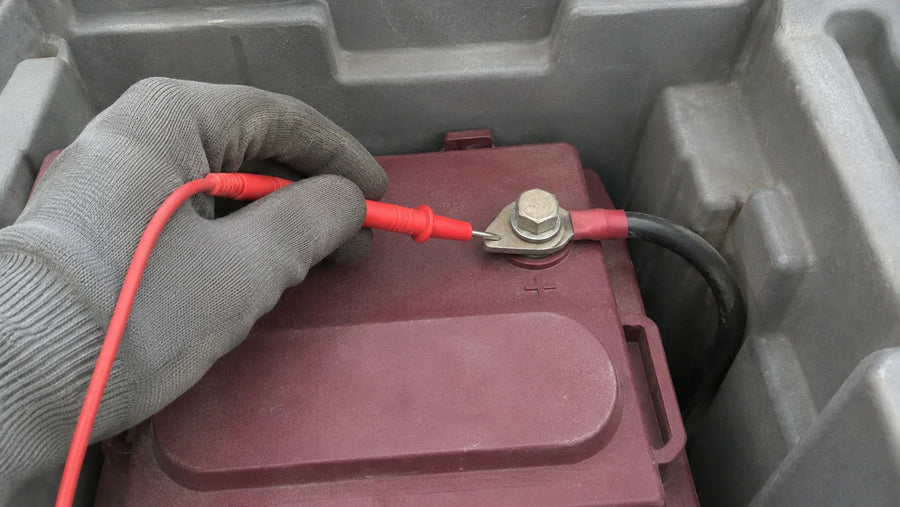
Perform identification visually with the cart secured. If you need to remove or move connections, follow the equipment's isolation procedure first; electrical-work guidance calls for disconnecting batteries and other power sources. Battery terminals themselves remain live, so avoid bridging them with tools.
If a cable disappears into a harness and you cannot establish its destination, mark it as unidentified and consult the model-specific diagram. Guessing its function can undo an otherwise correct pack arrangement.
FAQs
Can a main lead and a charging cable share a terminal?
Yes, where the vehicle and charger wiring instructions specify a shared pack connection. Sharing a post does not make them the same circuit: trace each cable separately and use the approved terminal hardware and arrangement.
Can I identify charger wires by their color?
Color alone is insufficient. Trace them from the charging connection or onboard charger and confirm their destination and function against the equipment diagram.
Does every cable leaving the battery tray power the motor?
No. Charging and accessory circuits can also have cables leaving the battery area. Trace the destination to distinguish them from the vehicle's main supply.