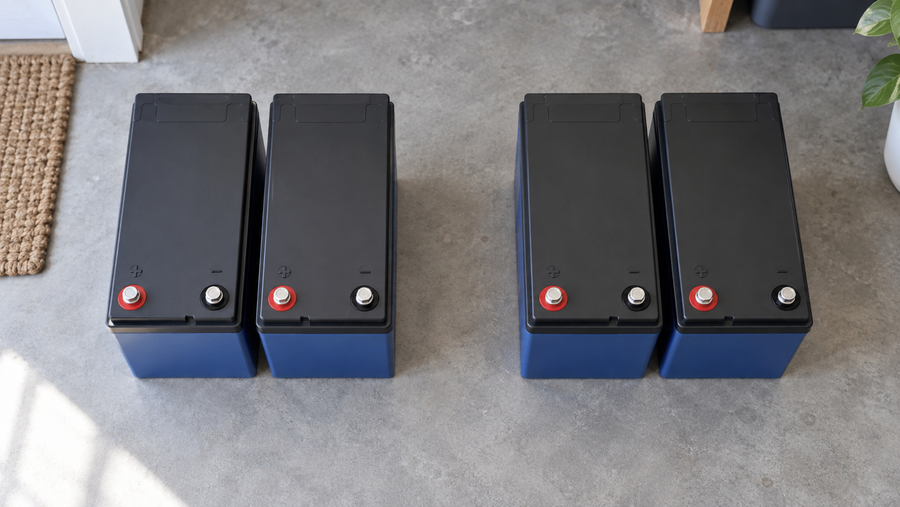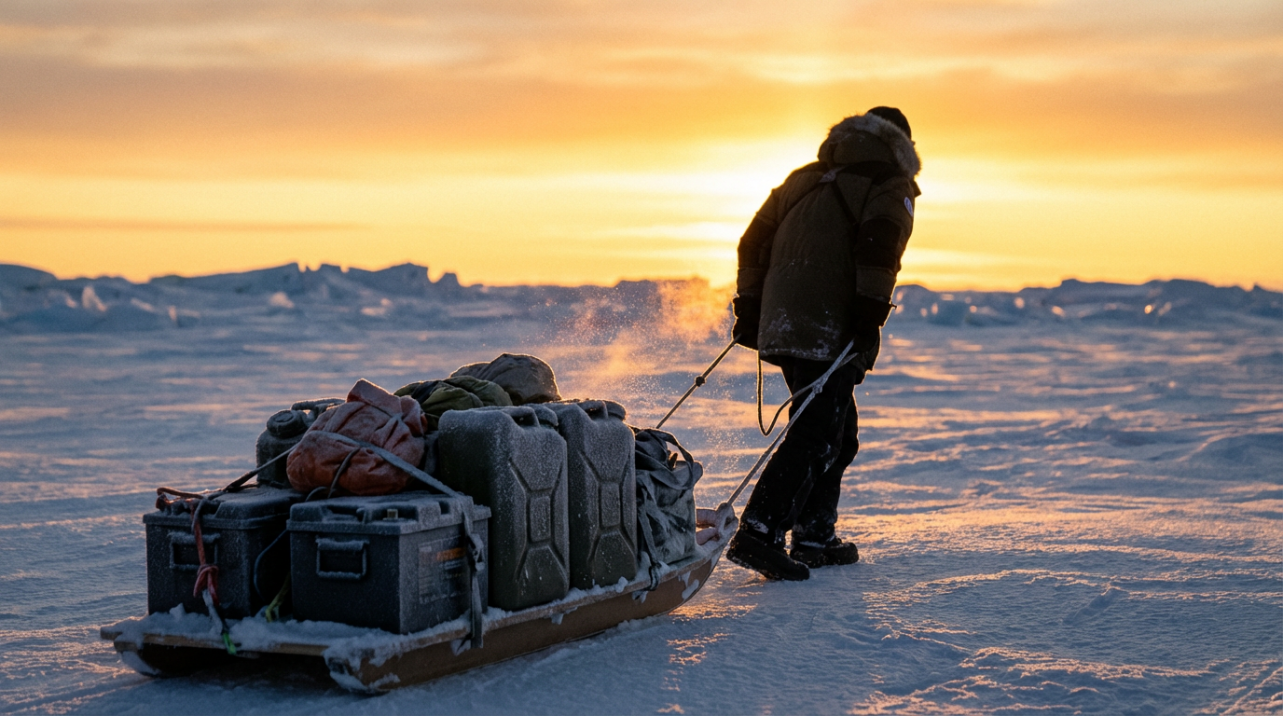

Energy weight—the mass of food, fuel, water, and power systems you can afford to carry—ultimately determines how far polar and desert science missions can go, how much science they can do, and how safely they can return.
On serious polar or desert missions, the real mission commander is the mass of usable energy you can afford to haul as food, fuel, water, and batteries. Get that wrong and no amount of grit or high-end gear will save the science plan.
You are days from the nearest runway, sled harness biting your hips or pack straps cutting into your shoulders, and every step you feel the drag of fuel cans, food bags, and battery boxes. On real polar treks, teams routinely burn through well over 4,000 calories per day and still lose body fat even when sleds already weigh more than 150 pounds. Treating energy weight as your primary design variable turns that grind into a controlled operation instead of a slow-motion failure. This article shows how to do that for people, power systems, and vehicles.
Energy Weight: The Constraint Behind Every “Impossible” Mission
Every remote science mission is fundamentally an energy-transport problem: how much usable energy you can move per pound of payload over a given distance and time. That is as true for autonomous Antarctic observatories designed around roughly 100 watts of continuous load as it is for long traverse vehicles or field camps on the ice sheet. A 100‑watt Antarctic power system built for Automatic Geophysical Observatories was engineered specifically to balance reliability against the cost and risk of flying in fuel to one of the harshest plateaus on Earth.
In practice, “energy weight” shows up in three main forms. First is metabolic energy in the team’s food: that decides how far your people can ski, climb, drill, or sample before they start consuming their own bodies. Second is fuel and stored electrical energy for heat, power, and vehicles: that decides which instruments can stay powered through storms and polar night, and for how long. Third is water, especially in hot deserts or enclosed habitats: without recycling, water mass tends to dominate life-support consumables, just as modeling of long-duration space missions shows that more than 90% of consumable mass can be water when no recycling is available. Together, those three dictate your payload, your range, and your margin for error.
A simple way to think about it is that every extra pound of energy you carry increases the energy it takes to move that pound. In cold, high-friction terrain, or in soft sand, that feedback loop is brutal: add fuel, and your people or vehicles burn still more fuel hauling it. The only sustainable answer is to raise the “energy-per-pound” of your entire system, from rations to generators, while cutting every avoidable watt of demand.
Humans As 100‑Watt Heaters: When Food Weight Sets Your Range
Human beings are wonderfully adaptable heaters and motors, but in extreme cold the energy bill explodes. A recent review of cold-weather military work shows daily energy expenditures often in the 4,300–6,200 calorie range in the field, frequently more than five times basal metabolic rate and more than double the traditional threshold for “heavy work” in cold operations. In that regime, the team is effectively a set of high-draw, self-heating devices that must be fed with astonishing amounts of energy-dense food just to stay functional.
On the 7‑day Women’s Euro‑Arabian North Pole Expedition, 11 nonathlete women skied 6–7 hours per day while pulling sleds of about 155 pounds each in full autonomy. Their measured total daily energy expenditure averaged 18.67 megajoules per day, around 4,460 calories, and yet their prepacked rations for the entire trek weighed only about 5.7 pounds per person and contained roughly 10,000 calories in total as quantified in the POWER study of women’s polar trekking. Over the week, the women lost around 3.7 pounds each, mostly body fat, because carrying enough food to close that gap would have made the sleds unacceptably heavy. Energy weight literally dictated how much tissue they had to burn to reach the Pole.

The same pattern appears in more extreme events. In an Antarctic race of about 500 miles to the South Pole, competitors lost on average about 18 pounds of body mass, most of it fat, over 14–28 days, despite reported intakes that for faster finishers exceeded 5,300 calories per day. Slower finishers ate closer to 3,000 calories and still finished, but at the cost of greater energy deficits and mass loss. In a 47‑day ski expedition from the Antarctic sea-ice edge to the South Pole, nine adults all lost weight; men lost roughly 19 pounds on average, women about 9 pounds, with most of the loss coming from adipose tissue while lean tissue was comparatively preserved in a detailed body-composition study of extended polar travel. The route, schedule, and resupply points were, in effect, designed around how much food mass each person could haul and still move.
Cold itself is an energy tax collector. Nonshivering and shivering thermogenesis together can push metabolic rate three to five times above resting levels, with maximal shivering alone reaching about 763 watts of heat production in lab settings for cold-exposed personnel. Deep snow that lets boots sink only about 4 inches can nearly triple the energy cost of walking; icy surfaces can raise it by about 70%, and complex storms with cold rain and wind can drive metabolic rate up by around 40%. Even “passive” design choices like footwear matter: modern tactical boots increase walking cost by about 7–10% compared with light running shoes. Every one of those penalties translates into more food mass per mile if you want to avoid dangerous energy deficits.
Desert missions flip the thermal sign but keep the same energy-weight logic. Here, water and shade replace down jackets and hot drinks, but the math is similar: hard work in heat dramatically raises energy expenditure and sweat loss, and water mass rapidly dwarfs everything else unless you can recycle or find reliable local sources. Just as in polar travel, underestimating the human energy and hydration budget in the planning phase shows up later as fatigue, cognitive slip, and retreat.
Infrastructure Power: Replacing Fuel Drums With Smarter Watts
Fixed and semi-fixed polar infrastructure turns energy weight into a logistics problem that never ends. At the Spanish Gabriel de Castilla Antarctic station, a two‑month summer monitoring campaign found that heating demand in one living wing reached roughly 103.5 kilowatt‑hours per square meter in only 28 days, a monthly load comparable to the typical annual heating demand of a well-insulated home in milder climates. Expressed in American terms, that is about 10 kilowatt‑hours per square foot in a single month. The same assessment showed degraded insulation, leaky aluminum-framed windows, and massive air infiltration, resulting in space-heating use around twelve times higher than the benchmark for ultra-efficient buildings. Every unnecessary watt of heat loss translated directly into more diesel that had to be shipped, stored, and burned in a place where each gallon of fuel comes at enormous financial and environmental cost.
Across Antarctica, that pattern has pushed operators to treat every saved gallon of diesel as a critical risk reduction. Reviews of energy efficiency and renewable deployments on the continent show that improved building envelopes, better controls, and behavioral changes have cut fuel use substantially at multiple stations, while wind and solar increasingly shoulder the remaining load. Even relatively small wind farms have delivered big gains: at one coastal station, a trio of turbines cut fuel consumption by about one‑third over their first six years, avoiding thousands of tons of carbon dioxide and paying back their capital cost well within the system’s life.
At the South Pole, modeling by national laboratories has taken this philosophy further by asking how to power new scientific loads without scaling up diesel at all. A recent optimization study found that supplying an additional constant 170‑kilowatt load with the existing diesel-only setup would effectively cost about $4.09 per kilowatt‑hour when you account for transporting fuel roughly 850 miles from the coast; the same analysis showed that wind power in that context could deliver energy around $0.33 per kilowatt‑hour and solar around $0.23 in a detailed South Pole renewable power study. The least-cost configuration was a hybrid of six wind turbines, 180 kilowatts of solar, and 3.4 megawatt‑hours of batteries, projected to cut diesel use by about 96%, save roughly $57 million over 15 years, and pay back an estimated $10 million investment in around two years. That is energy weight translated directly into dollars, flight hours, and safety margins.

For truly remote stations, the game shifts from megawatts to tens of watts, but the energy-weight logic is the same. The 100‑watt-class power system developed for Antarctic Automatic Geophysical Observatories grew out of painful experience with propane-fueled thermoelectric generators whose fuel and reliability problems dominated logistics. The second-generation design used renewable sources and meticulous thermal management so that instruments could run automatically through winter with minimal maintenance, all while slashing delivered fuel mass based on decades of AGO field experience. That kind of ultra-lean design, combined with best-practice station upgrades that emphasize insulation, airtightness, and heat-recovery ventilation, is exactly how you earn the right to size lithium storage and renewables modestly instead of dragging along oversized generators and fuel bladders.
Vehicles and Mobility: How Efficient Platforms Buy You Science
Mobility platforms are the multipliers—or killers—of your energy budget. Over Arctic sea ice and Antarctic ice shelves, the hovercraft Sabvabaa has been used as a science platform for 12 seasons, logging tens of thousands of miles. With an operating weight around 8 tons and a payload of roughly 2.2 tons, it rides on an air cushion that drops effective friction to about 0.0175, roughly half that of skis on snow as documented in long-term hovercraft field operations. On hard, low-friction Antarctic snow, that translates into fuel use of at most about 0.4 gallon per mile, about half the craft’s consumption over water and roughly half that of alternative surface transport options.
The payoff in energy weight is dramatic. During a 12‑month, roughly 1,400‑mile ice drift mission, Sabvabaa burned a total amount of fuel comparable to what an icebreaker would consume in only about six hours of heavy-ice transit. The hovercraft’s very low ground pressure and ability to glide over cracks up to about 3 feet wide at moderate speeds allow safe, efficient travel where tracked vehicles would bog down or require constant route grooming. Operator reports emphasize that the real enabler for large-radius missions with roughly one ton of science payload is not just the craft’s mechanical design but the fact that it turns fuel into miles far more efficiently than traditional platforms. In plain terms, you get more science stations, more cores, and more transects per pound of fuel you are willing to push out onto the ice.
The same principle applies when you move from polar ice to hot deserts. Sand, like deformed sea ice, punishes heavy vehicles through sinkage and high rolling resistance; every extra gallon of fuel and every extra battery pack increases the load that must claw its way through dunes. Choosing platforms with low ground pressure, simplified drivetrains, and high propulsion efficiency is the mobility equivalent of upgrading your station insulation: it shrinks the energy burden so your lithium packs and fuel tanks become range-extenders rather than dead weight.
Designing Missions Around Energy Weight: Practical Steps That Work
The first design move is always to quantify the human energy budget honestly. Cold-weather field data show that daily energy expenditure in sustained operations often exceeds 4,000–6,000 calories and can reach five times resting metabolic rate in demanding cold missions. For a polar team member consuming 4,500 calories per day, even a “small” misestimate of 500 calories per day over three weeks means a deficit of more than 70,000 calories, which is on the order of 20 pounds of fat. The POWER expedition’s one‑week deficit, created by rations of only about 10,000 calories for women burning roughly 31,000 calories over the trek, is a concrete reminder that rations chosen to keep sled weight manageable can still force significant body-mass loss in a well-characterized North Pole trek. On longer traverses, serial body-weight measurements and flexible ration caches, as in the 47‑day South Pole expedition, help keep that trade-off visible and manageable as shown in detailed energy-balance tracking during arduous polar travel.
Next, translate that energy into physical load and range. Food is one of the highest energy-density “batteries” you can carry, but it still has weight, especially once you build in packaging and cooking fuel. The North Pole example shows that doubling food to close the energy gap would have added several more pounds per sled—multiplying the work required every step and potentially slowing progress enough to negate the gain. In very long missions, resupply and prepositioned depots are therefore not luxuries; they are the only way to keep the food “battery” within what people can haul without tipping into unsustainable deficits.
Then, attack the stationary electric and thermal load with the same rigor you apply to sled weight. The Antarctic building audits that found space-heating demands many times higher than modern standards did not merely reveal inefficient walls; they pointed directly to excess fuel flights. When stations tightened envelopes, reduced air leakage, and added smart ventilation with heat recovery, they not only improved comfort but significantly reduced diesel use. At the system level, South Pole optimization studies demonstrate that once you have a lean load, a hybrid of wind, solar, and lithium storage can almost eliminate diesel, cut long-haul fuel convoys by more than 90%, and pay for itself rapidly in fuel and maintenance savings under South Pole renewable scenarios.
For remote instruments and outposts, treat 100 watts as a discipline, not a limit. The AGO experience shows that designing electronics, enclosures, and thermal management together so that an entire observatory can run on the output of modest renewables changes the nature of the logistics chain as demonstrated in Antarctic 100‑W autonomous stations. Low-power sensors in Antarctica have operated for more than a year on solar and lead-acid batteries precisely because their designers attacked the load first, not the generator size. The same design pattern—with more modern lithium packs and high-efficiency converters—translates directly to desert data loggers, seismic arrays, and communications relays.
Finally, design your mission like a spacecraft: treat crew size, body size, and exercise regime as explicit energy-weight variables. A modeling study of long-duration space exploration missions found that raising crew height and maintaining current high-volume exercise protocols could require an additional roughly 10,000–12,500 pounds of food, plus about 405 pounds of water, for a four-person crew over just one month when no recycling is available. Without water recycling, more than 90% of consumable mass was water alone. Those numbers are for orbit, but the logic applies on Earth: in deserts where water is scarce and resupply is slow, choosing lower-volume exercise, optimizing work-rest cycles, and aggressively recycling water can cut thousands of pounds from what has to be trucked or flown in.
Across all these examples, the lesson is the same. Whether you are planning a lithium retrofit for a small Antarctic lab, sizing batteries for a desert rover, or writing packing lists for a ski team, energy weight is not an afterthought. It is the design axis that decides how far you can go, how much science you can bring home, and how much margin you have when the weather or terrain refuses to cooperate. Treat every watt-hour, every pound of food, and every gallon of fuel as a precious passenger, and you will build missions that finish strong instead of fading at the edge of their range.