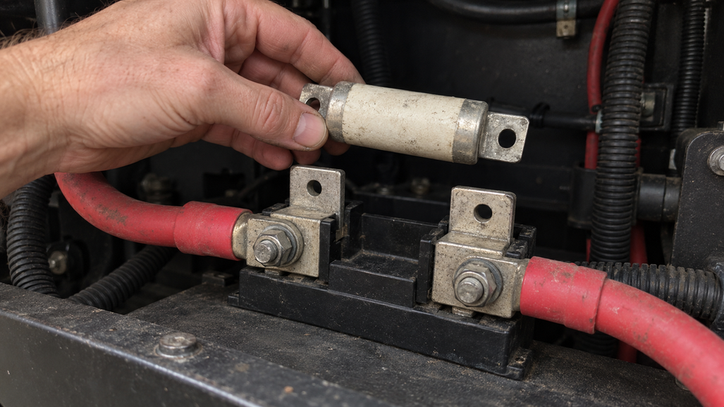

Choose a Class T fuse with a DC voltage rating equal to or greater than the circuit's maximum voltage. Check the holder's DC voltage rating separately against that same maximum, and confirm the holder's compatibility with the selected fuse in its documentation.
Choose the fuse for the circuit
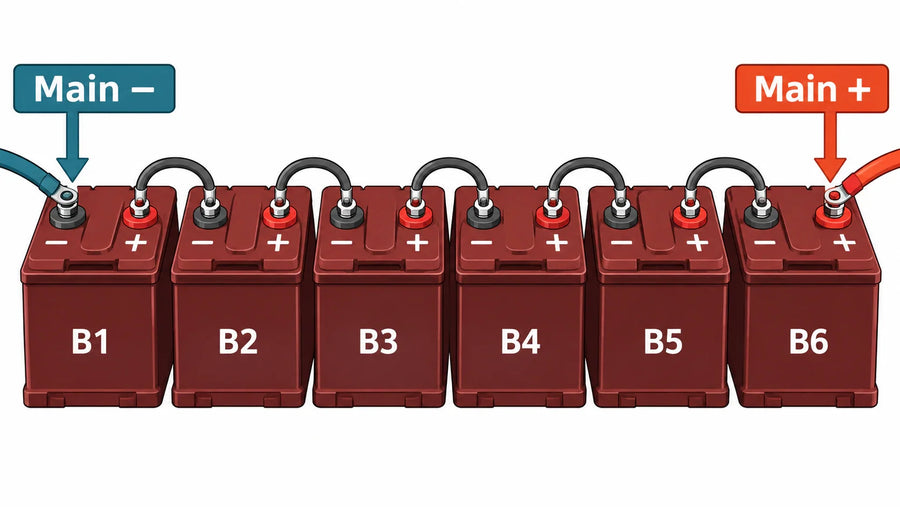
Determine the maximum voltage the circuit can reach, rather than relying only on a battery's nominal voltage. Select a fuse rated for DC whose voltage rating meets or exceeds that maximum. Fuse voltage ratings must equal or exceed circuit voltage, and a fuse used in a DC circuit must be specifically DC-rated.
“Class T” identifies the fuse class; it does not by itself give the voltage rating of a particular fuse or establish compatibility with a particular holder. Check the exact fuse and holder specifications and compatibility documentation.
Check the holder separately

Confirm that the exact holder is specified for DC use at the circuit's maximum voltage. Its documentation should also confirm that it accepts the selected fuse. Do not infer the holder's rating from the fuse's class or voltage rating.
FAQs
Do the Class T fuse and holder need the same DC voltage rating?
Not necessarily the same printed value, but both must be rated for DC at or above the circuit's maximum voltage. The holder documentation must also confirm compatibility with the selected fuse.
Can an AC voltage rating be used for a DC battery circuit?
Do not assume that an AC rating applies to DC. Use a fuse and holder that are explicitly rated for DC at the circuit's maximum voltage.
Should the rating be based on nominal voltage or maximum circuit voltage?
Use the maximum voltage the circuit can reach, including the battery's specified charging voltage where applicable. Nominal battery voltage alone may be lower than the actual maximum.