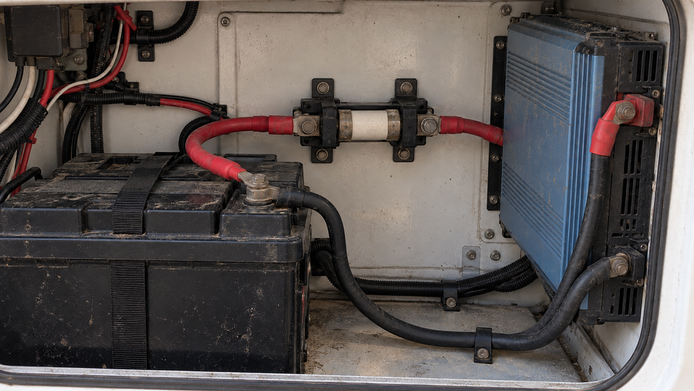

Choose a Class T fuse rating that meets the inverter's specified protection requirements, carries its expected continuous current and surges, and does not exceed the allowable ampacity of the conductor it protects. The usable rating is the overlap between those requirements: if no rating satisfies them all, change the cable or circuit design rather than forcing a fuse size.
Find a rating that fits the circuit

-
Start with the inverter's DC instructions. Use its specified fuse or overcurrent-protection rating and note the continuous input current and surge magnitude and duration. Treat the specified rating as a requirement to reconcile with the cable, not permission to exceed the cable's protection limit.
-
Cross-check the current. If the inverter gives input power instead of current, estimate DC current by dividing input watts by battery voltage. Use the lowest operating battery voltage relevant to the system and account for conversion losses. This estimate checks the inverter's stated current; it does not set the fuse rating by itself.
-
Set the cable's protection limit. Choose conductors for the expected current and actual installation conditions, including routing, temperature, bundling, and cable length. Determine the conductor's allowable ampacity under the applicable requirements. The fuse rating must stay within the ampacity limit of the conductor it protects.
-
Check whether the fuse can carry the load and surge. Compare the exact fuse's time-current curve with the inverter's continuous current and expected surge magnitude and duration. A rating that protects the cable but opens during expected operation is not a workable choice; a rating that tolerates the surge but exceeds the cable limit is not one either. Use a rating that satisfies both limits and the inverter's instructions. If there is no such rating, change the cable or circuit design.
-
Check voltage and fault interruption. The fuse's DC voltage rating must suit the circuit, and its interrupting rating must be adequate for the available battery fault current. An ampere rating alone does not establish suitability.
For example, the Vipboss 12V 105Ah Bluetooth LiFePO4 battery is rated at 12.8 V and has a built-in 100 A smart BMS. Its capacity and BMS rating alone do not establish the inverter's current, the cable's allowable ampacity, the expected surge, or available fault current, so they do not select the inverter-circuit fuse.
For installations governed by 33 CFR 183.455, each ungrounded current-carrying conductor must have overcurrent protection located at the power source, subject to the rule's placement exceptions. The rule also limits the device rating by the protected conductor's Table 5 ampacity: 150% for circuits below 50 volts, and the ampacity for circuits at 50 volts or more, with a next-standard-size allowance only under the stated conditions. These requirements apply to installations within the regulation's scope, not every battery-inverter circuit; the regulation's placement and conductor limits specify the conditions.
FAQs
How do you estimate an inverter’s DC current if only its input power is given?
Divide the inverter’s input watts by the battery voltage, using the lowest relevant operating voltage and accounting for conversion losses. Treat the result as a cross-check on the inverter’s stated current, not as the fuse rating by itself.
What should you do if no Class T fuse rating satisfies the inverter and cable requirements?
Change the cable or circuit design so a fuse rating can meet the inverter’s protection requirements, carry expected current and surges, and stay within the protected conductor’s allowable ampacity.
Does a battery’s BMS current rating determine the Class T fuse size for an inverter circuit?
No. The fuse rating must also satisfy the inverter’s specified protection requirements and expected current and surges, while staying within the allowable ampacity of the protected conductor.