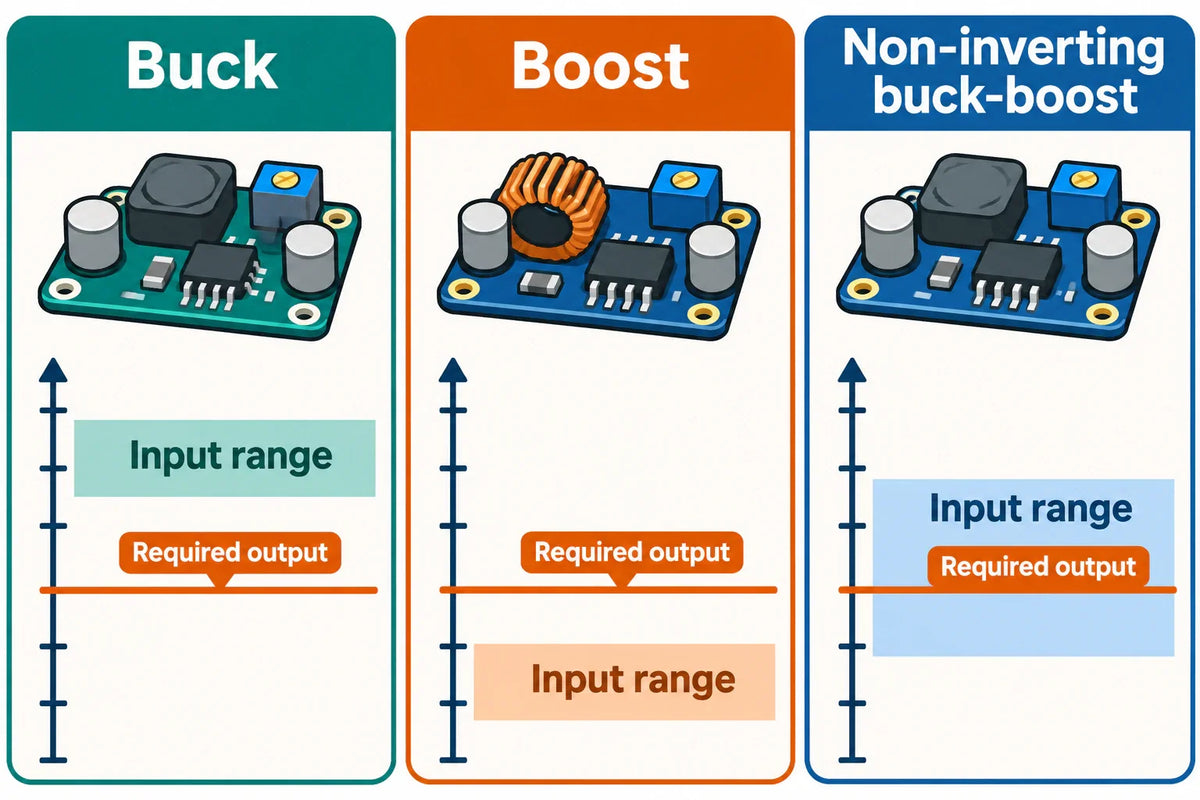

Choose from the source’s full operating-voltage range and the load’s required DC output: use buck when the source stays above the target, boost when it stays below, and non-inverting buck-boost when the range crosses the target. That is a choice among the three topologies in the title, not an exclusive rule: other topologies, including SEPIC and Zeta, can also operate with input voltage on either side of the output.
Compare the full range with the output
First identify the DC output voltage the load requires, then find the source’s minimum and maximum operating voltages. For a battery, nominal voltage is only a label for its general voltage class; it does not describe the entire voltage range during use. Comparing the minimum and maximum with the target reveals whether the input remains on one side or crosses it.
| Source voltage throughout its operating range | Candidate among these three | Function |
|---|---|---|
| Stays above the required output | Buck | Steps voltage down |
| Stays below the required output | Boost | Steps voltage up |
| Falls below and rises above the required output | Non-inverting buck-boost | Covers both sides of the target by changing between buck and boost operation |
These relationships describe topology functions, not a guarantee about a particular converter’s usable range. A comparison of common DC-DC topologies also shows that SEPIC and Zeta can handle input voltages on either side of their output. If you are choosing specifically among buck, boost, and non-inverting buck-boost, the third is the candidate when the source range crosses the output; it is not the only possible topology in general.
Check the converter’s actual limits
After identifying a topology candidate, compare the actual source range and required output with the selected converter’s specified input and output ranges. A topology name alone does not tell you the limits of an individual device. If the source can reach a voltage outside the converter’s specified range, that device does not cover the conditions you identified, even if its topology is otherwise a match.
Then check whether its output-current or power rating covers the load. Consider efficiency, quiescent current (the converter’s own current draw while operating), and thermal conditions as well. For battery-powered loads, battery voltage changes during discharge, and quiescent draw and heat can matter to the choice of device. The battery-load considerations for buck-boost converters explain why these factors belong alongside input range and load requirements.
Account for input current
A converter does not deliver more output power than it receives: because conversion has losses, input power must exceed output power. Since electrical power is voltage multiplied by current, a lower battery voltage generally means higher input current for the same output power. For example, if an illustrative load needs 12 W at the output, a converter with losses must draw more than 12 W from its source; the current needed for that input power rises as source voltage falls.

This is why a topology that covers the voltage relationship may still be a poor match for a battery load. Check the converter’s ratings and efficiency over the input range and load conditions you expect, and account for its own current draw and heat. The choice is complete only when both the topology and the particular converter’s specifications cover the source range and the load’s required output.
FAQs
How do I choose between buck, boost, and buck-boost when using a battery?
Compare the load’s required output voltage with the battery’s full operating-voltage range, not just its nominal voltage. Choose buck if the range stays above the output, boost if it stays below, and non-inverting buck-boost if it crosses the output.
Is buck-boost the only topology that can handle input voltage both above and below the output?
No. SEPIC and Zeta can also operate with input voltage on either side of the output; buck-boost is one option among these topologies.
Why can a converter that matches the voltage range still be unsuitable for a battery-powered load?
The particular converter must also meet the required input and output ranges, load current or power, efficiency, and thermal conditions. Conversion losses mean input power exceeds output power, and lower battery voltage generally requires higher input current for the same output power.