
When a golf cart stops unexpectedly, the fastest way to narrow the problem is to ask what stopped working and what stayed powered. If the battery monitor or BMS connection disappears at the same moment as drive power, start on the battery side. If the display and battery data remain normal but the motor no longer responds, start with the motor controller and its input circuit.
Neither observation proves that a component has failed. A BMS may be correctly protecting the battery from low cell voltage, excessive current, or temperature. A controller may stop the cart because it lost a throttle, direction, brake, contactor, or motor signal. The goal is to identify which system reported or initiated the shutdown before replacing parts.
Quick comparison: BMS shutdown or controller shutdown?

This table identifies the best starting point, not an automatic diagnosis. Accessories and dashboards are wired differently among golf carts, so battery or BMS data is usually more useful than the lights alone.
Signs that point first to the BMS or battery side
The BMS monitors individual cell voltages, pack current, and battery temperature. It can open the battery's discharge path when a limit is reached. Start with the BMS and battery information when one or more of these conditions are present:
- The battery display reports a protection event or changes abruptly when the cart stops.
- Bluetooth or other direct BMS communication drops out with drive power.
- The cart shuts down repeatedly at low state of charge or when a heavy load is applied.
- The recorded pack voltage falls sharply during acceleration.
- A low-cell-voltage, overcurrent, high-temperature, or low-temperature warning is stored.
- Connecting the charger wakes the battery after the shutdown.
An active BMS protection event does not necessarily mean the BMS is defective. It may be responding to a weak or imbalanced cell, an undersized or discharged battery, a poor high-current connection, excessive load, or an actual temperature limit. Record the warning and operating condition before clearing or cycling power.
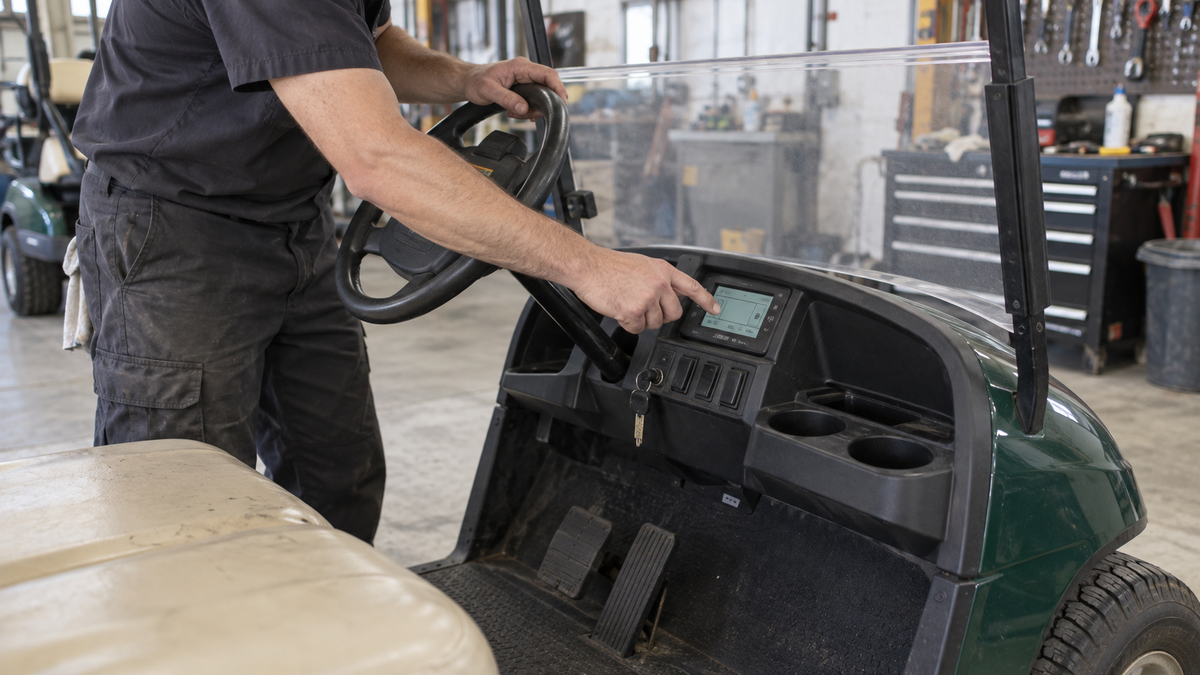
A Vipboss 48V 150Ah lithium golf cart battery conversion kit includes an external LCD monitor and Bluetooth status features. During diagnosis, these can help capture state of charge, battery status, and reported warnings before and immediately after the cart loses drive. The most useful evidence is the change that occurs at the same moment as the shutdown.
Signs that point first to the motor controller
The controller regulates current to the motor, but it also depends on several inputs that can prevent drive. Begin on the controller side when the battery remains awake, its status appears normal, and the cart still powers up but does not respond correctly to the accelerator.
Useful controller-side clues include:
- The dashboard and battery monitor stay on after drive is lost.
- A controller fault code appears while the BMS shows no corresponding protection event.
- Reverse, forward, or both directions stop working while battery communication remains available.
- The cart jerks, hesitates, or cuts drive when the accelerator position changes.
- The problem follows controller temperature or returns after the controller cools.
- The contactor does not engage, or the controller does not recognize a key, direction, brake, or accelerator input.
These signs do not automatically condemn the controller. A failed switch, accelerator sensor, contactor, connector, interlock, motor cable, or motor can produce the same “powers up but will not move” complaint. Read the exact fault code and follow the model-specific diagnostic sequence before ordering a controller.
A practical shutdown test
Use one repeatable, low-risk test to collect evidence instead of repeatedly cycling the key and guessing:
- Fully record the battery state of charge and any existing BMS or controller warnings.
- Note whether the cart fails at key-on, initial acceleration, steady driving, hill climbing, or after extended use.
- When the failure occurs, check the battery monitor or app before switching the cart off.
- Record whether the dashboard remains on, whether the cart accepts direction and accelerator inputs, and whether a fault code is displayed.
- Note what restores operation: cycling the key, waiting for the system to cool, reducing the load, or connecting the charger.
- Compare the recorded warning or fault code with the battery, cart, and controller manuals.
Do not intentionally repeat a shutdown under heavy load if the cart behaves unpredictably, cables become hot, there is a burning smell, or the battery reports a serious voltage or temperature warning.
How to interpret the result
The evidence favors a battery-side or BMS-initiated shutdown when battery output or communication disappears and the BMS records a matching protection event. Investigate why that protection occurred before deciding that the BMS itself is faulty.
The evidence favors a controller or drive-side shutdown when the battery remains online without a relevant warning, the cart retains electrical power, and the controller reports a fault or loses one of its required inputs. Continue through the controller manufacturer's troubleshooting procedure to distinguish the controller from its switches, wiring, contactor, and motor.
If both systems reset at once and neither stores useful information, inspect the shared power path and connections according to the cart's service manual. For high-current cable testing, live voltage measurements, or work inside the battery or controller enclosure, use a qualified golf-cart technician. Capturing the shutdown conditions first will make that service visit faster and reduce the chance of replacing the wrong component.