
Usually, a 25A charger can safely charge a 36V LiFePO4 battery only when the battery's own specifications allow at least 25A and the charger matches its required charging voltage and profile. Start with the battery label or manual: if its maximum charge current is below 25A, do not use that charger; if the limit is unknown, stop before connecting it.
Check the battery's charge-current limit first

A 25A charger can supply up to 25 amps. The battery's permitted charge current—not the charger's label—sets whether that current is acceptable. Find the battery's maximum charge-current specification and compare it with 25A.
For example, an illustrative 36V battery rated for a maximum 20A charge current is not a match for a 25A charger. A battery rated for 25A or more may pass this part of the check, but it still must match the voltage and charging profile.
Do not assume that a battery management system (BMS) makes an oversized charger safe. A BMS may disconnect the battery during a fault, but that does not replace the battery maker's charging limit.
Confirm the charger is made for 36V LiFePO4 batteries
“36V” usually describes the battery's nominal class, not the charger's required output voltage. A compatible charger must be intended for the battery's LiFePO4 chemistry and must reach the full-charge voltage specified for that particular battery.
Check these items together:
- LiFePO4 or lithium iron phosphate charging mode
- Required output voltage at full charge
- Maximum charging current
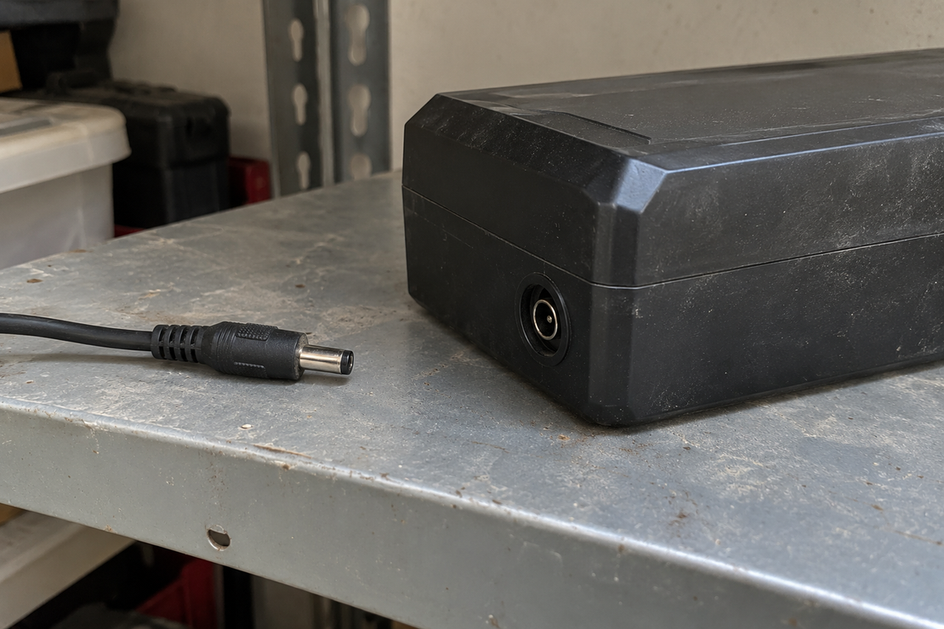
- Correct connector and polarity
- Charging-temperature limits in the battery instructions
A charger that only says “36V” is not enough evidence of compatibility. Do not substitute a charger because its voltage label looks similar, and do not use a lead-acid mode unless the battery instructions specifically approve it.
When the 25A charger in this example fits
The Vipboss 36V 25A Lithium Battery Charger provides a stated 43.8V, 25A output for 36V LiFePO4 batteries. It suits batteries whose specifications call for 43.8V charging and permit 25A of charge current.
The battery's maximum charge current, required full-charge voltage, connector, and charging-temperature range identify the appropriate charger. Its low-voltage activation feature can help initiate charging when a compatible battery is at a low state of charge.
Use the battery's actual limits, not a guess
You can make the decision with three outcomes:
- Compatible: the battery is LiFePO4, its required charging voltage matches the charger, and its maximum charge current is at least 25A.
- Not compatible: the battery's maximum charge current is below 25A, its required voltage differs, or its instructions prohibit this charger type.
- Unresolved: the battery's current limit, full-charge voltage, or chemistry is unknown. Do not connect the charger until those details are confirmed.
The practical answer is therefore conditional: a 25A charger is safe for a specific 36V LiFePO4 battery only when that battery's own charging limits match the charger's output. For the supplied Vipboss charger, verify the battery's documentation against the stated 43.8V and 25A output before use.
Frequently asked questions
Is a 25A charger too large for a 36V LiFePO4 battery?
Not if the battery permits at least 25A of charging current and the charger voltage matches the battery's specification.
How can I find my battery's maximum charge current?
Check the battery label, manual, or manufacturer specification for a maximum recommended or allowed charging current.
Can a 25A charger charge a battery faster than a 10A charger?
Yes, when the battery accepts 25A. The actual time also depends on the missing capacity and the reduced-current finishing stage near full charge.