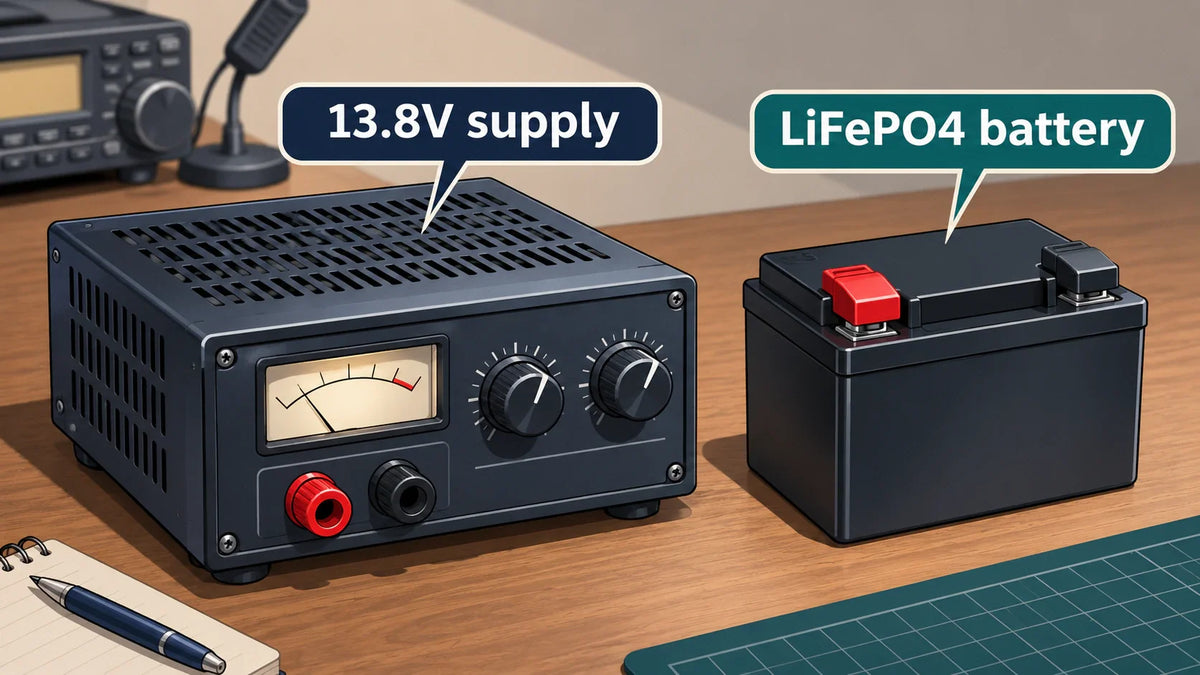

A 13.8V ham-radio power supply is suitable for charging a particular 12V LiFePO4 battery only when documentation authorizes that use and the supply's documented output behavior meets the battery's charging requirements. A matching voltage or technical fit alone does not establish manufacturer approval. If approval or a necessary specification is missing, suitability remains unestablished; use charging equipment specified as compatible with that battery.
Why 13.8V alone does not decide it
A supply's stated voltage is an output rating. By itself, it does not describe how the output behaves as battery voltage changes, how current is limited, or how charging ends. A battery's requirements can include permitted charging voltage and current as well as a charging profile or termination behavior. Matching one voltage figure therefore does not show that the source meets the battery's full requirements.
The numbers are model-specific. One manufacturer's guidance identifies 13.8V as a recommended float voltage for its own batteries under stated conditions. Another manual specifies 14.2V absorption and 13.5V float for its 12.8V lithium battery. These examples show that a voltage can have a particular role within a battery-specific profile; neither establishes a universal LiFePO4 setting or approves an unspecified ham-radio supply. Each set of charging instructions applies only to the batteries and conditions it covers.
Check approval and technical fit

Look for authorization first. Check the exact battery's documentation and the supply's documentation for an explicit statement that the supply is authorized for charging that battery. A technical comparison may show that documented limits appear to match, but it does not itself establish that the manufacturer approves this charging use. Without that authorization, treat approval as unestablished.
Read the battery's requirements. Find the exact model's permitted charging voltage and current limit, along with any stated charging-profile or termination requirements. Do not substitute specifications for a different battery just because both are described as 12V LiFePO4.
For a concrete battery-side comparison, the Vipboss 12V 105Ah LiFePO4 battery specifications list a 14.2–14.6V charging range. That is a specification for this battery, not permission to charge it from an unspecified 13.8V ham-radio supply.
Check the supply's documented behavior. Look for its regulated output range or tolerance, current limit or behavior under load, and operating modes that affect output. The front-panel 13.8V rating alone does not answer these questions.
Compare the documented requirements. The supply's documented output and behavior must meet the battery's permitted limits and stated charging requirements. A mismatch means it does not meet those documented requirements. Missing or unclear approval or specifications mean suitability has not been established, not that every 13.8V supply is incompatible.
Use compatible charging equipment if the match is unestablished. Choose a charger or charging arrangement specified for LiFePO4 and compatible with the particular battery's voltage, current limit, and charging requirements. Do not treat an arbitrary fixed-voltage source as an equivalent charger based only on its nominal voltage.
FAQs
What should I compare to decide whether my 13.8V supply is suitable for my LiFePO4 battery?
Check documentation authorizing the supply for charging the exact battery, then compare the battery's permitted charging voltage and current and any profile or termination requirements with the supply's documented output and behavior. If authorization or a necessary specification is missing, suitability has not been established.
What should I use if my 13.8V supply does not meet or document my battery’s charging requirements?
Use a charger or other charging arrangement specified for LiFePO4 and compatible with that battery’s voltage, current limit, and charging requirements.