
No. Voltage alone cannot accurately determine an exact LiFePO4 state-of-charge (SOC) percentage in ordinary use. A properly rested open-circuit-voltage reading can sometimes indicate a broad range or show that the battery is near an end of its usable range, but it is not a precise fuel gauge.
Why voltage alone is not a precise SOC gauge
LiFePO4 has a broad, relatively flat SOC–open-circuit-voltage curve. In an experimental study of LiFePO4 voltage hysteresis, the open-circuit voltage was described as flat across roughly 20% to 80% SOC for the tested cell. Through that region, a large change in remaining charge produces only a small voltage change. Meter error, temperature, relaxation, and normal cell-to-cell variation can therefore be significant compared with the voltage difference being interpreted.
The relationship also depends on recent battery history. The same study measured hysteresis between charge and discharge paths, while a separate LFP state-estimation study explains that different SOC values can be associated with the same open-circuit voltage when hysteresis is considered. One voltage observation is therefore not enough to identify one exact SOC value.
A live terminal reading is even less suitable for precise SOC estimation because charge or load current changes the measured terminal voltage. Allowing the battery to rest removes that immediate operating condition, but resting does not remove the flat curve, hysteresis, temperature dependence, or battery-to-battery variation.
What a voltage reading can still tell you
Voltage remains useful when its limits are respected:
- Boundary indication: A sufficiently high or low rested reading may indicate that the battery is nearer one end of its operating range than the other.
- Consistent comparison: Readings taken after the same rest time, at similar temperature, and after a similar prior condition can reveal a meaningful change over time.
- Fault screening: An unexpected voltage can prompt checks for charging, cutoff, connection, or cell-balance problems.
Treat these as broad indications. Do not convert a small voltage difference into an exact remaining-charge percentage, especially through the flat middle of the LiFePO4 curve.
Use current history for a better estimate

A better running estimate uses current history rather than a voltage snapshot alone. Coulomb counting tracks current into and out of the battery from a known reference point. It can drift as measurement errors accumulate, so the monitor or BMS still needs a trustworthy reference and the correction procedure documented by its manufacturer.
More advanced estimators combine current, voltage, temperature, battery parameters, and a hysteresis-aware model. Those methods do not make voltage irrelevant; they use voltage as one input among several instead of treating it as a direct percentage scale.
For routine use:
- Use the battery's BMS or a properly installed current-counting monitor as the primary running estimate.
- Establish or synchronize the reference only with the procedure documented for that equipment.
- Use rested voltage as a reasonableness or boundary check, not as a precise replacement for current history.
- Compare voltage readings only under similar rest, temperature, and prior charge-or-discharge conditions.
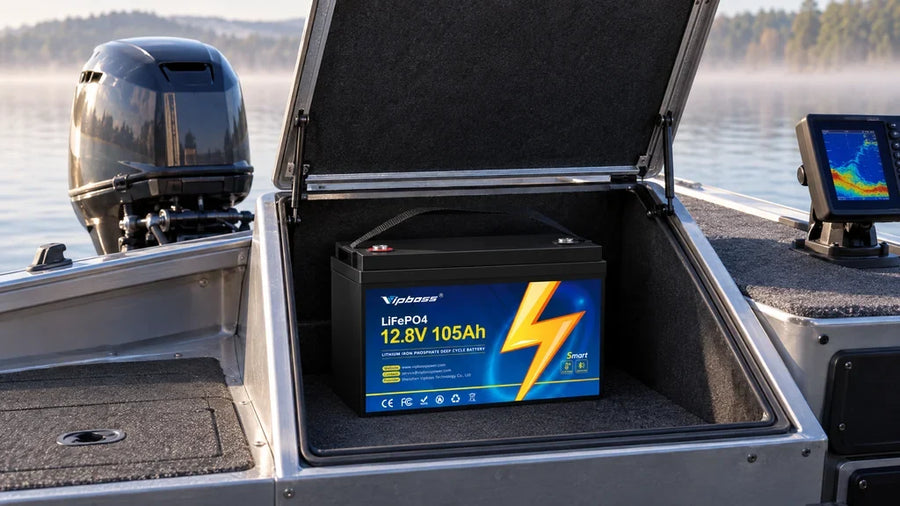
If you use the Vipboss 12V 105Ah Bluetooth LiFePO4 battery, its Bluetooth monitoring provides a convenient way to observe the BMS estimate. The displayed percentage should still be interpreted as an estimate produced by the BMS, not as a percentage proven by one voltage reading.
FAQs
Can a rested LiFePO4 voltage give an exact SOC percentage?
No. Resting removes the immediate effect of charge or load current, but the flat voltage curve, hysteresis, temperature, and battery variation still prevent one voltage value from identifying one exact SOC percentage.
Is voltage useless for LiFePO4 state of charge?
No. It can support broad range checks, comparisons made under consistent conditions, and detection of unexpected readings. It should not be treated as a precise fuel gauge.
What is better than voltage alone for estimating remaining charge?
A BMS or battery monitor that tracks current over time from a reliable reference is generally more informative. Better estimators combine that current history with voltage, temperature, and a battery model.