
The right lithium battery for a Yamaha golf cart depends first on the cart's original system voltage, not simply its age or body style. Many older Yamaha electric models used 36V systems, while G19E, G22E, Drive, and Drive2 electric models commonly used 48V systems. After identifying the model, you still need to confirm the installed controller, charger, battery-compartment dimensions, and any previous modifications before ordering a conversion kit.
Yamaha model and voltage reference

Use this table as an initial screening guide for common Yamaha electric golf carts. The model code matters: Yamaha also produced gasoline versions with similar names, and a used cart may no longer have its factory electrical configuration.
This is a model-and-voltage reference, not a universal fitment guarantee. Yamaha's model records distinguish 36V models such as the G16E from 48V models such as the G19E, G22E, Drive, and Drive2. Production dates, trim, market, fleet configuration, and later modifications can still affect the actual cart. Review the Yamaha serial-number and model chart, use Yamaha's identification-number guidance, and consult the applicable Yamaha owner's manual library before treating the table as a purchase decision.
Identify the exact Yamaha model before choosing a battery
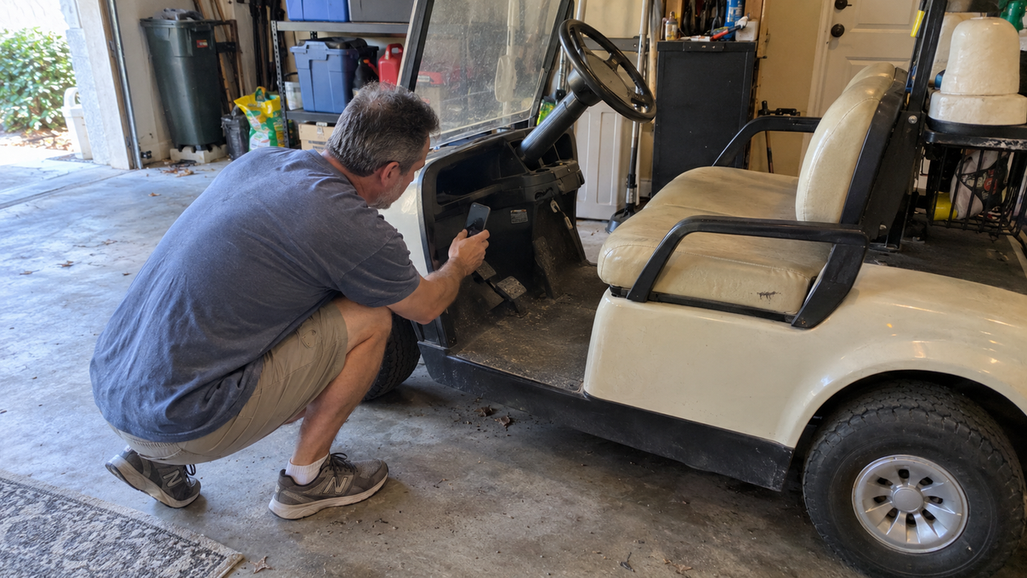
Find the cart's serial or Primary Identification Number (PID) and record the complete model code. Depending on the model, the identification label may be under the seat where the floorboard meets the motor compartment, under the rear bumper on the frame, or under the driver's-side glove box.
The letter after the model number is especially important on older carts. For example, G16E identifies an electric model, while G16A identifies a gasoline model. Body panels can also be changed, so appearance alone is not a dependable way to identify the cart.
Before shopping, write down:
- The full model code, serial or PID number, and model year
- The voltage printed on the existing battery bank and charger
- The controller and motor model numbers
- Whether the cart is stock, lifted, fitted with a high-speed motor, or otherwise modified
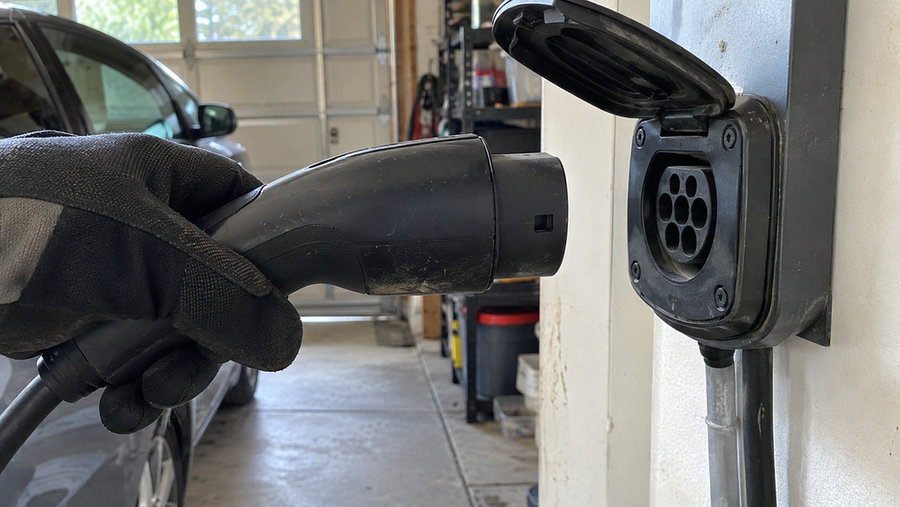
- The current charge receptacle, charger type, and any 12V accessory reducer
If the identification label, manual, battery bank, and charger do not agree, treat the cart's configuration as unknown until a Yamaha dealer or qualified golf-cart technician confirms it.
Check electrical compatibility beyond the voltage label
A battery marketed as “48V” is not automatically compatible with every 48V Yamaha. A typical 48V LiFePO4 pack has a nominal voltage of 51.2V, and its full-charge voltage, BMS limits, and discharge behavior differ from a lead-acid bank. The cart's controller, motor, solenoid, wiring, and accessories must operate within the battery manufacturer's specified range.
The charger must also be designed for the lithium pack's chemistry and charging profile. Do not assume the original lead-acid charger can remain in service, and do not bypass charger-control wiring based on a generic conversion video. Yamaha's own golf-car FAQ warns that using a non-recommended replacement battery can cause the vehicle not to operate, so an aftermarket conversion should be checked as a complete electrical system.
For Drive and Drive2 carts, record whether the cart uses an AC or DC drive system. This does not change the nominal 48V reference in the table, but it can change the controller, wiring, and installation requirements. The battery's continuous and peak discharge ratings must be adequate for the actual controller and vehicle setup.
Measure the Yamaha battery compartment
Voltage compatibility does not guarantee physical fit. Remove the old batteries only when it is safe to do so, then measure the usable length, width, and height of the battery area. Account for more than the outside dimensions of the new case.
Check all of the following:
- Terminal clearance below the seat and surrounding bodywork
- Space for battery cables, communication leads, and charger connections
- Cable reach without stretching, sharp bends, or contact with moving parts
- A secure mounting or hold-down method approved for the battery
- Access to the battery power switch, display, fuse, and service connections
- Protection from abrasion, water, and loose cargo
Do not cut structural supports or leave a heavy battery unsecured just to make an enclosure fit. If a mounting tray, cable set, charger receptacle, or accessory reducer is required, include those parts in the conversion plan before ordering.
Apply the checks to 36V and 48V lithium kits
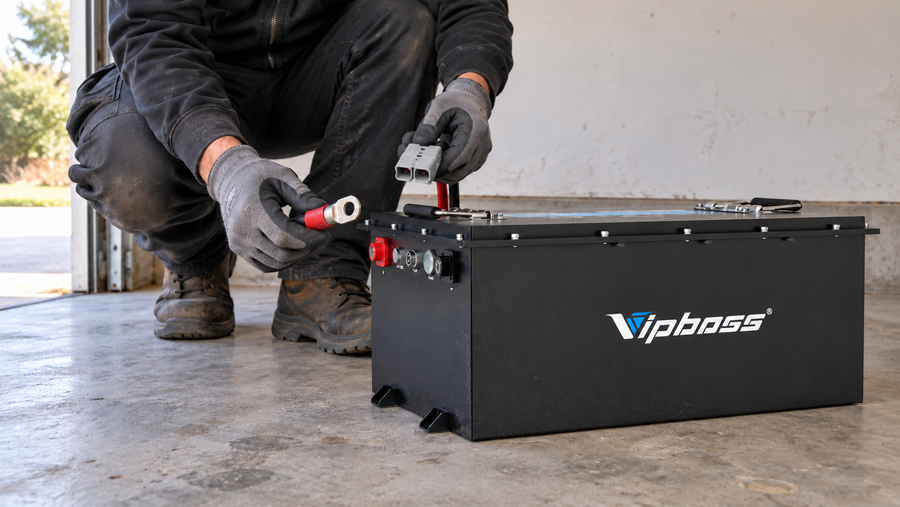
For an older Yamaha that is confirmed to retain its original 36V system, the Vipboss 36V 105Ah lithium golf cart battery conversion kit provides a 36V-class product to compare. It lists a 38.4V, 105Ah LiFePO4 battery, a 200A maximum continuous discharge rating, a lithium-compatible charger, and a 15.7 × 11.6 × 8.66-inch enclosure.
For a G2E, G3E, G5E, G8E, G9E, G14E, or G16E with a confirmed 36V configuration, compare those specifications with the measured compartment, terminal clearance, controller and motor requirements, cable layout, and charging path. Matching the voltage class is the starting point, not proof of model-specific fit.
The Vipboss 48V 150Ah lithium golf cart battery conversion kit lists a 51.2V, 150Ah LiFePO4 battery, a lithium-compatible charger, a 200A maximum continuous discharge rating, and a 20.5 × 13.7 × 8.66-inch enclosure.
For a G19E, G22E, Drive, or Drive2 with a confirmed 48V system, those specifications provide a starting point for comparison. The kit passes the initial screening only when the enclosure and terminals fit the measured compartment, the charger can be installed correctly, and the battery's voltage and BMS current limits match the controller and motor requirements.
The 48V kit is not a direct replacement for a cart that remains in its original 36V configuration. Converting an entire 36V cart to 48V is a different project that may require changes to the controller, motor, solenoid, charger, wiring, and accessories; it should not be treated as a battery-only swap.
Make the final fit decision
Use one of these outcomes before placing an order:
- Likely fit to verify: The cart is positively identified, its 36V or 48V voltage class matches the selected kit, the controller and motor requirements are known, the lithium charger is compatible, and the measured battery bay accepts the enclosure and mounting system.
- Not a fit: The selected kit's voltage class does not match the cart, the enclosure or terminal layout does not fit, or the battery and charger fall outside the cart's documented electrical requirements.
- Not enough information: The model or year is known, but the installed voltage, controller, charger, modifications, or usable compartment dimensions remain uncertain.
Do not use the Yamaha name, model year, battery count, or connector shape by itself as proof of compatibility. Confirm every item on the electrical and physical checklist, then follow the battery manufacturer's installation instructions or obtain model-specific help from a qualified technician.