
Even over a three‑foot run, high‑current off‑grid loads can push thin wire past safe current and voltage‑drop limits, so a wire gauge calculator often calls for cable that looks oversized to keep your system cool, efficient, and fire‑safe.
Picture this: you mount a new inverter a couple of feet from your lithium battery bank and expect to get away with something like extension‑cord wire, yet every calculator screams for cable as thick as your thumb. It feels like overkill until you realize that those few feet are the only path for hundreds of amps every time the system wakes up hard. Once you see how the numbers work, you can pick a cable size that protects your gear, your rig, and your upgrade budget with confidence.
Why the Calculator Recommends Such a Thick Cable
The first key is understanding what the calculator is actually sizing. American Wire Gauge (AWG) is the standard way to describe conductor size in North America, and in this system a lower gauge number means a thicker wire with lower resistance and higher current capacity, from fine 36 gauge up to heavy 4/0 and beyond in kcmil sizes. That relationship between gauge, diameter, and resistance is defined in detail for copper conductors in the American Wire Gauge standard and its ASTM tables, which show how each step down in gauge significantly increases area and cuts resistance. American Wire Gauge formalizes those dimensions so calculators can map a load directly to a safe size.
In off‑grid and mobile systems you typically work in the 18 AWG to 4/0 AWG range, where each step down in gauge gives a very real bump in current capacity and stiffness. Practical guides to wiring vans, RVs, and boats emphasize learning this “backwards” AWG scale and the way multi‑conductor cables are labeled, precisely because it underpins every decision a wire gauge calculator makes. That same guidance points out that thick cable is normal whenever a circuit combines low voltage and high current, which is exactly what battery‑to‑inverter links look like in a lithium retrofit. Understanding wire sizes lays out this range as the foundation for sizing DC runs.
A wire gauge calculator then takes your system voltage, expected current, total wire length, and an acceptable voltage drop and searches that AWG table for the smallest conductor that is both thermally safe and electrically efficient. Industrial and utility cable‑sizing tools use the same approach for higher‑voltage circuits, combining resistance data with load and length to avoid undersized conductors that could overheat or melt under heavy current. The same principle applies in your power shed or van: the calculator is a shortcut to the same conclusions a formal cable‑sizing workflow would reach for bigger installations.
Ampacity: The Current Limit That Does Not Care About Distance
The first hard limit is ampacity, the maximum current a wire can carry continuously without overheating its insulation. In the AWG system, higher gauge numbers mean smaller conductors with lower ampacity; for example, typical residential charts match about 15 amps to 14 AWG, 20 amps to 12 AWG, 30 amps to 10 AWG, and 40–55 amps to 8–6 AWG. Those charts are built so that the breaker or fuse rating never exceeds the safe current for the wire size. Matching wire size to circuit amp rating is one of the simplest and most important rules in home wiring references.
Crucially, ampacity is almost independent of length. Every cross‑section of the conductor sees the same current, whether the cable is three feet or thirty feet long, so a wire that is safe at 20 amps is unsafe at 100 amps no matter how short the run. Technical discussions of gauge and ampacity emphasize that as AWG number increases, conductor resistance and heating go up while allowable current goes down; pushing too much current through a small conductor leads directly to insulation damage and potential ignition. The relationship between gauge, resistance per thousand feet, and ampacity is tabulated, for example showing that #12 copper has roughly ten times the resistance of #2 copper, which explains why ampacity scales sharply as you move down the gauge numbers.
That is why a wire gauge calculator will happily specify something like 2 AWG or 1/0 for a short battery run that might see 150–250 amps. Even though the physical distance is small, the current puts the conductor into the same category as heavy appliance or feeder circuits in building wiring. Guidance on 60‑amp circuits, for example, points to 6 AWG and often 4 AWG copper as appropriate candidates, with the larger size favored for safety margin and reduced heating. The recommendation to err toward 4 AWG for continuous 60‑amp service illustrates the way high currents quickly demand thick copper, even before you think about voltage drop.

Voltage Drop: Why Short Runs Still Matter at Low Voltage
The second limit is voltage drop, the amount of pressure you lose along the wire because of its resistance. Even though resistance is rated per thousand feet, once you push very high currents, a few feet of small wire can drop more voltage than your equipment can tolerate. Technical material on gauge explains that as AWG number rises, both resistance and voltage drop increase for a given length and load, and that this can starve equipment of the voltage it needs to operate correctly. Designers often upsize wire or raise system voltage to keep loads within their required voltage window.
Cable‑sizing workflows for AC power formalize this by combining the circuit current, the loop length (out and back), and the resistance per foot of a candidate cable to compute voltage drop and check it against a design limit. Those calculators show that if you keep the same current but use a smaller conductor with higher resistance, the drop rises sharply. This is precisely the logic behind professional cable‑size calculators that flag undersized conductors as both inefficient and potentially unsafe, because high resistance not only wastes energy but also turns into heat.
To see why this matters even on a short run, look at two real copper sizes. Representative resistance values published for common AWG sizes show #2 copper around 0.156 ohms per thousand feet and #12 copper around 1.588 ohms per thousand feet, a ten‑to‑one ratio. That means a three‑foot one‑way run plus a three‑foot return, about six feet total, has roughly 0.00094 ohms in #2 and about 0.0095 ohms in #12. At 200 amps, that short #2 loop drops around 0.19 volts, while the #12 loop drops about 1.9 volts. On a 12‑volt battery system that is the difference between about 1.6 percent loss and nearly 16 percent loss, which would leave the inverter or DC bus severely undervolted long before the cable physically melts. Gauge‑to‑resistance tables for #2 and #12 copper underpin this kind of calculation.

Off‑Grid Lithium Systems: Perfect Storm of Short Runs and Huge Currents
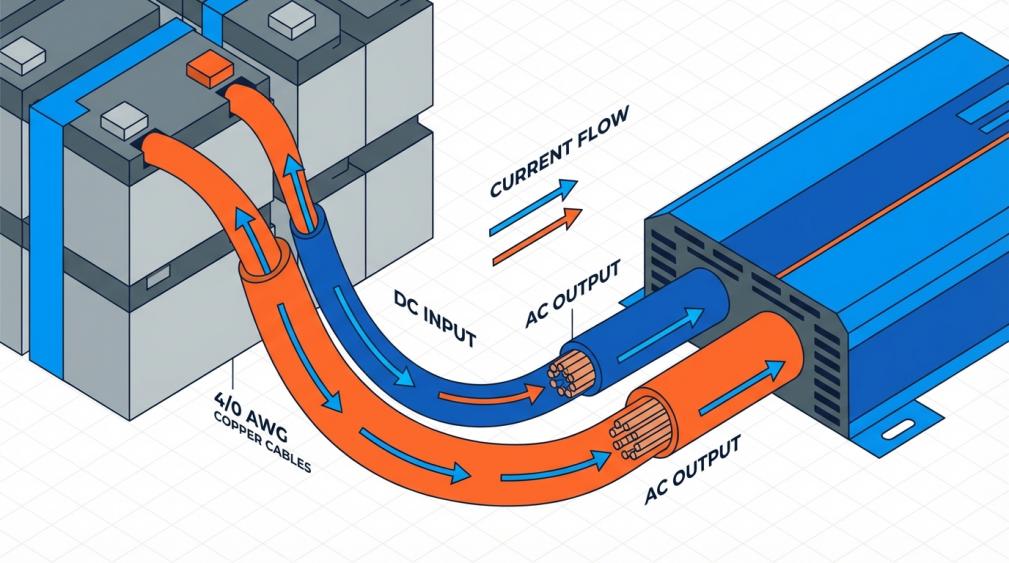
Lithium retrofits and off‑grid builds amplify these issues because they combine very high power with relatively low voltage. For a given power level, halving the voltage roughly doubles the current, so a 3,000‑watt inverter on a 12‑volt battery bank draws roughly twice the current of the same unit on 24 volts. Resources that teach the basics of wire sizing in off‑grid vans and boats highlight that this is why 18 AWG to 4/0 AWG cables are common: low‑voltage, high‑amp circuits need thick copper to stay in a safe, efficient operating window. Typical off‑grid wiring guides explicitly associate 4/0 AWG with major DC bus and battery connections and note that these sizes rarely appear in ordinary house circuits. Understanding wire sizes calls out this upper end of the AWG range for mobile and marine systems.
Add in lithium’s ability to deliver and accept very high currents during inverter surges and charging, and the demands on that “short” cable get even more intense. Instructional material on basic wiring stresses that even in conventional homes, high‑current devices should be plugged directly into properly rated circuits rather than into cheap extension cords, because overloads can heat and deform cords within seconds. Safety bulletins document cases where running double the rated current through a strip or cord melted housings and created severe fire risk. That same physics applies to your battery cables: if a wire is marginal at your continuous current, a brief overload can push it far beyond its safe temperature before any breaker trips. Electrical safety guidance includes dramatic overload examples that mirror what a mis‑sized battery cable could face.
Example: Three Feet Between Battery and Inverter
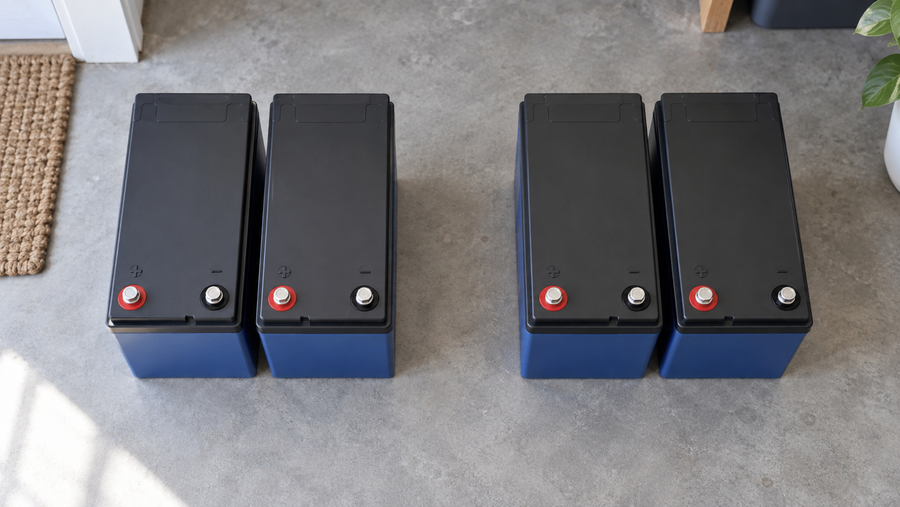
Take a typical off‑grid scenario: a lithium bank feeding a roughly 3,000‑watt inverter mounted about three feet away. At 12 volts, that inverter can demand on the order of 250 amps at full tilt, with even higher peaks during motor starts or surge loads. Compare that to house wiring tables, where 14 AWG copper is tied to 15‑amp lighting circuits, 12 AWG to 20‑amp small‑appliance circuits, 10 AWG to 30‑amp dryer or water‑heater circuits, and 6 AWG to the 40–50‑amp range. Residential guides use these examples to hammer home that the wire must always be sized to at least the breaker rating and that pushing much more current through small AWG sizes is inviting trouble.
A 250‑amp DC feed is well beyond those everyday circuits and lands in the territory of heavy feeders and large equipment. Even for a three‑foot one‑way run, using something like 10 or 8 AWG because “the distance is tiny” would violate the same ampacity logic that keeps household circuits safe. At those currents a correctly sized cable looks more like a welding lead. Off‑grid design references make the same point: as load current climbs, you rapidly move through the usual 10–8–6 AWG range into 2, 1/0, 2/0, and 4/0 cables for short, high‑amp battery runs, because both the current and the acceptable voltage drop are so demanding. That is why a calculator output asking for “huge” cable for a three‑foot link is not being conservative; it is simply applying the same physics and safety margins that house wiring tables already assume for much lower currents.
Surge, Faults, and Fire Safety
There is also the ugly side of worst‑case faults. If an inverter or cable fails short‑circuit near the battery, the current is limited mostly by the internal resistance of the bank and the cable until the fuse or breaker opens. That can be thousands of amps for a few milliseconds in a dense lithium pack. Safety literature on electrical equipment underlines how quickly conductors and components can fail when subjected to very high fault current, and why fuses, breakers, and conductor sizing are all treated as an integrated protection system. That same guidance emphasizes that fuses must never be uprated beyond what the conductor can safely handle, because doing so removes the only safeguard against turning the wire into a heating element.
House‑wiring guides mirror this by teaching that the breaker protects the wire first and the devices second, which is why you are warned never to place smaller‑gauge wire on a larger breaker. That means your three‑foot battery cable has to be sized not only for normal running current, but also to survive a worst‑case fault long enough for the upstream fuse or breaker to operate. The thicker the cable, the more thermal mass and cross‑section you have to absorb short‑term overloads without catastrophic damage. Consumer‑facing resources constantly remind readers that circuit breakers and fuses are not magic; they rely on properly sized conductors to do their job without creating a fire hazard.
Using Wire Gauge Calculators the Smart Way
A wire gauge calculator becomes a powerful design tool when you understand what to feed it and how to interpret the results. At a minimum you need to know your system voltage, the maximum continuous current, the total circuit length including both the positive and negative legs, and an acceptable voltage drop that keeps equipment within its operating window. Professional cable‑sizing software in industrial and utility settings uses exactly these inputs to choose a cable with acceptable heating, voltage drop, and short‑circuit performance. Publicly available calculators for power cables follow the same pattern, combining resistance, current, and length to arrive at a recommended cross‑section while flagging undersized choices as prone to overheating and excessive drop.
First, treat the calculator’s current input as “real worst case,” not ideal averages. For an inverter, that means using the continuous rating at your battery voltage rather than the AC current on the output side. For charging, use the maximum charge current your battery management system will allow. Ampacity resources built around AWG tables and code requirements assume that the wire might run near that rating for hours, and they build in margin to prevent insulation breakdown. As load increases, you must either upsize the wire or raise system voltage to stay inside thermal and voltage constraints.
Next, enter the correct length. Many DC calculators either ask you to input the one‑way distance and then double it internally, or ask directly for the round‑trip length. For a lithium bank under a bench with an inverter on the other side of a bulkhead, it is easy to underestimate this distance once you follow the actual routing path and bends. Marine lighting references, for example, recommend computing total run as the distance from battery to device multiplied by two, and then using that value to select wire so that both drop and heating stay within limits. That same mental model works for off‑grid power wiring, where the return path is every bit as important as the feed.
Finally, compare the calculator’s recommendation to standard ampacity charts and your overcurrent device ratings. If the result suggests 2 AWG, but your fuse chart or code table says that 4 AWG is the minimum for the breaker you plan to use, treat the larger of the two as your floor. Residential wiring primers stress this exact rule: the wire gauge must never be smaller than what the breaker or fuse requires, even if voltage drop calculations on a short run look acceptable.
When You Might Step Down One Size – And When You Should Not
On paper there are edge cases where a calculator might suggest a very large cable primarily because it is holding you to a very tight voltage‑drop limit on a very short run, and a designer might justify stepping down one size while staying comfortably within ampacity and real‑world drop. For example, a moderate‑power inverter on a 24‑volt bank with a three‑foot run may show negligible voltage drop even on a slightly smaller gauge, because the higher system voltage halves the current for the same power. In those cases, experienced designers double‑check that the smaller wire still exceeds the breaker‑protected ampacity, that terminals and lugs accept the chosen size, and that ambient temperature and bundling will not significantly derate the wire. Technical discussions of 60‑amp circuits illustrate this balancing act by comparing 6 AWG and 4 AWG copper, noting that the smaller conductor can be acceptable for short, moderate‑temperature runs but that the larger size provides more margin for longer runs or hotter environments. Choosing between 6 AWG and 4 AWG frames this as a judgment call around margin, not a license to undersize.
For most DIYers and many professionals, though, the safer habit is to treat the calculator’s output as a minimum, not a target, especially on battery‑side wiring. Going one size larger than the recommendation slightly increases cost and stiffness but buys lower resistance, cooler operation, and more headroom for future load increases. Resources on wire gauge and circuit planning consistently advise that oversizing wire within reason is far less risky than undersizing, as long as terminations are rated for the larger conductor. House‑wiring articles explicitly state that using a wire larger than required is generally not unsafe; the real danger lies in using wire that is too small for the circuit amperage.
FAQ: Thick Cable on Short Runs
If the wire is only about three feet long, can I ignore voltage drop? No. At the currents involved in battery‑to‑inverter wiring, even a six‑foot round‑trip loop of small‑gauge wire can drop more voltage than the inverter or DC equipment can tolerate and can dissipate that lost voltage as heat. Reference resistance values for common AWG sizes show an order‑of‑magnitude difference between heavy conductors like #2 copper and smaller ones like #12, which translates directly into roughly ten times more drop at the same current and length. Those gauge‑to‑resistance tables are the backbone of wire sizing and explain why calculators flag small wire as unacceptable even for very short, high‑amp runs.
Is oversizing wire ever a problem? Within reason, oversizing is usually a benefit, not a drawback, because thicker wire runs cooler, wastes less energy, and has lower voltage drop. The practical limits are physical rather than electrical: large cables are harder to route, heavier, and may not fit the lugs or breaker terminals on your equipment. Wiring guides for both homes and off‑grid systems stress that while using a larger gauge than required is generally safe, using a smaller gauge than the breaker or load demands is never acceptable. That is why both AWG primers and wiring charts focus their warnings on undersizing, not on reasonable oversizing.

A short, heavy copper cable between your lithium bank and your inverter is not wasted metal; it is a high‑performance component that lets the rest of your system run harder and cooler. Treat the calculator’s “ridiculous” recommendation as a reality check on how much power you are actually moving, then choose the gauge that satisfies both the math and the code, even if that means wrestling a few feet of 4/0 into place. Your batteries, your inverter, and your peace of mind will all run better for it.