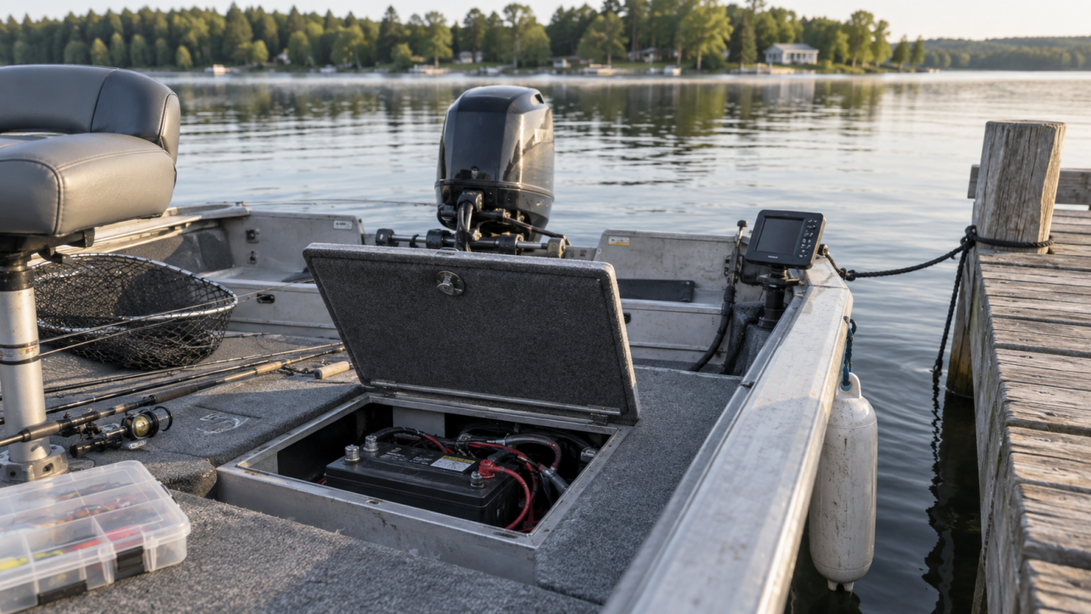

The right lithium battery for your boat depends first on what it powers: match the battery voltage to the equipment, then size its energy for the hours you need between charges. For a trolling motor, confirm whether the motor requires 12V, 24V, or 36V; for lights, pumps, and electronics, total their watt-hours; for engine starting, follow the engine maker’s required marine-cranking rating rather than choosing by amp-hours alone. If your load is a moderate 12V house or electronics setup, a 12V 100Ah-class battery is a reasonable starting point, provided its discharge rating, charger, dimensions, and marine suitability match the installation.
Match the battery voltage to the boat system
Voltage is the first sizing decision because batteries connected to the wrong system voltage will not operate the equipment correctly. A 12V battery suits many small electronics, pumps, lighting circuits, and modest house loads. A 24V or 36V trolling motor needs a battery bank configured for that voltage, not simply a larger 12V battery.
Check the label or manual for the trolling motor, inverter, charger, and other major loads. If the equipment requires 24V or 36V, use a compatible battery bank and confirm that the charger and protection equipment support the same voltage. Do not connect batteries in series or parallel unless the battery manufacturer permits that configuration.
Calculate the energy your boat uses

For a rough house-load estimate, multiply each device’s power by the hours it runs:
watt-hours = watts x hours
Add the results for all devices used between charges. Then allow room for conversion losses, temperature, wiring, battery limits, and unexpected use. A battery’s nominal watt-hours are not the same as the energy you should plan to use in every operating condition.
For a current-based estimate, use:
runtime in hours = amp-hours / average amps
This is an estimate, not a guarantee. Motor speed, wind, current, propeller load, temperature, battery age, and the equipment’s low-voltage cutoff can all reduce actual runtime.
Illustrative sizing example
Suppose your 12V boat uses a fish finder averaging 2A for 6 hours, cabin lights averaging 3A for 4 hours, and a pump averaging 5A for 1 hour:
Fish finder: 2A x 6 hours = 12Ah
Lights: 3A x 4 hours = 12Ah
Pump: 5A x 1 hour = 5Ah
Estimated total: 29Ah
That estimate does not mean a 29Ah battery is the correct purchase. Add reserve for the rest of the boat’s loads, operating conditions, and the battery’s allowed discharge. The example is illustrative; measure your actual loads when the choice is close.
Choose battery capacity from runtime and load
The same amp-hour rating can provide very different results at different voltages. Compare watt-hours when choosing between battery banks:
watt-hours = volts x amp-hours
A 12V 100Ah battery stores about 1,200Wh, or about 1,280Wh when calculated at a 12.8V nominal voltage. That capacity may suit moderate electronics or house loads, but it does not automatically suit a trolling motor that requires 24V or 36V. A higher-voltage motor may need several batteries or a purpose-built higher-voltage battery bank.
For a trolling motor, size capacity from the motor voltage, expected running time, speed, boat load, wind, current, and fishing conditions. A light boat used for short trips may need less capacity than a heavily loaded boat running at high speed for a full day. Choose a battery that can also supply the motor’s continuous and peak current.
For house loads, add the watt-hours for lights, pumps, refrigeration, navigation equipment, communications, and inverter-powered devices. If the boat has substantial electrical demand, keep the engine-starting battery separate so house loads cannot leave the starter without enough energy.
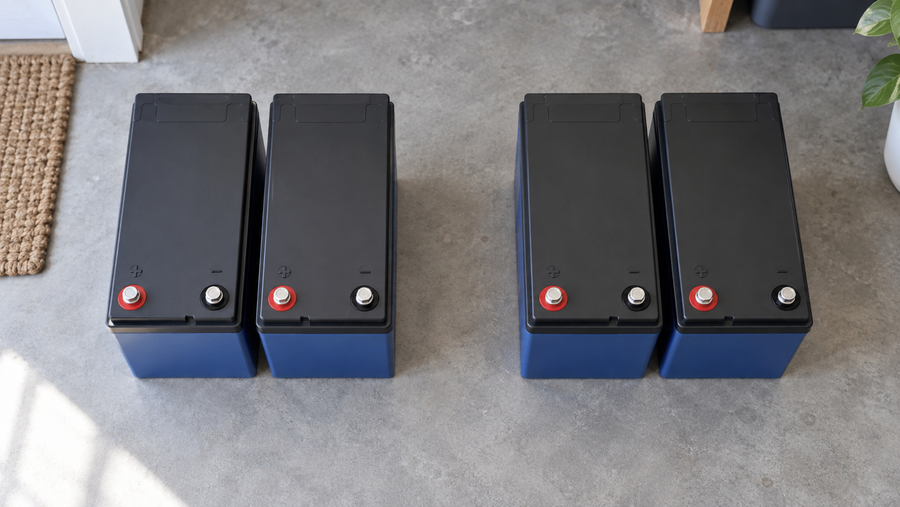
For a moderate 12V electronics or house-load circuit, the Vipboss 12V 105Ah LiFePO4 battery is a candidate when its current rating, physical size, charger compatibility, and installation conditions fit. This battery has 1,344Wh of energy, a 100A battery-management system, a Group 31-size enclosure, and low-temperature charging protection. These specifications do not make it a universal starting or trolling-motor battery. Confirm the equipment voltage and required starting or continuous current before installation.