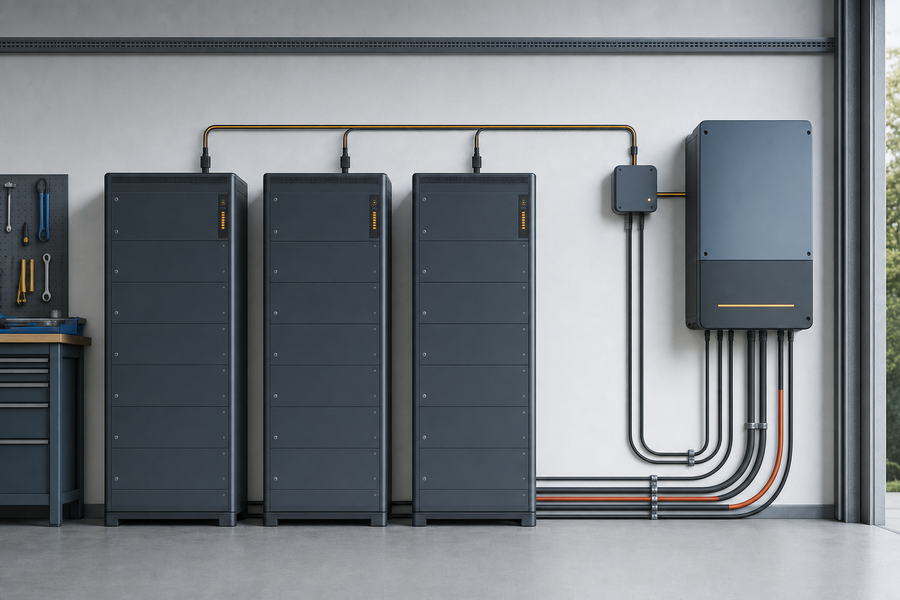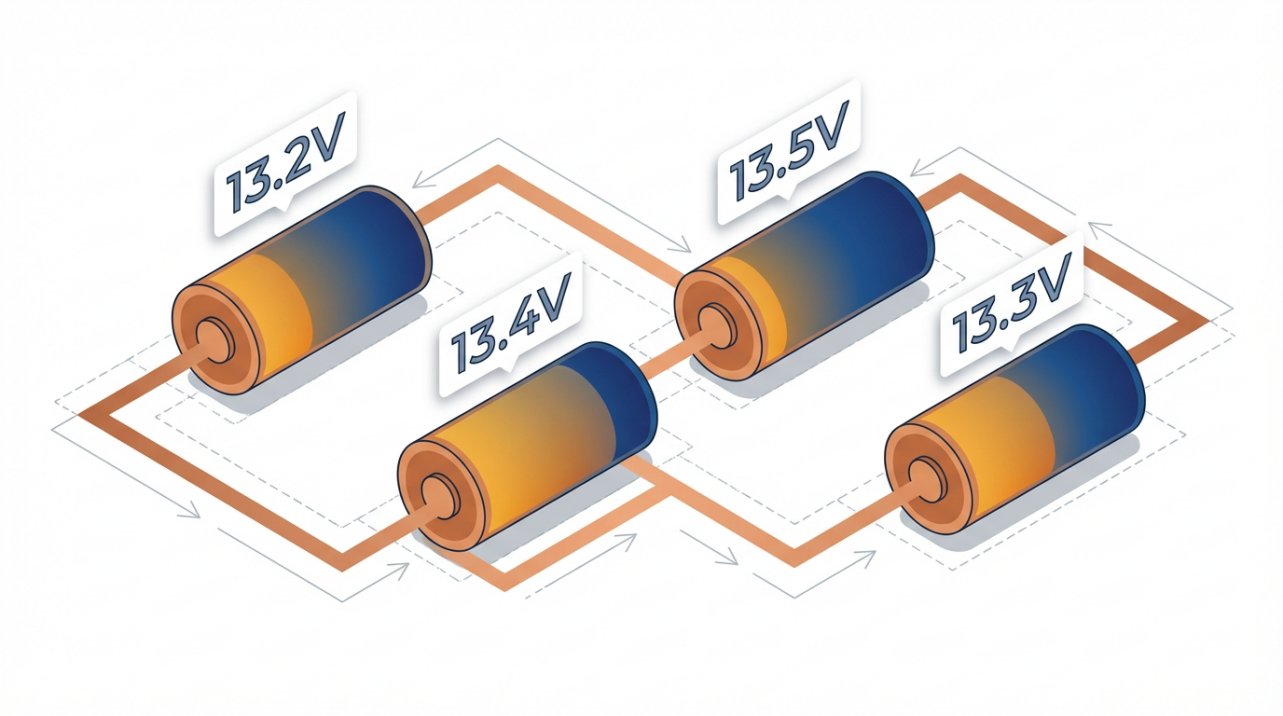

New lithium batteries often arrive at slightly different voltages because no two cells have exactly the same state of charge or internal resistance. If you wire them in series without top balancing, the “high” cells hit their limits first while the “low” cells bottom out early, so the pack never delivers its full rated energy.
Why New Batteries Don’t Match Exactly
Battery voltage is the electrical pressure that drives current, and it is set by the cell chemistry and how full the cell is. Even in the same production batch, cells leave the factory at slightly different states of charge and age at slightly different rates while sitting on the shelf.
A fresh 12 V lithium module might rest near 13.4–13.6 V, while a sibling from the same order sits closer to 13.2–13.3 V. That 0.1–0.3 V spread usually reflects state-of-charge differences, not “bad” batteries, especially because lithium batteries hold a fairly flat voltage over much of their usable capacity window.
Some vendors ship batteries closer to 50% state of charge for safety, while others ship them almost full, so small differences on your meter are normal until you actively equalize them.

How Imbalance Hurts Lithium Banks
In a series string, even small voltage differences translate into different states of charge for each cell. When you charge the pack to a fixed cutoff, the fullest cell hits its upper limit first and the battery management system (BMS) or charger has to back off, leaving the lower cells undercharged.
On discharge, the emptiest cell becomes the bottleneck. It reaches low-voltage cutoff first, so the BMS shuts down the entire bank while plenty of energy is still stored in the stronger cells. That is why a “400 Ah” off-grid bank can feel more like 250–300 Ah in real use when it is poorly balanced.
Lithium chemistries like LiFePO4 hold almost the same terminal voltage across a wide part of their usable capacity. Two modules that both measure around 13.2 V can be at very different depths of charge internally, so relying on pack voltage alone to judge balance is misleading.
What Top Balancing Actually Does
Top balancing means bringing every cell or module to the same full-charge voltage before the pack goes into service. Instead of accepting whatever state of charge the factory and shipping left you with, you deliberately line them up at the top.
Most practical systems do this with passive balancing: the higher-voltage cells are gently bled down as heat while the lower ones keep charging until everything matches. More advanced active balancers move energy from “high” cells to “low” cells, improving efficiency but adding cost and complexity.
Once top balanced, all cells reach their upper and lower limits together.

The BMS no longer has to protect the pack based on one outlier cell, the inverter sees a more stable DC bus, and the whole bank behaves like a single well-matched battery instead of a group of mismatched modules.
Simple Top-Balancing Game Plan for DIYers
Before you assemble the bank, confirm each battery’s resting voltage with a meter and compare it to a healthy open-circuit voltage range for that chemistry. If you are building a 12, 24, or 48 V lithium system for an RV or cabin, a straightforward top-balance looks like this:
- Charge each battery individually with a proper lithium charger to the manufacturer’s specified full voltage.
- Let each one rest disconnected for several hours, then confirm they are within about 0.01–0.02 V of each other.
- Connect them in parallel (all positives together, all negatives together) with appropriately sized cables and fuses, then hold at float for a few hours so cells equalize.
- Once the bank sits rock-steady at the same voltage across all modules, rewire into the final series configuration.
- Program your BMS and charger limits (pack high/low cutoffs, charge current) based on the balanced pack and record those values for future checks.
If a brand-new module still sits noticeably lower or higher than the others after this process, treat it as suspect—return it or isolate it rather than burying it in the middle of a critical series string.
Do this once at the start of a retrofit, and your power-upgrade bank will charge harder, run longer, and protect itself better every time the sun sets or the generator shuts off.