
To calculate a bank of identical batteries, multiply one battery’s nominal voltage by the number connected in series. Then multiply one battery’s amp-hour rating by the number of parallel strings. Multiply the bank voltage by the bank capacity to get watt-hours. These formulas apply only when all batteries have the same ratings and every parallel string contains the same number of batteries. If the batteries or strings do not match, this simple calculation does not apply.
Use the series and parallel counts separately

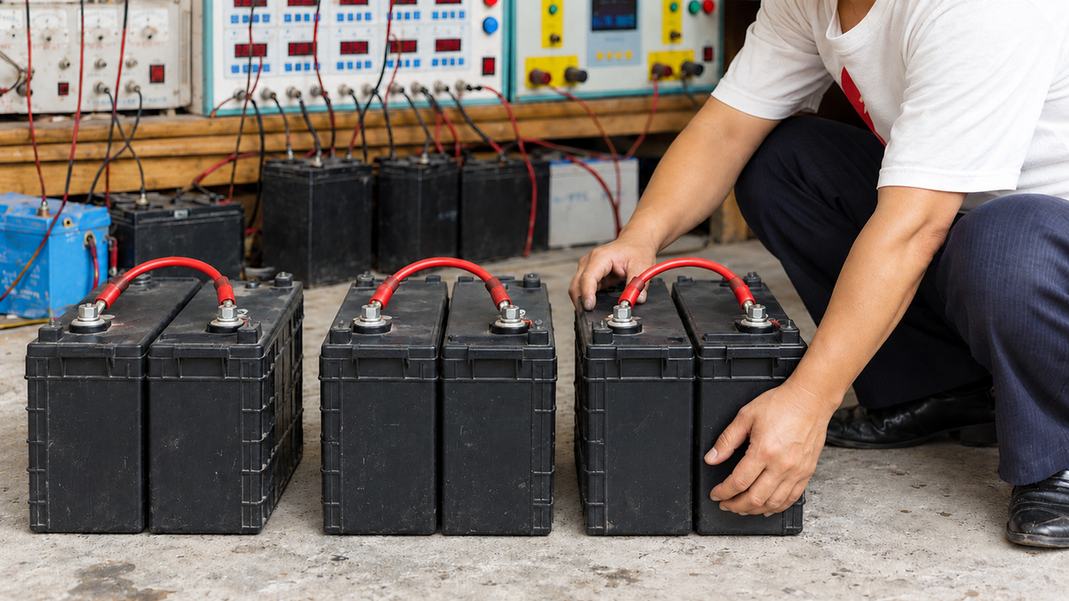
A series count is how many batteries are connected in each string. A parallel count is how many identical strings are joined together. In the notation 2S3P, the bank has two batteries per series string and three parallel strings.
| Result | Formula for identical batteries |
|---|---|
| Bank voltage | Battery nominal voltage × series count |
| Bank capacity | Battery amp-hours × parallel count |
| Bank energy | Bank voltage × bank amp-hours |
| Total batteries | Series count × parallel count |
For a battery rated V volts and C amp-hours in an S-series, P-parallel bank:
bank voltage = V × S
bank capacity = C × P
bank energy = V × C × S × P
Use the battery’s stated nominal voltage, not just a rounded class name such as “12V.” Keep voltage in volts, capacity in amp-hours (Ah), and energy in watt-hours (Wh). Divide watt-hours by 1,000 to express the result in kilowatt-hours (kWh).
Calculate the bank from its configuration

Illustrative example: 2S3P. This layout has two 12V, 100Ah batteries in each series string, with three matching strings in parallel. The bank is 2 × 12V = 24V, and its capacity is 3 × 100Ah = 300Ah. Its nominal energy is 24V × 300Ah = 7,200Wh, or 7.2kWh. The bank contains 2 × 3 = 6 batteries.
The same six batteries do not always produce the same voltage and capacity. Their layout determines the result:
| Six identical 12V, 100Ah batteries | Bank voltage | Bank capacity | Nominal energy |
|---|---|---|---|
| 1S6P | 12V | 600Ah | 7,200Wh |
| 2S3P | 24V | 300Ah | 7,200Wh |
| 3S2P | 36V | 200Ah | 7,200Wh |
| 6S1P | 72V | 100Ah | 7,200Wh |
This shows why total battery count alone cannot tell you the bank voltage or amp-hours. With identical batteries, changing the layout redistributes voltage and capacity while the nominal energy total remains the sum of the individual battery energies.
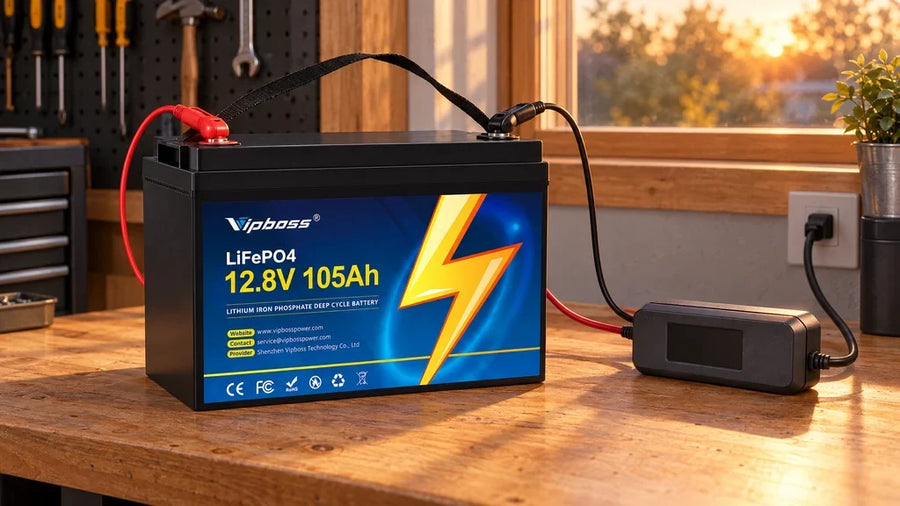
For a product-based calculation, the Vipboss 12V 105Ah battery is rated at 12.8V, 105Ah, and 1,344Wh and supports configurations up to 4S4P. With four batteries in each series string and four strings in parallel, the bank contains 16 batteries: 4 × 12.8V = 51.2V, 4 × 10⁵Ah = 420Ah, and 51.2V × 420Ah = 21,504Wh, or 21.504kWh.
If you know only the total number of batteries, first identify the series and parallel counts from the proposed layout; the total count alone does not determine the bank voltage or amp-hours. If the batteries or strings have different ratings or layouts, calculate from each string’s actual ratings and permitted configuration rather than applying the single-battery shortcut.
Rated watt-hours do not by themselves establish how much energy a particular load can use. Actual sizing may also require adjustments for discharge rate, temperature, aging, and depth of discharge, as covered in Oregon State’s stationary-battery sizing material.
Work backward from a target bank
You can also rearrange the formulas when choosing a layout. For identical batteries:
required series count = target bank voltage / one battery's nominal voltage
required parallel count = target bank amp-hours / one battery's amp-hours
Both results must be whole numbers, and the proposed series and parallel counts must be permitted by the battery manufacturer. For example, a target of 25.6V and 315Ah using 12.8V, 105Ah batteries gives 25.6 / 12.8 = 2 in series and 315 / 105 = 3 strings in parallel: a 2S3P bank containing six batteries.
This arithmetic identifies a nominal layout; it does not approve the design. Confirm the battery's series/parallel limit, BMS behavior, charging equipment, inverter voltage, cable and protection requirements, and whether communication between batteries is required.
Avoid four common calculation errors
- Adding amp-hours in series. Series raises voltage; the string retains the amp-hour rating of one matched battery.
- Adding voltage in parallel. Parallel raises capacity; the bank retains the nominal voltage of one string.
- Using “12V” instead of the stated nominal voltage. A 12.8V battery produces different watt-hour math from a 12.0V assumption.
- Treating nominal energy as runtime. Runtime also depends on usable capacity, load, conversion losses, temperature, and operating limits.