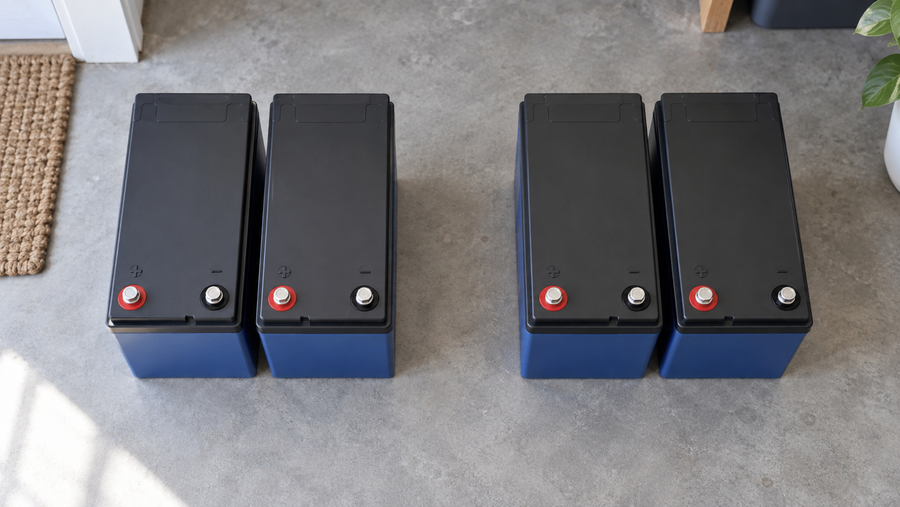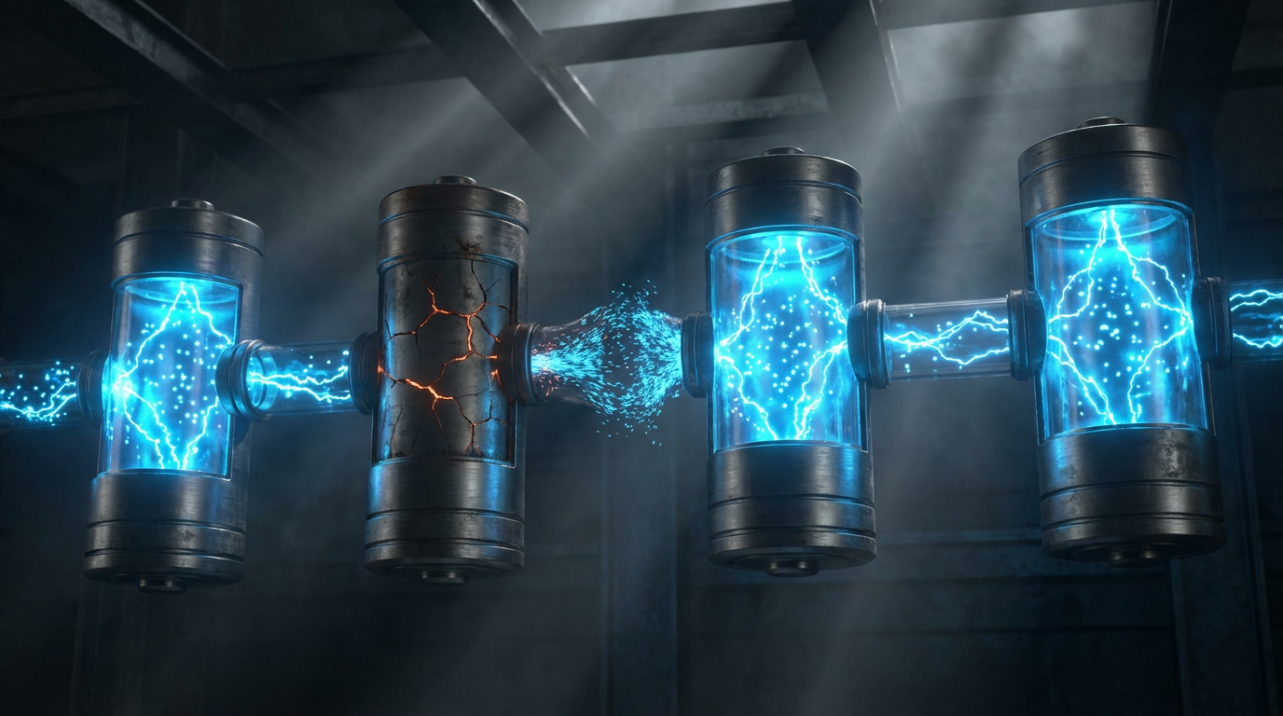

Yes, series battery strings definitely have a barrel effect, where one weak cell hits its limits first and drags down the whole pack. In real off-grid systems, that single lagging battery decides when your inverter quits, no matter how healthy the rest of the bank is.
The Barrel Effect in a Series String
In a series connection, the current is identical through every battery, so the string can only work as hard as its weakest member. Voltage adds, but the amp-hour capacity is effectively capped by the lowest-capacity battery in the chain.
If one battery has higher internal resistance or less capacity, it reaches low-voltage cutoff and sags first, pulling the total pack voltage down and forcing an early shutdown. That is the barrel effect in action: the shortest stave sets the water line.

For lithium packs, the battery management system (BMS) makes this even more absolute: once any cell in any series battery hits its limit, the entire string is taken offline to protect the pack.
How One Weak Battery Caps System Energy
Picture four 12 V, 100 Ah LiFePO4 batteries in series forming a 48 V, 100 Ah bank. On paper, that is 4,800 Wh of storage.
Now imagine one of those batteries has aged down to about 70 Ah while the others are still near 100 Ah. Because the same current flows through all four, the weak unit hits empty first, so you only get about 3,360 Wh (48 V at roughly 70 Ah) before your inverter or BMS shuts things down.
You just lost about 30% of your usable energy, even though three-quarters of the bank still has charge in the tank.

This is exactly why series banks demand closely matched batteries in voltage and capacity, as emphasized in many series-versus-parallel connection guides.
On top of that, the weak battery runs hotter under heavy loads, which accelerates aging and makes the barrel effect worse over time.
Why Lithium Off-Grid Banks Feel It First
Lithium chemistry is unforgiving of overcharge and deep over-discharge, so modern packs use strict per-cell voltage limits. In a series string, the BMS must react to the first cell that hits those limits.
Manufacturing tolerances, different ages, or mixing brands all create small capacity and resistance differences. Over hundreds of cycles, that small mismatch snowballs into a clearly weak battery that dictates when the lights go out.

Lithium manufacturers are clear: for series connections, batteries must match in voltage, capacity, and model, and the allowable series count is limited and spelled out in the datasheet for safe operation in series or parallel lithium banks. Ignore those limits, and the barrel effect shows up sooner and more severely.
Design Like a Pro: Preventing the Barrel Effect
In the field, the cleanest-running off-grid systems all follow the same series-bank rules.
- Use identical batteries: Keep chemistry, model, capacity, and age the same; never mix whatever is on sale into a series string.
- Start with equal state of charge: Before wiring in series, fully charge and, if possible, top-balance packs so every unit starts on the same rung of the ladder.
- Respect series limits and voltage: Stay within the manufacturer’s maximum series count and keep system voltage in a range your gear and safety plan can safely handle.
- Treat the string as a single unit: When one series battery fails or is clearly lagging, plan to replace the whole string or retire it to lighter duty rather than bolting a brand-new pack into a group of tired ones.
- Oversize instead of pushing hard: Design for shallow daily depth of discharge and moderate currents; the less you stress the weakest battery, the longer your barrel stays full.
Some vendors report longer life in all-series banks, but across the projects I have optimized, depth of discharge, temperature, and battery matching matter far more than series-versus-parallel configuration on paper.
When to Rethink Your Series-Only Strategy
If your retrofit relies on a tall series stack and you are already seeing early cutouts, hot spots, or one battery consistently low on voltage, you are looking at the barrel effect in real time. At that point, adding more batteries in parallel strings of well-matched series modules can be smarter than building one ever-longer chain.

Series remains the right choice for higher-voltage, efficient power delivery, especially for big inverters and long cable runs. But to keep that upgrade performing like new, design and maintain it as if every battery has the potential to be the limiting stave in your barrel, because electrically it does.