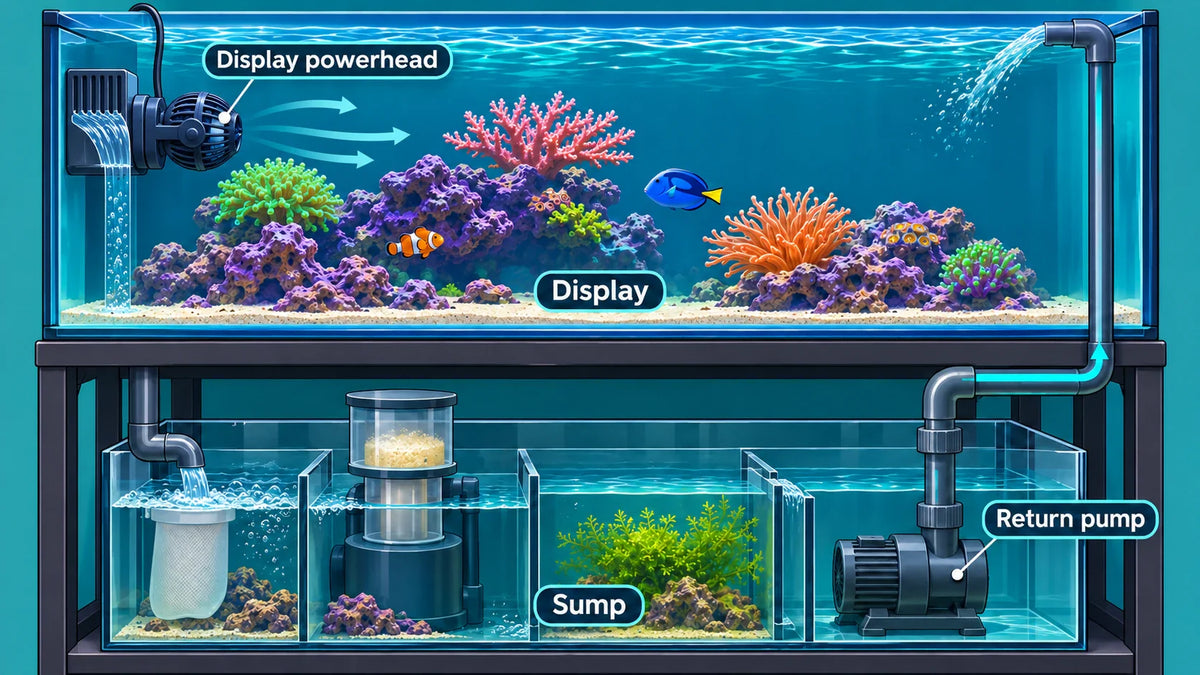

Back up the return pump when it provides useful circulation through both the sump and display and its observed outage water behavior makes that flow worthwhile. Favor a display powerhead when it keeps needed water movement and surface disturbance in the display, while return flow adds little or is not useful under outage conditions. When both devices meet the tank's movement needs, lower measured draw favors that option; when their benefits differ, weigh the extra useful movement against the extra energy it takes.
Compare the movement each device provides
With each device running, look at where its flow goes, whether it moves the display surface, and whether it circulates the display areas that matter to you during an outage. Surface movement is relevant because it promotes oxygen and carbon-dioxide exchange, as aquarium power-outage guidance explains. If the powerhead visibly disturbs the surface and keeps important display areas moving, while the return mainly sends water through the sump, the powerhead may preserve more of the movement you need in the display.

The return pump earns priority when its flow through the sump also produces meaningful circulation in the display that a powerhead alone would not provide. If both devices move the display well but only one disturbs the surface, that difference favors the device that provides the surface movement you need. If the return adds little display movement during the outage, its usual role in the filtration loop is not by itself a reason to back it up.
Let outage water behavior change the return choice
A return pump moves water between the display and sump. When power stops, water can drain from the display and overflow into the sump; what happens depends on the system's water levels and return arrangement. Observe where the water settles and how the sump behaves during an outage. If the return path leaves the sump without a useful role in the outage, or its observed water behavior makes return flow an unsuitable priority, favor display circulation. If return flow continues to serve a meaningful system need and the sump and display behave acceptably, backing up the return can make sense.

One documented reef-aquarium system describes its display draining to the return-nozzle level and its weirbox to the overflow-pipe level when the return pump is off, and calls for checking that the sump can accommodate that system's drain-down. This system-specific drain-down example illustrates why your own observed water behavior matters; those levels are not a rule for other aquariums.
Weigh useful movement against measured draw
Compare each device's consumption in the backup mode you intend to use with the movement it preserves. If both provide the needed surface disturbance and display circulation, the one with lower measured draw is the stronger priority under limited energy. If the lower-draw device leaves an important area still or fails to disturb the surface, its energy advantage may not make up for the movement you lose. In that case, the higher-draw device may deserve priority if its added movement addresses that need. The choice turns on whether that specific movement benefit is worth the difference in measured draw, not on nominal device role alone. Use the battery runtime calculator for general runtime arithmetic.
Check what happens during an outage
During a simulated-outage check, observe whether the selected device keeps the surface and important display areas moving, how the display and sump water behave, and what the device draws in backup mode. If the powerhead leaves needed display movement lacking while the return provides it and the sump behavior is acceptable, favor the return. If return flow adds little, or the observed water behavior makes it a poor priority, favor the powerhead. If both preserve the needed movement but the chosen one draws more, reconsider whether its added benefit justifies that energy tradeoff. The outage test guide covers the full test procedure.