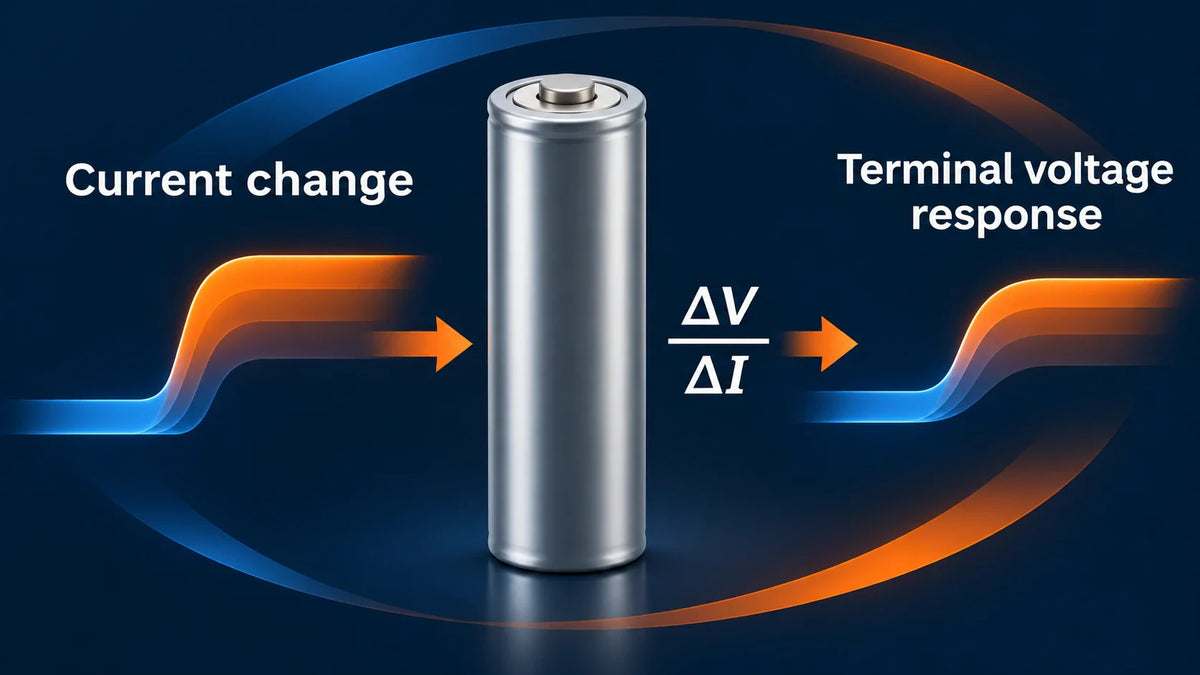

A lithium-ion cell’s internal resistance measures how much its terminal voltage changes when current changes, for a specified test method and time interval. It is commonly expressed as ΔV/ΔI in ohms or milliohms. This is an effective electrical response, not a single literal resistor inside the cell.
What the number represents
When current through a cell changes, its terminal voltage responds. Dividing the voltage change, ΔV, by the current change, ΔI, gives an effective resistance for that measurement. For example, if a test observes a 0.01-volt change for a 1-amp change in current, the ratio is 0.01 ohm, or 10 milliohms. This arithmetic illustrates the ratio; it is not a performance threshold.

The response can include more than an immediate voltage drop. The measurement interval matters: the initial response is associated with ohmic resistance in the cell’s electronic and electrolyte paths, while slower charge-transfer and diffusion-related polarization can contribute as the response continues. These contributions explain why a reported value depends on when voltage is sampled. Research on lithium-ion cell measurement timescales describes these distinct effects, while CALCE’s overview of DC internal-resistance testing explains how pulse duration affects the measured response.
How to interpret a reading
A larger reading means a greater voltage change per unit of current change in that particular test. Resistance can help characterize cell performance or state of health, but it does not directly measure stored capacity and cannot, by itself, establish that a cell is healthy or defective.
Readings can differ with the measurement method and sampling time, as well as cell temperature and state of charge. To compare readings, use the same method and comparable temperature and state of charge. Otherwise, a difference may reflect test conditions rather than a change in the cell. No single resistance value provides a universal pass/fail judgment across cells and test methods.
FAQs
Does a lithium-ion cell’s internal resistance measure its capacity?
No. Internal resistance describes voltage change in response to a current change under a particular test, while capacity measures stored charge.
Why can a cell’s internal-resistance reading change with the test method?
The measured voltage response depends on when it is sampled: slower charge-transfer and diffusion-related effects can contribute alongside the initial ohmic response. Temperature and state of charge can also affect the reading.