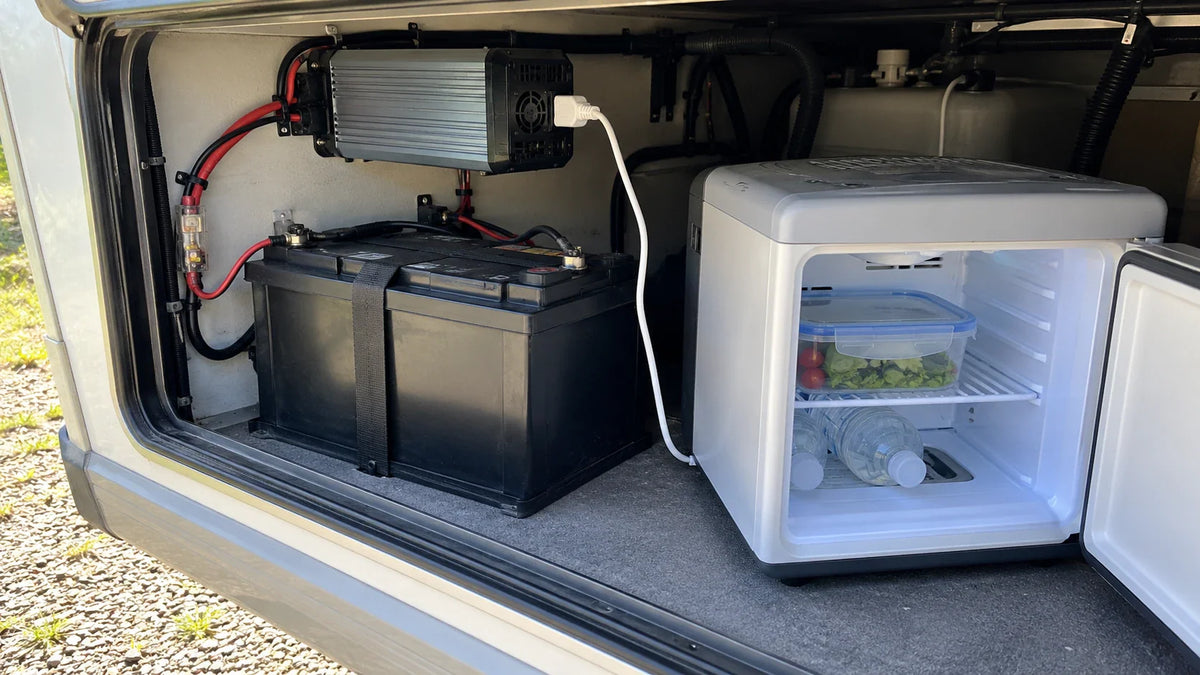

Yes, a 12V lithium battery can run an appliance when the inverter handles both its normal and startup demand and the battery-side current stays within the battery and BMS limits. Start with the appliance's running watts and highest startup watts, then check the inverter's continuous and surge ratings. Finally, convert the AC load to approximate 12V battery current; if that result exceeds the BMS or inverter input limit, the system may shut down even when the battery has enough stored energy.
Check running watts and startup watts separately
Running watts are the power an appliance uses after it is operating. Startup watts are the highest demand during the moment a motor, compressor, pump, or other load starts. Use the total startup demand, including other loads that remain on, rather than adding only an appliance's extra surge. A motor can need much more power during startup than during normal operation. Oregon State's battery-sizing material explains why starting current and running current must be treated separately.
Write down three values from the appliance label or manual:
- Normal running watts.
- Startup or locked-rotor watts, when provided.
- The startup duration, when the appliance maker provides it.
If the appliance gives only amps, use watts = volts x amps for a simple estimate. For a motor load without a stated startup value, do not assume a universal multiplier. Treat the startup requirement as unknown until the appliance documentation or a suitable measurement provides it.
Compare both values with the inverter
The inverter needs a continuous AC rating at least as high as the loads that can run together. Its surge rating must also meet the highest total startup demand for the required duration. A continuous rating that passes the running-watt check does not prove that a refrigerator, pump, compressor, or motor will start.
For a planning estimate, you can calculate a continuous requirement as:
running watts x (1 + chosen headroom percentage)
For example, 800 W of simultaneous running load with an illustrative 25% planning margin gives 1,000 W. That is a derived planning value, not a universal inverter rule. The startup check remains separate. The inverter-sizing reference also treats continuous load and startup peak as separate limits and says to verify surge magnitude and duration in the actual inverter documentation.
Check the inverter's manual for its DC input-voltage range, continuous output, surge watts, surge duration, waveform, and temperature conditions. If the inverter trips only when the appliance starts, the startup rating or duration is the first place to investigate. If it trips after running for a while, check continuous output, battery current, voltage drop, heat, and other loads that are operating at the same time.
Convert appliance watts into 12V battery current

The battery supplies DC power while the inverter produces AC power. A useful estimate is:
battery current = AC watts / (battery voltage x inverter efficiency)
Use the inverter's stated efficiency when available. The following example uses 12.8 V and 90% efficiency only to show the calculation:
| AC load | Approximate battery current at 12.8 V and 90% efficiency |
|---|---|
| 500 W running | 43.4 A |
| 1,000 W running | 86.8 A |
| 2,000 W running | 173.6 A |
| 2,560 W running | 222.2 A |
These are illustrative derived values. Actual current changes with battery voltage, inverter efficiency, temperature, wiring, and transient behavior. A 12V system carrying high AC power can therefore require very high DC current. The inverter-sizing calculation reference uses the same relationship for an approximate battery-side current estimate.
For a concrete comparison, the Vipboss 12V 210Ah Bluetooth LiFePO4 battery has a 12.8 V nominal voltage, a 200 A smart BMS, and a 2,560 W maximum load-power rating. At the nominal voltage, 12.8 V × 200 A = 2,560 W DC; with the illustrative 90% inverter efficiency used above, that corresponds to about 2,304 W AC. A 2,560 W AC load would instead require about 222.2 A, so the appliance must be checked on the battery side rather than matched to the load-power number alone.
The battery-side check must pass at both normal operation and startup. Compare the calculated current with the inverter's maximum DC input current and the battery's continuous and peak discharge limits. The lowest applicable limit determines the system's available output.
Read the result before connecting the appliance
The setup is a reasonable match only when all of these checks pass:
- The appliance's running watts fit the inverter's continuous rating with the other simultaneous loads included.
- The total startup demand fits the inverter's surge rating for long enough to start the appliance.
- Estimated battery current at both running and startup conditions stays within the inverter input limit and the battery BMS limits.
- The inverter accepts the battery's actual voltage range.
- The cables, fuses, terminals, and disconnects are rated for the resulting DC current under the equipment manuals and applicable electrical requirements.
If the appliance starts and then the inverter shuts off, the startup event may exceed the inverter or BMS limit. If the system runs briefly and then shuts down, continuous current, voltage sag, heat, or an additional load may be the problem. Stop using the setup until the specific limit is identified; do not defeat BMS or inverter protection.
Frequently asked questions
Can a 12V lithium battery run a household appliance?
It can when the inverter handles both running and startup demand and the battery-side current stays within all applicable limits.
Why does an appliance need more power at startup?
Motors, compressors, and pumps can draw a short surge when starting, which may be much higher than their normal running power.
How do I estimate battery current for an AC appliance?
Divide the appliance power by battery voltage and account for inverter efficiency. Then compare the result with the battery, BMS, inverter, cable, and fuse limits.