
If a marine battery label looks like a string of unrelated numbers, start by separating the jobs: group size tells you whether the case and terminals can fit, CCA and MCA describe engine-starting power, and Ah and RC describe stored energy or reserve time. Then match the battery type to how you use the boat. A starter battery and a deep-cycle battery can have similar-looking labels but serve different loads.
Read the label by battery job
| Label item | Unit / meaning | When it decides the choice |
|---|---|---|
| Group size | Case and terminal layout designation | Fit and terminal clearance for any installation; it does not prove electrical compatibility. |
| CCA / MCA | Starting-current ratings under different test conditions | Match the engine manufacturer's specified rating for a starting battery; do not swap one number for the other. |
| Ah | Charge capacity under a stated test rate | Estimate house or trolling-bank energy only after multiplying by voltage and applying usable-capacity limits. |
| RC | Minutes under the rating's defined load and cutoff | Compare reserve time only for ratings measured by the same method. |
| Continuous discharge limit | A, when supplied | Check motor/controller or inverter demand and BMS capability. |

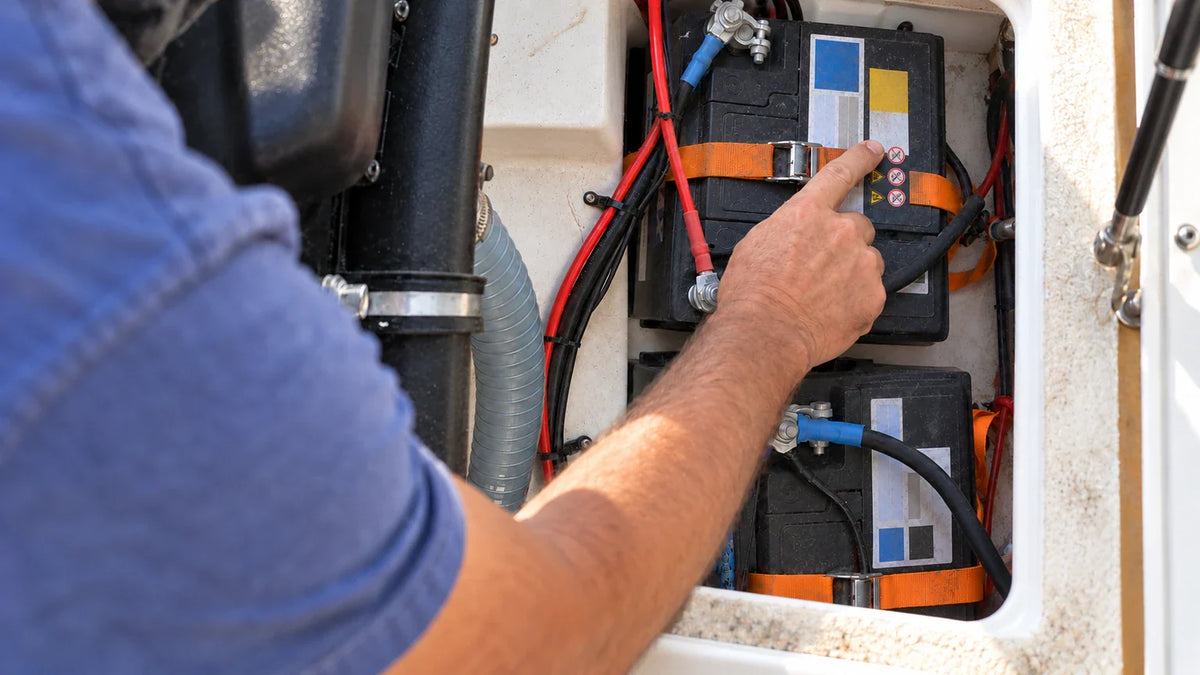
Illustrative label, not a product specification: Group 31 | 12 V | MCA ___ A | CCA ___ A | Ah ___ | RC ___ min. Circle the group size when checking the tray; circle MCA/CCA when checking the engine manual; circle Ah/RC and continuous current for house loads or a trolling motor. If a field is absent, ask the battery manufacturer for its datasheet rather than inventing it from another rating. The existing illustration below is a visual guide; the blank label above shows exactly which figures to seek on a real battery.
Group size tells you whether the battery can fit
A marine battery group size is a physical size code. It helps identify the case dimensions and terminal arrangement, such as Group 24, Group 27, or Group 31. It is not a direct measure of battery quality, chemistry, capacity, or starting power.
Before replacing a battery, compare the existing group size with the boat's battery compartment or box. Check the length, width, height, terminal position, hold-down, and cable reach. A battery can have enough electrical capacity and still be unsuitable if it cannot be secured or its terminals do not line up safely.
Group size also does not guarantee that two batteries are interchangeable. Chemistry, charging requirements, terminal design, starting rating, and the boat's electrical system still need to match.
CCA and MCA describe starting power
CCA, or cold cranking amps, is a starting-current rating measured under a colder test condition. MCA, or marine cranking amps, is another starting-current rating measured at a warmer temperature. Because the test conditions differ, the numbers are not directly interchangeable.
Use these ratings for the engine-starting part of the job. A higher number generally gives more starting-current capability under the stated test, but it does not tell you how long the battery can run lights, electronics, pumps, or a trolling motor with the engine off.
For a boat that must start reliably, compare the battery's starting rating with the engine maker's requirement. Do not choose by group size alone. A physically fitting battery may still lack the starting capability your engine needs.
Ah and RC describe energy available after starting
Ah, or amp-hours, describes charge capacity. It is useful when estimating how long a battery can support loads such as lights, fish finders, radios, pumps, or other equipment. The actual runtime depends on the load, battery type, temperature, wiring, state of charge, and the usable portion of the rated capacity.
RC, or reserve capacity, describes how long a lead-acid battery can deliver a specified test current before reaching the test's endpoint voltage. It is a time rating, usually expressed in minutes. RC helps compare reserve performance, but it is not the same thing as Ah and should not be converted casually without knowing the test conditions.
A simple illustrative estimate can show the relationship between load and capacity. If a 12-volt system draws 5 amps continuously, a nominal 100-Ah rating suggests 20 hours before adjustment for battery chemistry, usable capacity, temperature, and discharge limits:
100 Ah / 5 A = 20 hours
That is an illustrative calculation, not a promise of runtime. A motor, inverter, refrigerator, or pump may draw more current during startup, and a battery may not provide its full label capacity under every operating condition.
Battery type tells you what kind of work it is built to do
Marine batteries are commonly used as starter batteries, deep-cycle batteries, or dual-purpose batteries. Starter batteries are designed to deliver a short, strong burst for engine starting. Deep-cycle batteries are designed to provide steadier power over a longer discharge. Dual-purpose batteries combine some starting and cycling capability, but they may involve trade-offs compared with a battery designed for only one job.
Chemistry also matters. Flooded lead-acid batteries may require ventilation and fluid maintenance. AGM and gel batteries use sealed constructions, but they still require a compatible charging system. Lithium iron phosphate, or LiFePO4, batteries are lighter than many lead-acid alternatives and need charging and protection equipment that supports the battery's requirements.
Choose the type from the main load. If the battery starts the engine, prioritize the required starting rating. If it runs equipment while the engine is off, prioritize suitable deep-cycle capacity and the charging system. If it must do both, verify that the battery is explicitly suitable for both roles rather than assuming its group size answers the question.
How the labels fit together

Think of a marine battery label as a set of separate answers:
The quickest way to read a label is to ask four questions: Will it physically fit and secure? Does its starting rating meet the engine requirement? Does its capacity suit the equipment running with the engine off? Is its chemistry compatible with the charger and system?
The Vipboss 12V 105Ah Bluetooth LiFePO4 battery puts 1,344Wh of house-power capacity, Bluetooth monitoring, and a built-in 100A smart BMS into a Group 31-size case. That combination makes it easy to compare the three things a group label cannot answer on its own: physical fit, available energy, and day-to-day battery visibility. For a two-battery marine system, it gives lights, electronics, pumps, and refrigeration a dedicated lithium house bank while the starting battery is selected by the engine's required MCA or CCA rating.
The key distinction is simple: group size answers “Will it fit?”, CCA and MCA answer “Can it start the engine under the stated test?”, Ah and RC answer “How much reserve does the rating represent?”, and battery type answers “What job is this battery intended to perform?” Read the labels together, then verify the engine, charger, compartment, terminals, and connected loads before replacing the battery.
FAQs
What does a marine battery group size tell you?
A marine battery group size is a physical size code that helps identify the case dimensions and terminal arrangement, such as Group 24, Group 27, or Group 31. It does not directly indicate the battery’s chemistry, capacity, quality, or starting power, so also verify the compartment, hold-down, terminals, cable reach, and electrical requirements.
What is the difference between CCA, MCA, Ah, and RC on a marine battery?
CCA and MCA are starting-current ratings measured under different temperature conditions, while Ah describes charge capacity and RC describes reserve time under a specified test current. CCA and MCA help evaluate engine-starting capability, whereas Ah and RC help compare energy or reserve for equipment used when the engine is off; neither guarantees a particular runtime in every condition.
How should you choose between a starter, deep-cycle, and dual-purpose marine battery?
Choose a starter battery when the primary job is delivering a short, strong burst for engine starting, and choose a deep-cycle battery when the battery must provide steadier power over longer discharges. A dual-purpose battery is intended to handle both roles, but you should still confirm that its starting rating, capacity, chemistry, charging requirements, and physical fit match the boat and its loads.