
Neither chemistry is automatically better for every boat. First compare the boat's space, use pattern, existing system, and purchase priorities with the manufacturer documentation; choose lithium when its documented requirements fit those conditions, and favor lead-acid when keeping the existing system and simplifying replacement matter more.
Compare equivalent usable energy before comparing price or weight
The existing house-bank example uses illustrative 50% and 80% usable-capacity assumptions. At those assumptions, one 12 V × 100 Ah flooded pack supplies about 600 Wh planned usable energy, while one 12.8 V × 105 Ah lithium pack supplies about 1,075 Wh. To target roughly 1 kWh planned usable energy, the flooded option would need about 2.0 kWh nominal, versus about 1.25 kWh nominal for lithium. These are calculations, not measurements of any actual lead-acid product.
| Compare for the same house-load job | Flooded lead-acid | LiFePO4 |
|---|---|---|
| Number of packs / weight / space | Enter actual model count, mass, case dimensions and secured-installation clearance | Enter actual model count, mass, case dimensions and secured-installation clearance |
| Installed price | Battery + suitable charger + fittings + installation | Battery + compatible charging path + BMS-related installation + fittings |
| Life and maintenance | Maker cycle/calendar conditions, watering and charging schedule | Maker cycle/calendar conditions, charge-temperature and BMS limits |
Fill this table from the two specific datasheets and current quotes. A lower initial price cannot establish lower ownership cost without the expected replacement interval. Do not use this house-bank comparison to choose an engine-starting battery: first meet the outboard maker's cranking rating and charging-compatibility requirements.
Choose lithium when weight, space, and repeated use matter

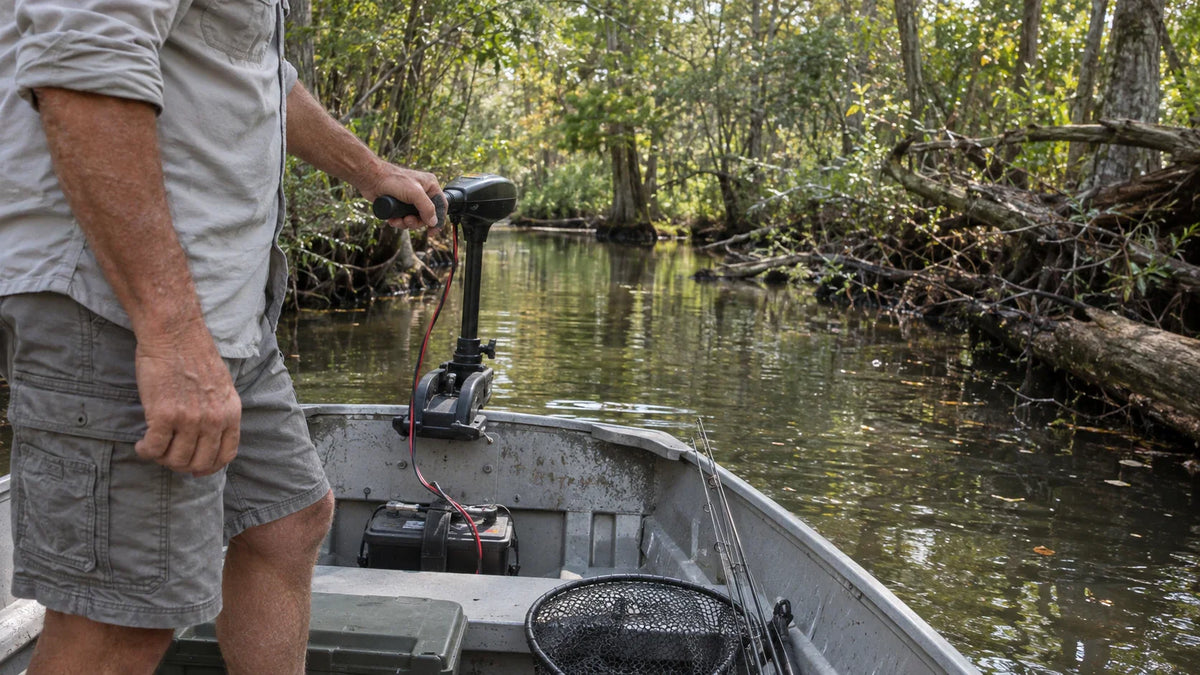
Consider lithium when lower battery weight, limited storage space, or repeated use are important selection criteria for your boat. Compare the proposed battery's documented characteristics with the boat's requirements instead of assuming that the chemistry alone determines the result.
For a marine-oriented product example, review the Vipboss 12V 105Ah Bluetooth LiFePO4 Lithium Battery. Vipboss lists this model for marine applications and trolling motors, but you should still confirm its voltage, charging requirements, dimensions, terminal layout, and installation requirements against your boat before ordering.
Before choosing it, verify the battery manufacturer's requirements against the boat's existing documentation. If those requirements cannot be confirmed, do not treat physical fit alone as sufficient grounds for replacement.
Choose lead-acid when simplicity and initial cost come first
Lead-acid may be the more practical choice when the boat already uses it and keeping the existing system or limiting the purchase cost is more important than changing chemistry. It may also suit a boat whose use pattern does not make the alternative's stated characteristics a priority.
For a replacement, match the proposed battery with the boat's documented requirements. Do not assume that changing chemistry is a direct replacement; check the relevant battery and boat manuals before ordering.
A same-job example: 12V house power, not engine starting
For house loads, compare a clearly hypothetical 12V 100Ah flooded battery with the Vipboss 12V 105Ah LiFePO4 model. The flooded example is a calculation placeholder, not a quoted product; substitute the actual lead-acid model's datasheet before buying. The two options' usable energy and charging needs must be checked separately.
| House-bank comparison | Illustrative 12V 100Ah flooded battery | Vipboss 12V 105Ah LiFePO4 |
|---|---|---|
| Nominal energy | 12V × 100Ah = 1.20kWh (assumption) | 12.8V × 105Ah = 1.344kWh (maker-listed capacity and nominal voltage) |
| Charging/maintenance | Flooded watering and charger guidance apply | LiFePO4 charge profile, BMS and cold-charge limits apply |
| Example planned usable energy | At an illustrative 50% DoD: about 0.60kWh | At an illustrative 80% DoD: about 1.08kWh |
The 50% and 80% limits are planning assumptions, not the makers' promises for these exact products. Recalculate from each product's manual and the boat's required reserve. The cost decision must include a compatible charger/controller, wiring or installation changes, and maintenance over the intended ownership period; nominal battery price alone is not total cost. Record the date and source of each actual quote instead of inventing a universal payback period.
Engine starting is a separate decision. This house-load example does not prove that the Vipboss model has the cranking rating, terminal arrangement, or maker approval required for a particular outboard. Use an engine-approved starting battery unless both the engine and battery manufacturers explicitly confirm the lithium alternative.
Compare the two options at the point that changes your decision
| If this describes your boat | Next decision |
|---|---|
| Weight or storage space is a major constraint | Compare the documented size and weight of both options with the boat's requirements. |
| The boat is used repeatedly between charging opportunities | Compare each option's documented suitability with that use pattern. |
| The existing lead-acid system works and replacement simplicity matters | Check whether staying with the existing chemistry meets the boat's requirements. |
| Purchase priorities favor the lower initial spend | Compare the purchase terms for each option without assuming the total cost. |
| The boat and battery documentation has not been checked | Choose neither yet; verify the relevant documentation first. |
Use the row that best matches the decision you are making. If more than one row applies, resolve the documentation and system-fit questions before treating weight, use pattern, or purchase priority as decisive.