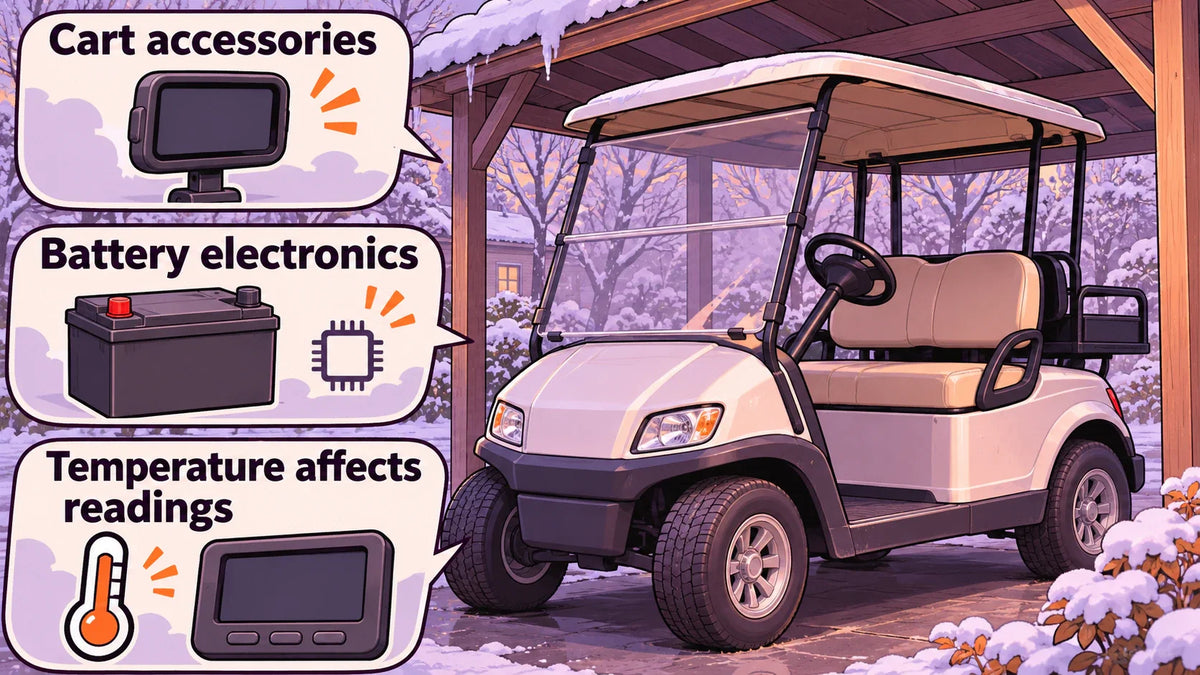

A lithium golf cart battery can lose charge while parked because of battery-side storage losses, including power used by its battery management system (BMS), or because the cart or an accessory continues drawing power. Winter temperature can also affect readings and whether charging is available; cold alone does not prove that energy is being consumed faster.
Start with comparable readings

Record a baseline. When you park the cart, note the battery’s own state-of-charge reading, its temperature, recent use or charging, and whether powered accessories remain connected. Repeat the observation later at a similar temperature and under similar conditions. This helps distinguish a repeatable change from a reading that shifted after use, charging, or a temperature change.
A single voltage or displayed percentage cannot identify the cause. Voltage depends on battery condition and measurement circumstances, while a displayed estimate may not represent a direct measurement of stored energy. Use the battery’s own display or monitoring method consistently, and treat the pattern over time as more informative than one reading.
Check for a parked load
Displays, trackers, alarms, converters, or other powered equipment may draw power while the cart is not moving. Note which devices remain powered and whether the battery reading changes in that configuration.
If the battery and cart instructions provide an isolation method, compare observations with cart-side loads connected and isolated using that method. Do not improvise a disconnection. A smaller decline with loads isolated makes cart or accessory draw more plausible. Similar decline in both conditions does not prove a battery fault: internal battery losses and temperature-related effects remain possible, and the comparison is only as useful as the consistency of the observations.
Separate cold effects from energy use
Cold conditions can affect available battery performance and readings, so compare observations at similar temperatures where possible. A lower or different reading after a temperature change is not, by itself, proof that the battery consumed that amount of energy while parked.
Charging is a separate question from parked drain. Whether charging is allowed in cold conditions depends on the specific battery’s documented limits and controls. If the battery does not accept a charge in winter, that behavior alone does not establish a parasitic load or a failing pack; use its own instructions to interpret charging behavior rather than applying a generic temperature threshold.
Interpret the pattern
- Decline is smaller when cart-side loads are isolated: A powered cart circuit or accessory becomes a more likely contributor. The comparison does not identify the specific device by itself.
- Decline persists with applicable loads isolated: Battery-side storage losses, including BMS draw, remain possible. A documented LiFePO4 battery’s storage guidance accounts for both cell self-discharge and draw from internal electronics; the amount is product-specific, not a universal monthly benchmark.
- The reading changes as temperature changes, or charging behavior differs in cold: Temperature or the battery’s charging controls may affect the observation. Compare under similar conditions and follow that battery’s documented guidance before drawing a conclusion.
If a repeatable decline remains after accounting for cart-side loads, temperature, and recent charge or use, consult the battery’s own diagnostics or service support. The observations can narrow the likely cause, but they cannot establish a fault from one reading or a universal pass/fail threshold.