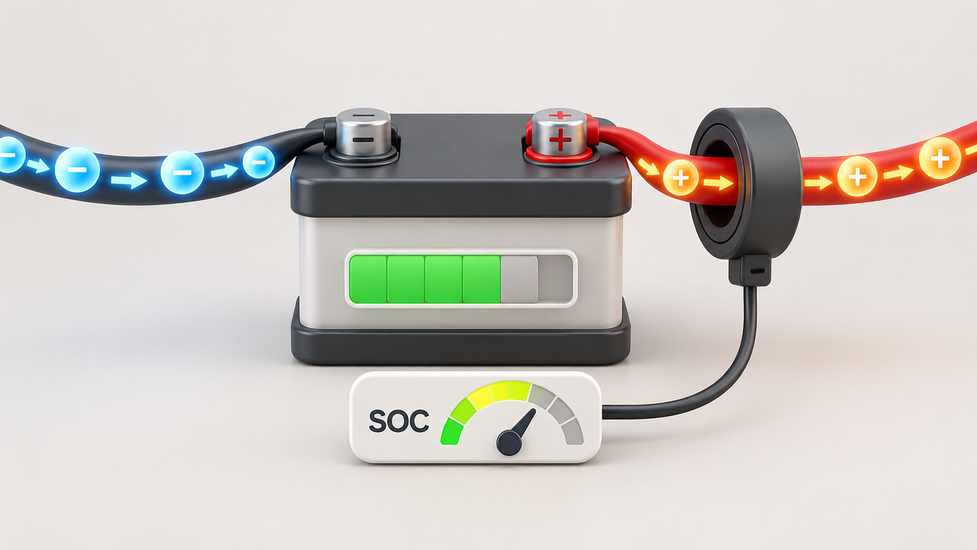

A LiFePO4 battery management system (BMS) commonly estimates state of charge (SOC) by tracking current into and out of the battery over time, relative to its estimated usable capacity. SOC is an estimate, not a direct measurement: errors in the starting value, current measurement, or capacity estimate can make the displayed percentage drift.
Current tracking builds the estimate

A simple conceptual update is:
New SOC = previous SOC + (charge added − charge removed) / estimated capacity
Here, SOC is expressed as a fraction or percentage, while charge added and removed and capacity must use the same units, such as amp-hours. Charging current adds charge; discharging current removes it. A practical estimator also accounts for factors such as sampling interval and Coulombic efficiency, the fraction of incoming charge stored by the cell.
In one published LiFePO4 cell model, the SOC state is updated from measured current over each sampling interval using the cell capacity and Coulombic efficiency. That describes the model examined in the research study of SOC estimation methods; it does not establish that every BMS uses the same model or algorithm.
The Vipboss 12V 105Ah Bluetooth LiFePO4 battery has a built-in 100A smart BMS and Bluetooth monitoring, which lets an owner view battery status.
What affects the estimate

Initial SOC: Current tracking needs a starting value. If that value is wrong, the error carries forward as the BMS adds and subtracts measured charge. A voltage-based estimate may help initialize or correct SOC, but it is not a direct measurement of stored charge.
Current-sensor accuracy: The BMS estimates charge from measured current accumulated over time. A small measurement bias can therefore build into a larger SOC error during extended operation.
Capacity change: The capacity used in the calculation is an estimate. If the battery's actual capacity changes with age or condition while the BMS continues using an outdated value, each measured amp-hour represents a different fraction of the battery's capacity than the estimate assumes.
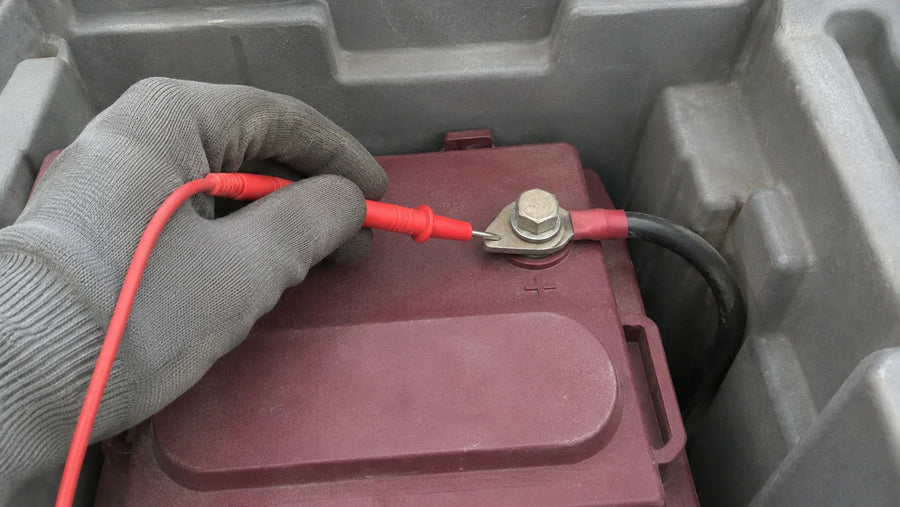
Voltage correction: A BMS may use open-circuit voltage (OCV), the battery voltage measured after current has stopped and the battery has relaxed, to help estimate SOC. The cited study describes a relatively flat middle portion of the LiFePO4 OCV–SOC curve, so voltage alone provides limited SOC distinction in that range. OCV estimation also requires relaxation; a voltage reading taken under charge or load is not the same as a relaxed open-circuit reading.
FAQs
How does a LiFePO4 BMS estimate state of charge?
It commonly integrates measured current over time, adding charge during charging and subtracting it during discharge, relative to an estimated battery capacity. The estimate depends on a starting SOC value and can be adjusted using factors such as sampling interval and charging efficiency.
Can battery voltage alone determine LiFePO4 state of charge?
Not reliably across the full charge range: the LiFePO4 voltage curve is relatively flat through the middle SOC range, so voltage distinguishes charge levels less clearly there. Open-circuit voltage can help estimate SOC after the battery has relaxed, but a voltage reading under load or charge is not an open-circuit reading.
What does Coulombic efficiency mean in a LiFePO4 SOC calculation?
Coulombic efficiency is the fraction of incoming charge that is stored by the cell, so an estimator may use it to account for the difference between charge entering the battery and charge actually stored.