
Daily cycling increases cycle exposure, while a battery stored for long periods continues to calendar-age. Which process sets the practical limit depends on cycle depth, temperature, state of charge during idle time and the particular cell; frequency alone cannot decide it. Start by estimating how often you use the battery and how deeply you discharge it. Then compare that use pattern with the battery's cycle rating and expected years, without treating either number as a guaranteed replacement date.
Match the aging mechanism to actual use
| Use pattern | Cycle exposure | Calendar exposure to record | What to check first |
|---|---|---|---|
| Daily cycling | Many equivalent full cycles; depth varies | Time spent hot or at high SOC between cycles | Cycle depth, charge rate and temperature/SOC dwell time |
| Weekly cycling | Fewer cycles per year | Long idle intervals between uses | Storage SOC and ambient temperature, plus occasional deep discharge |
| Long storage | Few cycles | Months or years at a particular SOC and temperature | Storage instructions, self-discharge and periodic condition checks |
One 50%-depth discharge followed by recharge is about half an equivalent full cycle, not one full cycle in this bookkeeping example. Two such uses sum to roughly one equivalent full cycle; that is not a prediction of product life. The existing cycle diagram is schematic. In an experimental study of 2 Ah LFP pouch cells, researchers compared calendar and cycle aging across storage SOC, temperature and cycling conditions, including tests at 25°C, 45°C and 60°C. Those cell-level findings establish which variables to monitor; they do not provide a finished battery's service-life forecast. Keep the battery's own warranty and manual separate from published cell tests.
What cycle life measures
Cycle life describes wear caused by charging and discharging. One full cycle represents the equivalent of using the battery's full capacity, even when that happens through several partial discharges. For example, using about half the battery one day and half the next is roughly one full cycle.

A cycle rating is tied to test conditions and a capacity endpoint. It does not usually mean the battery suddenly stops working at that count. Usable runtime gradually decreases as capacity falls, and the rating only has meaning when the test's discharge depth, temperature, charge rate, and end point are known.
What calendar aging measures
Calendar aging is capacity loss that occurs as time passes, including while the battery is stored or on standby. A battery can age even when it completes very few cycles. Temperature, storage charge level, and the length of idle periods can affect how quickly that aging appears.
This is why a backup battery and a daily-use battery can reach their practical limits for different reasons. The backup battery may accumulate too little cycling to approach its cycle rating, while years of storage still reduce available capacity. The daily-use battery may accumulate substantial cycling before elapsed time becomes the main constraint.
Which type of aging will matter first
Use the battery's operating pattern as the deciding clue:
- Frequent, deep use: Cycle wear is more likely to matter first because the battery moves a large amount of energy repeatedly.
- Occasional or standby use: Calendar aging is more likely to matter first because the battery spends long periods waiting.
- Mixed use: Neither headline number is enough. Seasonal use, temperature, discharge depth, and storage conditions can shift the result.
The important comparison is not simply “4,000 cycles versus 10 years.” It is whether your actual use can accumulate those cycles before the stated time period, and whether the rating conditions resemble your application.
How to compare the two limits for your use
Estimate your equivalent full cycles per year. If you use about 40% of the battery on a typical day, that is about 0.4 equivalent cycles for that day. Multiply that fraction by the number of use days. The result is an estimate, not a laboratory prediction.
For example, using 40% on 180 days gives about 72 equivalent full cycles in a year. That pattern is unlikely to approach a multi-thousand-cycle rating quickly, so calendar aging and storage conditions deserve more attention. Daily deep cycling produces a very different result and makes the cycle rating more relevant.
Keep the calculation limited to the question it can answer. It estimates how quickly use accumulates cycles; it does not predict exact capacity loss, because the result also depends on temperature, charge rate, discharge depth, and the battery's test conditions.
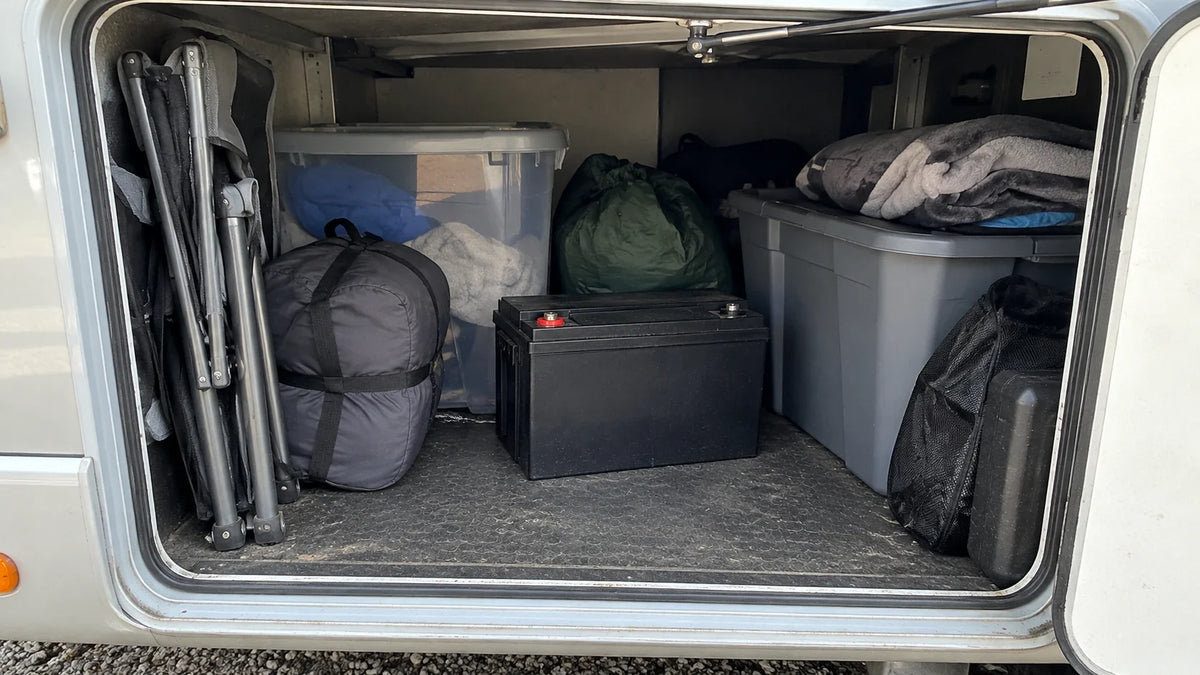
For a product example, the Vipboss 12V 105Ah Bluetooth LiFePO4 battery is described with a 1,344Wh capacity, a rating of more than 4,000 charge cycles, and a stated 10-year lifespan. Those figures should be compared as separate cycle and time-based limits, not added together or treated as a guaranteed replacement date. The battery is intended for RV, marine, solar, off-grid, or backup-power use when its capacity, wiring, charger, and installation space match the system; confirm the complete requirements before relying on the product specifications.